

Key Takeaways
- U.S. higher education faces a $112 billion deferred maintenance backlog, with costs averaging $140 per square foot across 6.2 billion square feet in 210,000 buildings
- Campus buildings average nearly 50 years old, with facilities teams managing 25% more square footage per worker since 2007
- The median age of skilled craft workforce is 54, with more than half between ages 50-65, creating an acute staffing crisis as retirements accelerate
- Beginning in 2026, the 'enrollment cliff' will reduce tuition revenue while facilities expectations remain high. CMMS helps maximize efficiency and demonstrate ROI
- CMMS implementation reduces emergency work by up to 40% and increases preventive maintenance completion rates from under 50% to over 90%
U.S. higher education institutions face a deferred maintenance backlog exceeding $112 billion, according to APPA’s analysis of campus infrastructure. This isn’t a theoretical problem. It affects 6.2 billion square feet of floor space across 210,000 buildings with an average age approaching 50 years and a Current Replacement Value exceeding $2 trillion.
Meanwhile, Moody’s Ratings warns this growing backlog poses “significant credit risk” for the higher education sector, estimating $750 billion to $950 billion in spending will be needed over the next decade just to make meaningful progress. Yet a majority of colleges and universities funded less than 25% of their deferred maintenance needs last fiscal year.
The operational reality is equally stark. According to Gordian’s 2025 State of Facilities in Higher Education report, square footage maintained per facilities worker has increased 25% since 2007, while building condition scores have declined 15-20%. The median age of skilled craft workforce is now 54, with more than half between ages 50 and 65, meaning an acute staffing crisis is accelerating as retirements loom.
Add the looming “enrollment cliff,” a sharp decline in student populations beginning in 2026 traced to post-2008 recession birth rates, and facilities teams face an unprecedented challenge: maintain or improve service levels with less revenue, fewer staff, and aging infrastructure.
This is where Computerized Maintenance Management Systems (CMMS) transform from “nice to have” to strategic necessity. Here’s how universities are using CMMS to navigate these pressures.
The Scale and Complexity of University Facilities Management
Campus as Small City
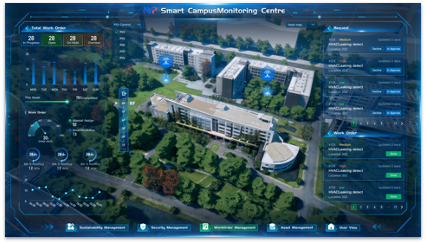
Universities aren’t just big buildings. They’re complex ecosystems that would challenge any property management firm. A typical mid-size campus operates as a small city, with infrastructure demands that dwarf most commercial real estate portfolios.
Consider the diversity of building types and their unique maintenance requirements:
| Building Type | Annual Maintenance Challenges | Critical Systems |
|---|---|---|
| Academic buildings | Classroom scheduling coordination, AV equipment maintenance, high turnover between classes | HVAC, lighting controls, audiovisual systems, Wi-Fi infrastructure |
| Research laboratories | Specialized ventilation (12+ air changes/hour), hazardous materials handling, 24/7 climate control, fume hood certifications | Laboratory HVAC, biosafety cabinets, ultra-low freezers, deionized water systems |
| Residence halls | 24/7 emergency response expectations, high work order volume (300+ annually per 500 beds), summer turnover preparation | Plumbing, fire safety systems, access control, laundry equipment |
| Athletic facilities | Specialized turf and court maintenance, massive HVAC loads (field houses), pool mechanical systems | HVAC, dehumidification, pool filtration, synthetic turf systems |
| Dining halls | Food safety compliance (health inspections), commercial kitchen equipment, grease trap maintenance | Commercial refrigeration, hood systems, dishwashers, fire suppression |
| Libraries | Climate control for archives (55°F, 35% RH), extended hours operations (16+ hours daily), quiet HVAC requirements | Precision HVAC, humidification, book conveyor systems, compact shelving |
| Student centers | High traffic wear (10,000+ daily visitors), event setup/teardown coordination, multipurpose space flexibility | Furniture systems, audiovisual, building automation, elevators |
| Performing arts | Specialized lighting and sound systems, rigging equipment, stage machinery, acoustic considerations | Theatrical rigging, dimming systems, audio systems, hydraulic lifts |
| Administrative offices | Standard office maintenance, data center support, security system integration | Standard HVAC, access control, data center cooling, backup power |
| Historic buildings | Heritage preservation requirements, non-standard systems, materials conservation, regulatory oversight | Aging boilers, outdated electrical, preservation-compliant retrofits |
Each building type requires different preventive maintenance schedules, compliance documentation, response time targets, and specialized technician skills. According to Campus Insights analysis, this complexity makes standardized commercial CMMS platforms inadequate. Universities need systems that accommodate diverse workflows while maintaining centralized visibility.
The Deferred Maintenance Crisis in Numbers
The statistics are sobering. Gordian’s 2025 report, which analyzes 43,000 campus buildings representing 1.1 billion gross square feet and more than $13.5 billion in capital and operating budgets, reveals:
| Metric | 2023 | 2025 | Trend |
|---|---|---|---|
| Deferred maintenance per sqft | $125/gsf | $140/gsf | +12% in 2 years |
| Capital renewal funding gap | 34% | 32.5% | Slight improvement but still critical |
| Buildings over 50 years old | 33% | 35% | Aging accelerates |
| AI adoption in facilities | N/A | 11% active, 53% exploring | Emerging technology |
What this means in practical terms: A campus with 5 million square feet of building space faces a deferred maintenance backlog of $700 million, yet likely funds less than $175 million annually for all facilities operations, maintenance, utilities, AND capital renewal combined.
State system examples illustrate the crisis:
California State University requested $1.3 billion for deferred maintenance in their state budget and received zero. That request represented just a fraction of their $5.8 billion backlog, which grows by $280 million annually even without addressing existing needs.
Oklahoma faces over $1.48 billion in deferred maintenance across its higher education system, with several institutions reporting critical infrastructure failures that directly impact student learning environments.
According to Inside Higher Ed’s analysis, most colleges funded less than a quarter of their deferred maintenance needs last fiscal year. This chronic underfunding means the backlog compounds. Delayed roof replacement becomes roof replacement plus interior water damage plus mold remediation.
The Staffing Crisis
The workforce challenges amplify infrastructure problems. University Business reports on acute facilities staff shortages, particularly in skilled trades like electricians, carpenters, plumbers, and HVAC technicians.
The numbers tell the story:
According to the College and University Professional Association–HR survey, the median age of the skilled craft workforce is 54, with more than half between ages 50 and 65. Many experienced facilities professionals are retiring, creating a shortage of skilled labor, while fewer young people are entering the trades.
Meanwhile, Gordian documents that square footage maintained per worker increased 25% since 2007. Do the math: each technician now maintains 25% more space, while building condition scores declined 15% for exteriors and 20% for mechanical systems over the same period.
The private sector exacerbates this challenge by offering higher salaries and better benefits, making it difficult for universities to compete for talent. Facilities maintenance standards suggest one staff member per 25,000-45,000 square feet, but many universities operate well above that ratio.
This isn’t sustainable without technology that multiplies staff effectiveness. As one facilities director told us: “We can’t hire our way out of this problem. We have to work smarter.”
Why Universities Need CMMS: Beyond Basic Work Orders

Challenge 1: Multi-Building Portfolio Coordination
Managing a multi-million-square-foot campus with 10+ distinct building types requires coordination that spreadsheets and legacy systems can’t provide. Students expect dorm issues resolved within 24 hours. Researchers need lab environments maintained within tight tolerances 24/7. Faculty require advance notice before classroom disruptions.
CMMS addresses complexity through:
| Operational Challenge | CMMS Solution | Impact |
|---|---|---|
| Work orders from diverse sources | Centralized request portal with building/room/asset routing | Single source of truth, no lost requests |
| Different maintenance requirements per space | Asset-specific PM schedules and customized procedures | Ensures compliance, reduces failures |
| Resource allocation across campus | Technician workload balancing and geographic routing optimization | 10-15% labor efficiency gains |
| Coordinating with academic schedules | Calendar integration, semester-based planning, blackout dates | Minimizes academic disruption |
| Emergency prioritization | Tiered priority system with auto-escalation rules | Reduces emergency response time significantly |
| Vendor coordination | Contractor access tracking, permit workflows, insurance verification | Streamlines contractor management |
A work order management system designed for multi-site operations becomes essential when managing millions of square feet across building types with vastly different requirements. The alternative (facilities staff spending hours daily on manual coordination) is no longer viable with reduced staffing levels.
Challenge 2: The Academic Calendar Constraint
Unlike commercial facilities that can schedule major maintenance whenever tenant schedules allow, universities face the rigid constraint of the academic calendar. Classes, labs, and residence halls operate September through May. Summer break provides an 8-12 week window for major projects, but this creates intense pressure to complete a year’s worth of deferred work in three months.
CMMS transforms summer planning from reactive scramble to strategic execution:
Year-Round Workflow:
Academic Year (September-May):
- Flag non-emergency work orders as “defer to summer”
- Continuously update summer project backlog with cost estimates
- Track labor hour requirements and material needs
- Document urgency levels based on safety, code compliance, and user impact
- Identify buildings with multiple deferred projects for scheduling efficiency
Spring Planning Phase (March-May):
- Prioritize summer projects by safety impact, building use, and available budget
- Schedule internal teams and contractors with confirmed availability
- Order long-lead materials and equipment (8-12 week delivery items)
- Coordinate with Events office for summer programs requiring building access
- Create contingency plans for projects that may extend beyond summer
- Set up mobile access for summer student workers and contractors
Summer Execution (June-August):
- Track project completion daily against target dates
- Document before/after conditions with photos for records
- Manage contractor access, permits, and safety compliance
- Report progress to administration weekly with dashboard metrics
- Adjust resource allocation based on real-time completion data
- Flag projects at risk of not completing before fall semester
Back-to-School Preparation (August):
- Verify all occupied spaces ready for students and faculty
- Complete safety inspections with digital checklists
- Document completed work vs. deferred items with justifications
- Update asset records with new equipment, renovations, warranties
- Generate reports showing summer accomplishments for stakeholders
Without CMMS systematically tracking this cycle, deferred items get lost in handwritten notes and email threads. The backlog grows invisibly until infrastructure failures force emergency action at three times the cost of preventive work.
Challenge 3: Diverse Stakeholder Expectations
Commercial facilities typically serve one tenant type with consistent expectations. Universities serve multiple distinct communities with competing priorities:
| Stakeholder Group | Primary Facilities Concern | Communication Preference | CMMS Feature Needed |
|---|---|---|---|
| Students (18-24) | Quick response to dorm issues, clear status updates | Mobile app, text notifications | Self-service portal, real-time status tracking, mobile optimization |
| Faculty | Minimal classroom disruption, advance notification | Email, 48+ hour notice | Scheduled maintenance calendars, advance notification workflows |
| Researchers | Lab environment stability, equipment uptime | Immediate alerts for critical issues | IoT sensor monitoring, automated threshold alerts, priority escalation |
| Athletics staff | Field/court readiness for games, event coordination | Group calendars, event integration | Specialized asset tracking, preventive schedules aligned with season |
| Administration | Budget visibility, compliance documentation, risk management | Executive dashboards, board reports | Cost tracking and analytics, compliance audit trails |
| Housing operations | Turnover efficiency (summer), student satisfaction scores | Workflow metrics, completion rates | Inspection checklists, punch list management, photo documentation |
| Environmental Health & Safety | Code compliance, safety inspections, audit readiness | Compliance documentation, violation tracking | Digital inspection forms, certification tracking, automated compliance reminders |
CMMS creates the structured communication layer that ensures each stakeholder group receives relevant information in their preferred format, while facilities teams maintain centralized visibility across all requests and projects.
Challenge 4: Compliance Documentation and Risk Management
Universities face regulatory scrutiny from multiple agencies, each with documentation requirements that create liability if not properly maintained.
Safety and Building Codes:
- Fire alarm testing (monthly function tests, annual full system)
- Emergency lighting and exit sign tests (monthly)
- Elevator certifications (annual inspections, five-year load tests)
- Asbestos management programs (ongoing monitoring)
- ADA accessibility compliance (continuous)
- Backflow preventer testing (annual)
Research Compliance:
- Laboratory ventilation verification (quarterly airflow measurements)
- Fume hood inspections (annual certifications, sash function)
- Biosafety cabinet certifications (annual by certified technicians)
- Chemical storage inspections (monthly, documented)
- Radiation safety equipment (varies by isotope/equipment)
Housing and Food Service:
- Residential fire safety systems (semester inspections)
- Health department inspections (unannounced, quarterly in some states)
- Life safety system documentation (continuous)
- Sprinkler system inspections (quarterly, annual, five-year)
Environmental Compliance:
- Stormwater management systems (quarterly)
- Wastewater pre-treatment (ongoing monitoring)
- Air quality monitoring (varies by equipment/location)
- Refrigerant leak inspections (quarterly for large systems)
Digital forms and inspection checklists create the audit trail that regulators require and that protects the institution from liability. When an auditor asks, “Show me your fire alarm testing records for the past three years,” the answer needs to be immediate and complete. CMMS makes this possible; paper-based systems make it a crisis.
Download the Full Report
Get 100+ data points, verifiable sources, and actionable frameworks in a single PDF.
Get the ReportSee It In Action
Watch how facilities teams achieve 75% less unplanned downtime with Infodeck.
Book a DemoEssential CMMS Features for Higher Education
Core Capabilities
Not all CMMS platforms suit university operations. Based on hundreds of campus implementations, these features separate functional systems from frustrating ones:
| Feature Category | Specific Capability | Why Universities Need It |
|---|---|---|
| Asset Management | Multi-site hierarchy (campus → building → floor → room → asset) | Navigate complex building portfolios efficiently |
| Equipment history tracking | Document repairs over asset lifecycles for capital planning | |
| Certification and warranty tracking | Never miss equipment certifications or lose warranty coverage | |
| Barcode/QR code integration | Quickly locate assets across sprawling campuses | |
| Work Order Management | Customizable request forms by building type | Capture relevant information upfront (lab work vs. dorm work) |
| Auto-routing rules based on location, trade, priority | Reduce manual triage time for coordinators | |
| Mobile technician access | Teams work across campus, not at desks | |
| Photo and video documentation | Document conditions before/after for records and charge-backs | |
| Preventive Maintenance | Automated PM scheduling with calendar flexibility | Combat deferred maintenance with proactive programs |
| Task templates by equipment type | Ensure consistent maintenance procedures | |
| Compliance workflow tracking | Document required inspections for audits | |
| Seasonal scheduling | Align PM with academic calendar constraints | |
| Requestor Experience | Self-service portal for students/faculty | Reduce phone calls and emails to facilities office |
| Real-time status updates | Reduce “where’s my work order?” follow-up calls | |
| Request history and reopen functionality | Track chronic issues requiring capital investment | |
| Reporting and Analytics | Executive dashboards for administration | Demonstrate facilities value and justify budget requests |
| KPI tracking (response time, PM completion, cost per sqft) | Benchmark performance against APPA standards | |
| Budget vs. actual spend analysis | Track departmental charge-backs and grant-funded work | |
| Deferred work reports | Quantify and communicate maintenance backlog | |
| Integration Capabilities | Building Management System (BMS) connectivity | Automate work orders from equipment alerts |
| ERP/financial system integration | Streamline purchasing and accounting workflows | |
| Student information system (optional) | Validate student resident work requests | |
| Calendar system integration | Coordinate maintenance with events and classes |
University-Specific Workflows
Residence Hall Turnover Management:
The window between spring move-out and fall move-in represents the highest-stress period for housing facilities teams. CMMS structures this chaos:
| Turnover Phase | CMMS Workflow Function | Efficiency Gain |
|---|---|---|
| Spring move-out inspection | Digital checklist with required photos | 40% faster than paper |
| Damage assessment | Auto-calculate charges from standardized rate sheet | Eliminates billing disputes |
| Punch list generation | Auto-create work orders from inspection findings | No items lost in transition |
| Work prioritization | Sort by move-in date, building, and severity | Focus on critical path |
| Progress tracking | Real-time dashboard showing rooms completed vs. remaining | Identify bottlenecks early |
| Quality verification | Final inspection checklist with resident life sign-off | Document move-in readiness |
| Historical analysis | Compare turnover costs year-over-year by building | Identify buildings needing capital renewal |
Research Lab Support:
Lab failures have the highest consequences: destroyed samples representing years of research, or safety incidents endangering researchers. CMMS provides the structure research operations demand:
| Lab Requirement | CMMS Approach | Risk Reduction |
|---|---|---|
| Equipment certification tracking | Asset records with cert dates, auto-PM generation 60 days before expiration | Eliminates missed certifications |
| Environmental monitoring | IoT integration with threshold alerts for temp, humidity, airflow | Immediate notification before damage |
| Emergency response | Priority level 1 escalation for lab-critical equipment failures | Minutes vs. hours response |
| Compliance documentation | Digital inspection records with Principal Investigator electronic sign-off | Audit-ready records instantly |
| Specialized vendor management | Approved vendor lists for biosafety cabinets, ultra-low freezers | Ensures qualified service providers |
| Grant-funded equipment tracking | Separate cost codes for grant-purchased equipment maintenance | Meets grant reporting requirements |
Event and Conference Support:
Universities host hundreds of events annually: commencements, conferences, performances, athletics. Each requires facilities coordination:
| Event Activity | CMMS Workflow | Coordination Benefit |
|---|---|---|
| Setup requests | Work order type with event date/time, specific requirements | Clear communication between Events and Facilities |
| Equipment reservations | Asset scheduling prevents double-booking chairs, tables, staging | Reduces day-of scrambles |
| Pre-event walkthroughs | Inspection checklist 24 hours before event | Identifies issues before guests arrive |
| Post-event inspection | Follow-up work order generation for repairs or deep cleaning | Documents damage, enables charge-backs |
| Cost tracking | Labor and material allocation by event or department | Accurate interdepartmental billing |
Implementation Approach for Universities
Phase 1: Foundation (Weeks 1-8)
Weeks 1-2: Core System Configuration
- Configure campus building hierarchy (campus → zone → building → floor → room)
- Set up user accounts for facilities team with role-based permissions
- Define work order categories and priority levels
- Create initial asset inventory for critical equipment (boilers, chillers, elevators, fire systems)
- Configure mobile app for iOS and Android technician devices
Weeks 3-4: Work Order System Launch
- Deploy public-facing request submission portal
- Create internal request forms for different building types
- Train facilities team on mobile app work order functions
- Establish triage and auto-routing rules based on location and trade
- Begin capturing all new maintenance requests in CMMS (parallel with old system)
Weeks 5-6: Initial Reporting and Refinement
- Set up supervisor dashboards showing open work orders, aging, and technician workload
- Document baseline metrics (current backlog, average age of open requests)
- Train coordinators on report generation for administration
- Gather initial user feedback and adjust workflows
- Sunset old work order system if data capture is stable
Weeks 7-8: Expand Asset Data
- Import additional asset data from spreadsheets or old systems
- Schedule barcode/QR code generation and placement
- Begin photo documentation of critical assets
- Create equipment groups for PM planning (all AHUs, all emergency generators, etc.)
Phase 2: Preventive Maintenance and Expansion (Weeks 9-20)
Weeks 9-12: PM Program Development
- Enter manufacturer-recommended PM schedules for critical assets
- Create compliance inspection checklists (fire alarm, elevator, lab ventilation)
- Set up automated PM work order generation aligned with academic calendar
- Create PM task templates with detailed procedures
- Assign PM routes to specific technicians based on trade and location
Weeks 13-16: Campus-Wide Stakeholder Rollout
- Train Housing staff on resident request portal and inspection workflows
- Enable faculty self-service work requests via campus portal
- Create student-facing communication explaining new request process
- Connect CMMS portal to student information system if applicable
- Establish service level agreements (SLAs) for different request types
- Communicate campus-wide via email, orientation, and portal announcements
Weeks 17-20: System Integration
- Connect to Building Management System (BMS) for automated alerts if available
- Set up IoT sensor integration for critical equipment monitoring
- Configure executive reporting dashboards for administration
- Establish financial system integration for purchase orders and invoicing
- Document integration workflows and troubleshooting procedures
Phase 3: Optimization and Continuous Improvement (Ongoing)
Semester 1 Analysis:
- Review first semester data for trends and outliers
- Identify buildings with highest work order volume for proactive attention
- Analyze response time performance by building type and priority
- Adjust PM frequencies based on actual failure patterns
- Refine work order categories based on technician feedback
Summer Maintenance Planning:
- Generate summer project list from deferred work orders
- Estimate labor hours and material costs using historical CMMS data
- Present data-driven summer maintenance plan to administration
- Track summer project execution in real-time
- Document completion for fall semester readiness reports
Annual Benchmarking:
- Compare KPIs against APPA standards for similar-sized institutions
- Calculate cost per gross square foot and compare to regional peers
- Analyze PM completion rates (target: greater than 90%)
- Review emergency work percentage (target: less than 25%)
- Assess asset uptime for critical equipment (target: greater than 95%)
Continuous Training:
- Quarterly refresher training for facilities staff on new features
- Annual training for new stakeholders (incoming RAs, new faculty, student workers)
- Document power user workflows and share across teams
- Use vendor training resources and user communities
Measuring Success: KPIs for Higher Education Facilities
Essential Performance Metrics
| KPI Category | Specific Metric | Typical Baseline | Realistic Target | Why It Matters |
|---|---|---|---|---|
| Responsiveness | Average work order response time | Often unmeasured or 48+ hours | Less than 24 hours | Student/faculty satisfaction, retention factor |
| Emergency work order response | Varies widely | Less than 2 hours | Safety, minimize damage | |
| Work orders completed on-time | Often 60-70% | Greater than 90% | Service level reliability | |
| Preventive Maintenance | PM completion rate | Often less than 50% | Greater than 90% | Deferred maintenance prevention |
| Ratio of emergency to total work | Often 40%+ | Less than 25% | Indicates reactive vs. proactive operations | |
| Equipment uptime for critical assets | Often unknown | Greater than 95% | Research and teaching support | |
| Financial Performance | Facilities cost per gross square foot | Varies widely | Benchmark to APPA by building type | Budget efficiency and competitiveness |
| Maintenance cost as percentage of CRV | Often 2-3% | APPA recommends 2-4% depending on building age | Industry standard alignment | |
| Deferred maintenance as percentage of CRV | Often 5-7%+ | APPA target less than 5% | Long-term financial health indicator | |
| Productivity | Work orders completed per technician | Varies by trade | 20-30% improvement year one | Labor efficiency with same staffing |
| Average labor hours per work order | Often unknown | Establish baseline, track trends | Identify training needs, process inefficiencies | |
| Scheduled vs. unscheduled work ratio | Often 40:60 | Target 70:30 | Shift from reactive to planned maintenance |
Reporting for Different Audiences
Universities require different facility metrics depending on the audience:
For Board of Trustees and Senior Administration:
- Deferred maintenance backlog trend (absolute dollars and per square foot)
- Capital renewal needs by building with prioritization
- Compliance status summary across all regulatory requirements
- Safety incident metrics and trend analysis
- Facilities investment as percentage of operating budget
- Comparison to peer institutions (APPA benchmarks)
For Facilities Operations Management:
- Technician productivity metrics and workload distribution
- Work order aging reports showing requests approaching SLA deadlines
- Preventive maintenance completion rates by building and system
- Vendor performance scorecards (response time, quality, cost)
- Parts inventory turnover and stockout frequency
- Overtime analysis and staffing optimization opportunities
For Academic and Housing Departments:
- Request status and history for their buildings
- Average response time metrics for their spaces
- Cost allocation by department or cost center
- Scheduled maintenance calendar for advance planning
- Satisfaction survey results from their users
- Trends showing chronic issues requiring capital investment
Start Free Trial
Experience the full platform with 30-day free access. No credit card required.
Start Free TrialBook a Demo
Get a personalized walkthrough from our team. See how Infodeck fits your operation.
Schedule DemoNavigating the Enrollment Cliff: CMMS as Strategic Tool
The Demographic Challenge
According to AGB’s analysis of enrollment trends, beginning as early as 2026, colleges and universities face a sharp and sustained decline in student populations. The trend traces back to declining birth rates following the 2008 recession. The impact will be most severe for small and mid-sized colleges, particularly in the Midwest and Northeast where demographic shrinkage is highest.
GoAssetWorks documents that declining enrollment means declining tuition revenue, and that means facilities teams will be expected to do more with less just as buildings continue aging and systems continue failing.
Facilities Response Strategies Enabled by CMMS
Budget Optimization Under Revenue Pressure:
With tuition revenue declining, CMMS provides the data needed for strategic resource allocation:
- Prioritization modeling: Rank deferred maintenance by safety impact, user satisfaction effect, and cost-to-delay. Address highest ROI items first when budgets tighten.
- Building utilization analysis: Identify underutilized buildings that could be mothballed or consolidated to reduce operations costs. CMMS work order data reveals which buildings consume disproportionate maintenance resources.
- Asset lifecycle planning: Extend equipment lifespan through optimized preventive maintenance rather than premature replacement, critical when capital budgets shrink.
- Vendor consolidation: Analyze vendor spending to negotiate better rates or consolidate to fewer strategic partners.
Space Rationalization:
As enrollment declines, some buildings may need to be taken offline:
- CMMS data shows total cost of ownership by building (maintenance + utilities + staffing)
- Identifies buildings with highest maintenance burden relative to utilization
- Provides decommissioning checklists (winterizing, securing, ongoing monitoring)
- Tracks reduced maintenance requirements for mothballed spaces
Competitive Advantage Through Facilities Quality:
When competing for a shrinking pool of students, facilities quality becomes differentiator:
- Well-maintained residence halls improve retention (students vote with their housing choices)
- Reliable campus infrastructure supports student success and satisfaction scores
- Modern, efficient facilities demonstrate institutional financial health to prospective students and parents
- Data-driven facilities management signals administrative competence
As one CFO told us: “In 2026 and beyond, facilities isn’t just operations; it’s enrollment strategy. Students have choices. Deferred maintenance is now a competitive disadvantage we can’t afford.”
Special Considerations for Complex Campuses
Historic and Heritage Buildings
Many campuses include buildings with historic designations requiring specialized maintenance approaches. CMMS helps navigate preservation requirements:
Documentation Requirements:
- Detailed asset records capturing original materials, construction methods, and architectural features
- Photo archives showing building evolution over time for preservation authorities
- Vendor qualifications documenting expertise in historic restoration
- Work approvals from state historic preservation offices or campus preservation committees
Balancing Preservation and Modernization:
- Separate PM schedules for modern systems (HVAC, electrical) vs. historic elements
- Documentation of approved modern interventions (accessibility, life safety, energy efficiency)
- Capital project tracking showing how renovations maintain historic character
- Coordination workflows ensuring preservation review before any exterior or character-defining interior work
Research Facility Mission-Critical Support
Research labs represent the highest stakes for facilities failures. A failed ultra-low freezer could destroy decades of biological samples. A ventilation system failure could endanger researchers or compromise experiments.
CMMS capabilities essential for research support:
- Environmental monitoring integration: IoT sensors track temperature, humidity, airflow, differential pressure in real-time. Threshold breaches generate immediate work orders and notifications.
- Priority escalation: Level 1 priority for lab-critical equipment triggers immediate technician dispatch and supervisor notification.
- Certification management: Track fume hood certifications, biosafety cabinet annual testing, autoclave validations with automatic reminders 60 days before expiration.
- Principal Investigator workflows: Electronic notification and approval for maintenance affecting active experiments.
- Grant equipment tracking: Separate asset codes for NSF, NIH, or foundation-funded equipment with maintenance requirements.
- Vendor pre-qualification: Approved vendor lists ensuring only qualified technicians service specialized research equipment.
According to research facility managers we’ve consulted, the cost of a single freezer failure (both in lost research and investigator relationship damage) exceeds annual CMMS investment. Research support alone justifies CMMS for research-intensive universities.
Sustainability and Energy Management
Universities increasingly face sustainability commitments: carbon neutrality by 2030, 2040, or 2050. CMMS supports these goals through:
Energy System Optimization:
- Preventive maintenance schedules optimized for equipment efficiency (dirty filters increase HVAC energy consumption 15%+)
- Equipment efficiency tracking showing when aging systems should be replaced rather than repaired
- Integration with energy management systems for complete building performance
- Tracking of energy conservation measures (ECMs) and their measured impact
Utility Data Integration:
- Building-level utility meter data imported to correlate maintenance with energy performance
- Identify buildings with anomalous energy use for investigation
- Measure impact of maintenance actions on energy consumption
- Support for LEED, ENERGY STAR, and other certification programs
Sustainability Reporting:
- Greenhouse gas emissions related to maintenance activities (refrigerant leaks, vehicle fleet)
- Waste diversion from maintenance and renovation projects
- Green cleaning product usage tracking
- Sustainable procurement metrics for materials and equipment
According to research on CMMS and campus sustainability, effective maintenance is one of the most cost-effective sustainability strategies. Optimized existing equipment performs 10-20% more efficiently than neglected equipment, deferring expensive capital replacement while reducing carbon footprint.
Common Implementation Challenges and Solutions
Challenge 1: Decentralized Facilities Operations
Many universities split facilities responsibilities across multiple units:
- Central facilities handles major buildings
- Housing runs residence hall maintenance
- Athletics manages sports venues
- Individual colleges or departments maintain their own buildings
Solution Strategy:
Start with central facilities to prove value, then expand to other units once success is documented. Use CMMS reporting to demonstrate benefits:
- Show how Housing could reduce turnover time with structured workflows
- Demonstrate how Athletics could better coordinate field maintenance with game schedules
- Illustrate how departments could gain budget visibility with cost tracking
Provide each unit autonomy within shared platform (their staff, their budgets) while administration gains enterprise visibility.
Challenge 2: Legacy Systems and Data Migration
Universities often operate decades-old systems: paper-based in some areas, ancient COBOL-based software in others. The temptation is comprehensive data migration, but this often stalls implementations for months.
Solution Strategy:
Don’t migrate everything. Start fresh with work orders (historical request data has limited value). Import only:
- Critical asset inventory with basic specifications
- Active preventive maintenance schedules
- Open work orders that must be completed
Build history forward from CMMS launch. After 6-12 months, you’ll have richer data than old systems ever contained. Archive old system data for reference but don’t let migration delay going live.
Challenge 3: Academic Culture and Change Management
Faculty and researchers often resist operational changes, expecting instant response to any request regardless of priority or resource constraints. Long-tenured staff may prefer “the way we’ve always done it.”
Solution Strategy:
Create clear service level agreements and communicate them transparently:
- Emergency (safety/security): less than 2 hours response
- Urgent (impacts teaching/research): less than 24 hours
- Routine: less than 5 business days
- Scheduled: coordinated around academic calendar
Use data to demonstrate fairness in resource allocation. Every request is tracked, prioritized, and addressed based on impact, not who makes the most noise.
Involve stakeholders early: pilot with friendly departments, gather testimonials, address concerns proactively before campus-wide rollout.
Challenge 4: IT Integration Complexity
University IT environments are notoriously complex with security requirements that can slow integrations. Lengthy procurement processes, information security reviews, and limited IT resources extend timelines.
Solution Strategy:
Choose cloud-based CMMS requiring minimal IT infrastructure (no servers to provision, no software to install). This reduces IT burden and accelerates deployment.
Plan integration as Phase 2, not Phase 1:
- Month 1-2: Launch CMMS standalone for work orders and basic PM
- Month 3-6: Prove value, build stakeholder support
- Month 6-9: Prioritize highest-value integrations (BMS, financial system)
- Month 9-12: Add nice-to-have integrations (calendars, student system)
This phased approach generates quick wins that build momentum for larger integration projects.
The Path Forward: Starting Your CMMS Journey
The deferred maintenance crisis in higher education isn’t resolving on its own. The $112 billion national backlog grows annually. Facilities staffing challenges intensify as experienced workers retire. The 2026 enrollment cliff reduces revenue while expectations remain unchanged.
But CMMS provides the visibility, planning capability, and operational efficiency needed to navigate these pressures. Universities that have implemented CMMS report the same insight: they wish they had started sooner.
The key is beginning:
- Start capturing data about work, assets, and maintenance activities
- Build systematic processes that don’t depend on individual knowledge
- Demonstrate value through metrics that resonate with administration
- Engage stakeholders by solving their problems, not just facilities problems
According to facility management software market research, CMMS adoption in education is accelerating. The global facilities management software market was $3.79 billion in 2024 and is projected to reach $9.60 billion by 2033, with CMMS accounting for 32% of the market. Universities aren’t asking “should we implement CMMS?” anymore. They’re asking “how do we implement it successfully?”
This guide provides the roadmap. The rest is execution.
Managing a university campus? Explore how Infodeck helps higher education facilities manage multi-building operations, diverse stakeholders, and complex compliance requirements with flexibility that university environments demand. Book a demo to discuss your campus’s specific challenges, from summer maintenance planning to research lab support to enrollment cliff strategies.
Related Resources:
Industry Guides:
- CMMS for Schools: K-12 Implementation Guide
- Multi-Site Facility Management with CMMS
- Government and Municipal Facilities CMMS Guide
Implementation and Strategy:
- CMMS Vendor Selection and Evaluation Guide
- Change Management for CMMS Adoption
- How to Calculate CMMS ROI
Operational Excellence:


