

Key Takeaways
- A digital twin is a living virtual replica of your building that mirrors real-time conditions using IoT sensor data, BMS feeds, and maintenance records
- The global building twin market reached USD 4.18 billion in 2026, with facilities achieving 50-70% reductions in unplanned downtime through predictive maintenance
- Buildings using digital twins report 20-35% energy savings and reduce maintenance costs by up to 40% according to industry research
- You do not need a full 3D model to start--sensor-connected asset models in your CMMS already form the foundation of a practical digital twin
- Start small with one building system (HVAC or electrical), prove ROI in 6-12 months, then expand to full-building digital twin coverage
If you manage a commercial building, you already have a mental model of how your facility behaves. You know that the east-wing chiller struggles on Friday afternoons when the conference rooms fill up. You know the lobby AHU needs a filter change every three months, not four, despite what the manufacturer says. You know which elevators throw faults after long weekends.
But that knowledge lives in your head. When you’re on leave, it goes with you. When you retire, it vanishes entirely.
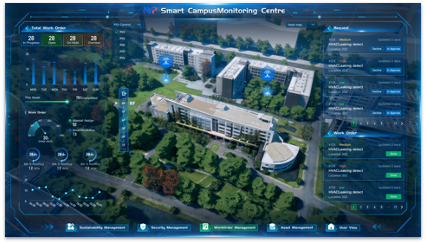
A digital twin captures that knowledge—and adds data you can’t possibly hold in memory. It’s a virtual replica of your building that reflects real-time conditions, learns from historical patterns, and predicts what’s coming next. And when integrated with a CMMS platform, it becomes more than a visualization tool. It becomes the operating system for your building.
The market validates this shift. According to Straits Research, the global building twin market reached USD 4.18 billion in 2026, with North America accounting for 36.42% of market share as enterprise facilities accelerate adoption of integrated building management systems. More broadly, Fortune Business Insights projects the global digital twin market will grow from USD 24.48 billion in 2025 to USD 259.32 billion by 2032 at a CAGR of 40.1%. The technology has moved from early adopter phase to mainstream implementation.
This guide covers what digital twins actually mean for building operations, how they connect with maintenance management systems, and the practical steps to implement one without burning your entire capital budget.
What Is a Digital Twin in Facility Management?
Let’s clear up the confusion first. The term “digital twin” gets thrown around loosely in the facilities world. Some vendors use it to describe a 3D model of a building. Others mean a dashboard showing sensor readings. Neither is quite right on its own.
A digital twin in facility management is a dynamic virtual representation of a physical building and its systems that updates continuously using real-time data. According to Gartner’s technology glossary, a digital twin is “a digital representation of a real-world entity or system” that “is implemented as an encapsulated software object or model that mirrors a unique physical object.” Gartner research indicates the digital twin market will cross the chasm in 2026 to reach $183 billion in revenue by 2031, signaling widespread enterprise adoption.
For buildings, that means three things working together:
1. Physical model — the structure, spatial layout, and installed systems (often derived from BIM data)
2. Operational data — real-time sensor readings, BMS feeds, energy metering, occupancy counts
3. Historical context — maintenance records, failure patterns, lifecycle data, performance trends
Think of it this way: a building blueprint tells you what was designed. A BIM model tells you what was built. A digital twin tells you what’s happening right now and what’s likely to happen next.
Digital Twins vs. BIM vs. BMS: Clearing Up the Terminology
This is where facility teams get tripped up. You might already have BIM models from your construction phase and a BMS running your mechanical systems. How is a digital twin different?
| Aspect | BIM Model | BMS (Building Management System) | Digital Twin |
|---|---|---|---|
| Purpose | Design and construction documentation | Real-time system control | Holistic building intelligence |
| Data type | Static geometry and specifications | Live sensor and control data | Combined static + dynamic + historical |
| Time dimension | Snapshot at design/as-built | Current state only | Past, present, and predicted future |
| Users | Architects, engineers | Building operators | Facility managers, operations, leadership |
| Maintenance value | Asset location reference | Equipment status monitoring | Predictive maintenance and lifecycle optimization |
| Updates | Manual (per renovation) | Automatic (real-time) | Automatic + machine learning |
Here’s the key insight: a digital twin isn’t a replacement for BIM or BMS. It’s a layer that sits above both, combining their data with maintenance history from your CMMS to create something more powerful than any individual system. As the ISO 19650 international standard emphasizes, this integration creates a continuous digital thread connecting information management throughout the entire asset lifecycle—from design through operations to decommissioning.
Research from MDPI’s systematic review on digital twin applications in energy efficiency found that IoT-enabled digital twins achieve 25-40% better energy performance optimization compared to traditional building automation systems. That performance gap comes from the integration layer—connecting operational data with historical patterns and predictive analytics.
How Digital Twins Work: From Sensors to Simulation
A building digital twin isn’t magic. It’s an architecture of connected data layers that feed a unified model. Understanding the layers helps you plan implementation practically.
Layer 1: Physical Sensors and IoT Devices
Everything starts with data collection. IoT sensors placed on critical equipment and building systems provide the raw data that brings a digital twin to life.
Common sensor types for building digital twins:
| Sensor Type | What It Measures | Building Application |
|---|---|---|
| Temperature | Air/surface/pipe temp | HVAC performance, server rooms, cold storage |
| Vibration | Equipment oscillation | Motors, pumps, compressors, fans |
| Energy meter | kWh consumption | Circuit-level monitoring, equipment efficiency |
| Occupancy | People count / presence | Space utilization, demand-based HVAC |
| Air quality | CO2, PM2.5, humidity | Ventilation control, compliance |
| Pressure | System pressure | Chilled water loops, duct pressure |
| Flow rate | Liquid/air volume | Water systems, HVAC airflow |
For practical guidance on choosing and deploying these sensors, see our IoT sensors for predictive maintenance guide.
Layer 2: Connectivity and Data Ingestion
Sensors need to talk to your digital twin platform. This happens through communication protocols—MQTT for lightweight sensor data, BACnet or Modbus for BMS integration, and REST APIs for cloud-to-cloud connections.
This is where IoT-native architecture matters. Platforms built to ingest sensor data natively process it faster and with fewer failure points than those relying on middleware layers.
Layer 3: The Digital Model
The model itself can range from simple to sophisticated:
- Basic (asset-centric): A connected database of assets with real-time sensor readings and maintenance history. This is what a modern CMMS with IoT integration already provides.
- Intermediate (system-level): Connected models of building systems (HVAC, electrical, plumbing) showing interdependencies and real-time performance.
- Advanced (geometric 3D): Full BIM-integrated 3D visualization with real-time data overlays, spatial analytics, and virtual walkthroughs.
Here’s what most vendors won’t tell you: the basic level already delivers 70-80% of the operational value. You don’t need a photorealistic 3D model to predict chiller failures or optimize energy usage. You need connected asset data, sensor feeds, and intelligent automation—which is exactly what a CMMS with native IoT capabilities provides.
Layer 4: Analytics and Intelligence
Raw data becomes actionable insight through analytics. This is where the real ROI lives:
- Descriptive analytics: What is happening right now? (Dashboard monitoring)
- Diagnostic analytics: Why did it happen? (Root cause analysis using historical data)
- Predictive analytics: What will happen next? (Failure prediction using sensor trends)
- Prescriptive analytics: What should we do? (Automated work order generation)
According to MicroMain’s analysis of digital twins in predictive maintenance, facilities implementing strategic digital twin predictive maintenance achieve 50-70% reductions in unplanned downtime while improving maintenance efficiency by 35-45% compared to conventional monitoring approaches.
Digital Twins + CMMS: Why Integration Matters
A digital twin without a maintenance management system is like a dashboard without controls. You can see the problems, but you can’t systematically act on them.
When you integrate a digital twin with your CMMS platform, the data loop closes:
Sensors detect —> Twin analyzes —> CMMS acts —> Technicians resolve —> Twin learns
What Integration Actually Looks Like
Here’s a concrete example. Your digital twin monitors a rooftop AHU (Air Handling Unit) through vibration, temperature, and airflow sensors. One morning, the vibration sensor shows a gradual increase over two weeks—still within normal range, but trending upward.
Without CMMS integration, that data sits in a dashboard. Someone would need to notice it, interpret it, and manually create a work order.
With CMMS integration, the system automatically:
- Detects the trend against historical baselines
- Correlates with the asset’s maintenance history in the CMMS
- Identifies that the last bearing replacement was 18 months ago (bearing life: 24 months)
- Creates a work order flagged as “predictive—bearing inspection recommended”
- Attaches sensor trend data to the work order for technician context
- Schedules the work during the next low-occupancy window
That’s the difference between having data and using data. The digital twin provides intelligence. The CMMS provides action.
The Five Integration Points
| Integration Point | Digital Twin Provides | CMMS Provides |
|---|---|---|
| Asset monitoring | Real-time sensor data, performance baselines | Asset records, maintenance history, warranty info |
| Failure prediction | Trend analysis, anomaly detection | Work order generation, technician assignment |
| Energy optimization | Consumption patterns, inefficiency identification | PM schedules for efficiency-related maintenance |
| Space management | Occupancy data, utilization analytics | Cleaning/maintenance scheduling based on usage |
| Lifecycle planning | Degradation models, remaining useful life | Replacement scheduling, capital planning data |
The asset management capabilities in your CMMS become dramatically more powerful when fed with real-time performance data from a digital twin. Instead of replacing equipment on a fixed schedule, you replace it when the data says it’s actually degrading.
Start Free Trial
Experience the full platform with 30-day free access. No credit card required.
Start Free TrialBook a Demo
Get a personalized walkthrough from our team. See how Infodeck fits your operation.
Schedule DemoReal-World Use Cases and Proven ROI
Let’s move from theory to practice. These are the building operations scenarios where digital twin CMMS integration delivers measurable results, backed by real industry data.
Use Case 1: HVAC Optimization
HVAC systems typically account for 40-60% of a commercial building’s energy consumption. They’re also the most common source of tenant complaints and emergency work orders. That makes them the ideal starting point for digital twin implementation.
How it works:
Temperature, humidity, pressure, and airflow sensors feed real-time data into the digital twin. The model compares actual performance against design parameters and historical patterns. When a chiller’s coefficient of performance (COP) drops below its baseline, the system flags efficiency degradation.
Example scenario: A 20-story commercial building in Singapore runs three centrifugal chillers. Sensor data shows Chiller 2’s COP declining from 5.2 to 4.1 over six weeks. The digital twin correlates this with increasing condenser approach temperatures and identifies likely tube fouling.
The CMMS automatically generates a preventive work order for condenser tube cleaning—three weeks before the chiller would have tripped on high-pressure safety. Estimated savings: S$15,000 in emergency repair costs and avoided tenant disruption.
Industry data: Research published in Frontiers in Built Environment demonstrates that smart building implementations using digital twin technology achieve 20-35% improvements in energy efficiency while simultaneously improving occupant comfort and reducing maintenance costs. A Hilton pilot project in the UK employed a digital twin model and achieved nearly a 30% reduction in energy consumption. Additionally, McKinsey research on digital twin implementations shows that organizations have cut development times by up to 50 percent while reducing costs, with some achieving 20 to 30 percent improvements in capital and operational efficiency.
Use Case 2: Space Utilization and Demand-Based Maintenance
Occupancy sensors in meeting rooms, common areas, and workspaces feed utilization data to the digital twin. This data drives two operational improvements:
Demand-based cleaning and maintenance: Rather than cleaning every floor daily on a fixed schedule, maintenance teams prioritize based on actual usage. Floor 12 had 90% occupancy Tuesday? Clean it Wednesday morning. Floor 8 was at 20% occupancy? Defer to Thursday.
HVAC demand response: The digital twin adjusts ventilation and cooling recommendations based on real occupancy rather than fixed schedules. Unoccupied zones get setback temperatures. High-occupancy zones get boosted airflow.
The CMMS integrates this by adjusting preventive maintenance schedules based on actual equipment runtime hours (driven by demand) rather than calendar intervals. An AHU serving a consistently underutilized zone runs fewer hours and genuinely needs less frequent maintenance.
Use Case 3: Energy Management and Carbon Tracking
With Singapore’s BCA Green Mark certification requirements and growing ESG reporting obligations, energy management is no longer optional for commercial buildings.
A digital twin aggregates energy data from circuit-level meters, submeters, and equipment sensors to provide:
- Real-time energy dashboards by zone, system, and time period
- Anomaly detection when consumption deviates from expected patterns
- Automated fault detection for energy-wasting equipment behavior (stuck dampers, simultaneous heating/cooling, short-cycling compressors)
When the digital twin detects that a VAV box is stuck open (causing overcooling and wasted energy), the CMMS receives the alert and generates a work order with the specific fault, location, and recommended resolution. The technician arrives knowing exactly what to fix.
Cost savings: According to TwinView’s comprehensive ROI analysis, facilities can reduce their utility bills by up to 30% by optimizing energy consumption and making dynamic adjustments through digital twin technology. An industrial facility case study documented a 25% reduction in energy costs through digital twin implementation.
Use Case 4: Predictive Lifecycle Management
Every piece of equipment in your building has a lifespan. The question is whether you replace it on a manufacturer’s estimate, wait until it fails catastrophically, or use data to determine exactly when replacement makes economic sense.
Digital twins track equipment degradation curves using sensor data. When a pump’s vibration signature, energy consumption, and repair frequency all trend toward end-of-life thresholds simultaneously, the system generates a capital replacement recommendation—not just a repair work order.
This feeds directly into asset lifecycle planning, helping facility teams build data-backed capital expenditure forecasts rather than guesswork.
Maintenance savings: Research from OxMaint shows that using digital twins can slash maintenance costs by up to 40% while boosting asset uptime between 5-10%. Digital twins can reduce asset downtime by 20% and maintenance costs by 18% by using data to predict equipment failures.
For guidance on building the financial case for this kind of investment, see our predictive maintenance ROI calculator guide.
Download the Full Report
Get the complete State of Maintenance 2026 report with all benchmark data and implementation frameworks.
Download Free ReportSee It In Action
Ready to join the facilities teams achieving 75% less unplanned downtime? Start your free 30-day trial.
Start Free TrialThe Technology Stack: What You Need
Building a digital twin doesn’t require ripping out your existing systems. It’s about connecting what you have and filling the gaps strategically.
Minimum Viable Digital Twin Stack
| Component | Purpose | Options | Estimated Cost |
|---|---|---|---|
| IoT sensors | Data collection from equipment | Temperature, vibration, energy meters | $50-500 per sensor |
| Connectivity | Sensor communication | LoRaWAN gateway, Wi-Fi, cellular | $200-2,000 per gateway |
| CMMS with IoT integration | Asset management + automation | Cloud CMMS with native sensor support | $10-50/user/month |
| BMS integration (if applicable) | Existing system data | BACnet/Modbus gateway | $2,000-10,000 |
| Analytics/dashboards | Visualization and insights | Built into CMMS or standalone BI | Included or $500-2,000/month |
Optional (Advanced) Components
| Component | Purpose | When to Add |
|---|---|---|
| BIM model integration | 3D spatial visualization | When managing complex multi-system buildings |
| Machine learning platform | Advanced prediction models | After 12+ months of historical data |
| AR/VR visualization | Technician field support | When maintenance complexity justifies cost |
| Digital twin platform (Autodesk Tandem, Azure Digital Twins, etc.) | Enterprise-scale modeling | When managing 10+ buildings |
Here’s the practical advice: start with what a modern CMMS already gives you. A CMMS platform with native IoT integration already provides connected asset models, real-time sensor data, automated alerting, and maintenance automation. That’s the operational core of a digital twin—without the need for a separate digital twin platform.
The 3D visualization, machine learning, and enterprise platforms? Those are enhancers. They add value. But the foundation is sensor-connected assets with automated maintenance workflows. If your current CMMS can’t handle IoT data natively, that’s the first gap to close.
ROI expectations: According to Industrial Sage’s analysis of digital twin statistics, most manufacturers achieve positive ROI within 18-36 months through reduced unplanned downtime (50-70% reduction) and optimized maintenance scheduling, with initial digital twin investments of $200,000-600,000 typically generating $1.2-3.5 million in annual savings.
Implementation Roadmap: Getting Started
You don’t build a full-building digital twin in one project. You build it in phases, proving value at each stage before expanding scope.
Phase 1: Foundation (Weeks 1-8)
Objective: Connect critical equipment to your CMMS via IoT sensors. Establish baseline performance data.
Steps:
- Audit critical assets — Identify your top 10-20 pieces of equipment by failure impact and energy consumption. Chillers, boilers, main AHUs, and critical pumps are typical starting points.
- Deploy sensors — Install vibration, temperature, and energy sensors on selected assets. Use wireless protocols (LoRaWAN or Wi-Fi) to minimize installation cost.
- Configure CMMS integration — Connect sensors to your CMMS platform. Set up asset-sensor mappings and define initial alert thresholds.
- Establish baselines — Run for 4-6 weeks collecting data before setting automated actions. You need to know “normal” before you can detect “abnormal.”
Deliverable: Real-time monitoring dashboard for critical assets with basic threshold alerts.
Cost estimate: $15,000-40,000 for a mid-size commercial building (50-100 sensors).
Phase 2: Automation (Weeks 8-16)
Objective: Automate maintenance responses based on sensor data. Start predictive rather than just reactive monitoring.
Steps:
- Configure automated work orders — When sensor readings exceed thresholds, the CMMS automatically generates and assigns work orders.
- Build correlation rules — Combine multiple sensor inputs for smarter alerts. For example: rising vibration AND increasing temperature on the same motor suggests bearing failure, not just a one-off reading.
- Integrate BMS data — If you have a BMS, connect it to your CMMS to enrich the data model with control system information.
- Start workflow automation — Route work orders automatically based on equipment type, location, and urgency.
Deliverable: Automated predictive maintenance workflows for critical assets with 80%+ of sensor alerts generating appropriate CMMS actions.
Phase 3: Intelligence (Months 4-12)
Objective: Move from threshold-based alerts to trend-based predictions. Begin lifecycle analytics.
Steps:
- Analyze historical patterns — With 3-6 months of sensor data, identify degradation trends specific to your equipment and operating conditions.
- Build prediction models — Use historical failure data correlated with sensor patterns to predict failures 2-4 weeks in advance.
- Implement energy optimization — Use consumption data to identify efficiency opportunities and track improvements.
- Develop lifecycle models — Combine sensor data with maintenance history to project remaining useful life for major assets.
Deliverable: Predictive maintenance reducing unplanned failures by 20-35%. Energy optimization initiatives with measurable savings.
Phase 4: Scale (Year 2+)
Objective: Expand coverage to full-building systems. Consider advanced visualization and enterprise features.
Steps:
- Expand sensor coverage to secondary equipment and building envelope systems
- Evaluate 3D visualization if spatial context would improve maintenance operations
- Connect multiple buildings into a portfolio-level digital twin
- Integrate with capital planning for data-driven replacement scheduling
Challenges and Realistic Expectations
Digital twins are powerful, but they’re not a silver bullet. Setting realistic expectations upfront prevents disillusionment and project abandonment.
Challenge 1: Data Quality Is Everything
A digital twin is only as good as its data. Garbage sensor data produces garbage insights.
Common data issues:
- Sensors lose calibration over time (plan for annual recalibration)
- Wi-Fi dead zones cause data gaps (survey RF coverage before deployment)
- Inconsistent asset naming makes correlation difficult (standardize your asset registry first)
- Legacy BMS protocols may not expose all data points
Mitigation: Start with a data quality audit. Ensure your CMMS asset database is clean and consistent before adding sensor layers. According to Toobler’s analysis of digital twin implementation challenges, one of the foremost challenges in implementing digital twin technology is managing the sheer volume and variety of data required at the desired quality to power a digital twin. Inconsistent, incomplete, or inaccurate data can significantly diminish the effectiveness of a digital twin.
Challenge 2: Integration Complexity
Connecting sensors, BMS, CMMS, and potentially BIM models involves multiple protocols, vendors, and data formats.
Research from Matterport’s facility management analysis found that data lives in silos, with spreadsheets, outdated CAD files, and disconnected software platforms creating gaps that lead to inconsistent records and communication breakdowns. Although 78% of facility decision-makers have deployed smart building features, over a third (38%) struggle to integrate the required data analytics into their smart building platforms. A comprehensive 2024 systematic review confirms that interoperability between different models and standardization of data exchange remain critical barriers to digital twin adoption in building operations.
Mitigation: Choose platforms with native integration capabilities rather than building custom middleware. This is exactly why IoT-native CMMS architecture matters—it reduces the integration layers you need to build and maintain.
Challenge 3: Organizational Readiness
Technology is the easy part. Getting maintenance teams to trust automated work orders, operations to act on predictive insights, and leadership to fund expansion—that’s the hard part.
According to Lingaro Group’s research on digital twin adoption, some employees worry that digital tools might replace their roles, creating hesitation around adoption. Additionally, it is quite difficult to find or train people who are familiar with the complexities involved in creating and operating these systems. However, IFMA’s 2022 State of the Digital Twin survey of 1,500 facility professionals found that three-quarters of senior leadership sees value in digital twins, with nearly 70% intending to maintain their implementations in-house rather than outsourcing.
Mitigation: Start with a pilot that delivers visible wins. When a sensor-triggered work order prevents a chiller failure that would have disrupted building operations, that story travels. Build momentum through demonstrated value, not PowerPoint presentations.
Challenge 4: Realistic ROI Timelines
Don’t expect:
- Instant results from day one
- 100% failure prediction accuracy (60-80% is realistic and valuable)
- Elimination of all reactive maintenance (some failures are inherently unpredictable)
Do expect:
- 20-35% energy savings within 12 months
- 50-70% reduction in unplanned equipment failures
- Significantly better data for capital planning decisions
- Gradual shift from reactive to predictive maintenance culture
The Cost of Doing Nothing
Here’s the counterpoint to implementation challenges: buildings without connected data strategies are falling behind. Tenant expectations for comfort and responsiveness are rising. Energy costs and carbon reporting requirements aren’t going away. And the institutional knowledge problem—experienced facility managers retiring without capturing what they know—only gets worse.
A digital twin, even at the basic CMMS-integrated sensor level, starts capturing that knowledge in data. That’s an investment that compounds over time.
Getting Started: Your Next Steps
You don’t need a million-dollar platform to start building a digital twin. You need three things:
-
A modern CMMS with IoT integration — If your current system can’t ingest sensor data and automate work orders from it, that’s the first upgrade. Compare CMMS options to find platforms with native sensor support.
-
Sensors on your most critical equipment — Start with 10-20 sensors on the equipment that causes the most pain when it fails. Vibration and temperature sensors on chillers, pumps, and main AHUs give you the highest initial value.
-
A 90-day pilot plan — Pick one building system, deploy sensors, connect to your CMMS, collect baseline data for 30 days, then activate automated alerting. Measure the results. Use those results to justify expansion.
The digital twin journey starts with connected assets. If your CMMS platform already tracks your equipment and maintenance history, you’re closer to a digital twin than you think. Adding sensor data and automation transforms that static database into a living, predictive model of your building.
According to Astute Analytica’s market analysis, the digital twin for buildings market was valued at US$ 2.07 billion in 2024 and is projected to reach a market size of US$ 26.23 billion by 2033 at a CAGR of 32.6% during the forecast period 2025–2033. The technology has crossed the early adopter chasm—recent facility management market research shows 87% of facility managers plan to use more data and analytics for decision-making, with 78% expecting to integrate AI in daily operations. The question isn’t whether to implement digital twins—it’s how quickly you can get started.
Ready to see how sensor-connected CMMS works in practice? Book a demo to explore how Infodeck’s native IoT integration provides the foundation for building digital twins—without the complexity of separate platforms.
Sources and Further Reading
Market Research and Statistics
- Straits Research — Building Twin Market Size, Share, Trends Report 2026-2034
- MarketsandMarkets — Digital Twin Market 2025-2030 Report
- Astute Analytica — Digital Twin for Buildings Market Analysis
- Industrial Sage — 12 Digital Twin Stats That Prove Manufacturing’s Future
Technology and Implementation
- Gartner IT Glossary — Digital Twin Definition
- MDPI — Analysis of Digital Twin Applications in Energy Efficiency
- Frontiers in Built Environment — Digital Twins for Energy Efficiency and Indoor Environment Quality
Predictive Maintenance and ROI
- MicroMain — Digital Twins in Predictive Maintenance Strategies
- OxMaint — How Digital Twins Are Transforming Predictive Maintenance
- TwinView — Maximising ROI with Digital Twin Technology
- HFTP — How Digital Twins Are Powering the Sustainable Smart Hotel
Implementation Challenges
- Toobler — Digital Twin Implementation Challenges and Practices
- Matterport — How Digital Twins Solve Facility Management Challenges
- Lingaro Group — Digital Twins: Navigate Complexities, Capitalize on Technology
Regional Standards and Certifications
Last updated: August 2023. David Miller is a technical writer at Infodeck, specializing in facility technology trends, IoT integration, smart building systems, and the intersection of operational technology and maintenance management. For questions about digital twin implementation, contact our team.


