
PropTech Facilities Management: Technology Integration Guide
Explore how PropTech innovations including CMMS, IoT sensors, digital twins, and AI analytics are revolutionising facilities management and building operations.

Key Takeaways
- The global PropTech market is projected to grow from USD 54.66 billion in 2026 to USD 185.31 billion by 2034, with smart building technologies revolutionising facilities management
- PropTech solutions including CMMS, IoT sensors, and AI analytics are transforming reactive building maintenance into data-driven predictive operations that reduce costs by 15-30%
- Integration between property management platforms and CMMS creates connected workflows from tenant requests to maintenance completion, improving satisfaction scores by 25-40%
- Smart building technologies enable 115 million connected buildings by 2026, with 78% of businesses adopting building technology for competitive advantage
- Properties using PropTech achieve higher asset valuations through demonstrable operational efficiency, extended equipment lifecycles, and superior tenant satisfaction metrics
The commercial real estate industry is experiencing its most significant technological transformation in decades. PropTech (property technology) has evolved from basic building management systems to sophisticated ecosystems that fundamentally reshape how properties are maintained, operated, and valued. The global PropTech market demonstrates this momentum, projected to grow from USD 54.66 billion in 2026 to USD 185.31 billion by 2034, representing a compound annual growth rate of 16.40% as smart cities and digital real estate adoption accelerate worldwide.
For facilities managers, this transformation represents both unprecedented opportunity and urgent necessity as tenant expectations, regulatory requirements, and competitive pressures converge. The number of smart buildings is expected to reach 115 million by 2026, while 78% of businesses have already adopted some type of building technology to maintain competitive advantage. This isn’t incremental improvement but fundamental reimagining of how buildings operate.
The PropTech revolution in facilities management goes far beyond digitising paper-based processes. Modern property technology integrates maintenance management platforms, IoT sensor networks, artificial intelligence analytics, digital twin simulations, and tenant experience portals into unified systems that deliver measurable operational improvements. Buildings equipped with these technologies consistently outperform traditional properties across every metric that matters: lower operating costs, higher tenant satisfaction, reduced environmental impact, and superior asset valuations.
This comprehensive guide explores how PropTech is transforming building maintenance, the specific technologies driving this change, and the strategic implementation approach that delivers results. Whether you manage a single commercial building or a diverse property portfolio, understanding this PropTech market has become essential to maintaining competitive advantage.
The PropTech Revolution: From Reactive to Predictive Maintenance
Traditional facilities management operated reactively. Equipment failures triggered emergency work orders, scheduled maintenance followed fixed calendars regardless of actual conditions, and decision-making relied on incomplete information from disconnected systems. This approach accepted high operating costs, tenant disruption, and shortened asset lifecycles as unavoidable realities.
PropTech fundamentally rejects this reactive paradigm. Modern property technology creates data-rich environments where building systems communicate their status continuously, analytics platforms identify emerging issues before they cause failures, and maintenance activities occur precisely when needed rather than on arbitrary schedules. The transformation from reactive to predictive maintenance represents the most significant operational improvement in facilities management history, with implementation of smart technology and IoT devices achieving 70% energy savings in documented three-year deployments.
The Foundation: CMMS as PropTech Infrastructure
Every successful PropTech implementation begins with solid CMMS (Computerized Maintenance Management System) software. While CMMS platforms may seem conventional compared to emerging technologies like AI and digital twins, they provide the essential data infrastructure that makes advanced PropTech capabilities possible. The CMMS serves as the central nervous system that connects disparate technologies into cohesive operational intelligence.
Modern CMMS solutions digitise the complete maintenance lifecycle. Work orders flow from creation through assignment, execution, and completion with full documentation. Asset registers track every piece of equipment across the property portfolio with maintenance history, warranty information, and replacement schedules. Preventive maintenance programs automate routine servicing based on time intervals, usage metrics, or condition triggers. Inventory management ensures parts availability while controlling costs.
This foundational data becomes exponentially more valuable when integrated with other PropTech solutions. IoT sensors feed equipment condition data into CMMS platforms to trigger condition-based maintenance. Digital twins visualise CMMS asset information in spatial context. AI analytics mine CMMS work order history to identify failure patterns. Tenant portals connect to CMMS work order systems for direct service requests.
The Infodeck CMMS platform exemplifies this modern approach, providing the solid data foundation while offering native integrations with IoT sensors, analytics platforms, and property management systems. Facilities managers implementing PropTech strategies consistently identify CMMS as the critical first step that enables everything that follows.
IoT Integration: Real-Time Building Intelligence
IoT (Internet of Things) sensors represent the sensory nervous system of smart buildings. These connected devices monitor equipment performance, environmental conditions, energy consumption, and space utilisation continuously, transforming buildings from static structures into responsive, data-generating assets. By 2028, over four billion connected IoT devices will operate in commercial smart buildings, powered by telecommunications infrastructures with 5G and high-efficiency Wi-Fi enabling unprecedented connectivity.
The facilities management applications of IoT technology span every building system. HVAC sensors track temperature, humidity, air quality, and equipment operating parameters to optimise comfort while minimising energy waste. Electrical monitoring detects abnormal consumption patterns that indicate failing equipment or energy inefficiencies. Water sensors identify leaks immediately, preventing damage and controlling utility costs. Vibration sensors on rotating equipment detect bearing wear and misalignment before catastrophic failures occur.
The IoT integration capabilities within modern CMMS platforms transform this sensor data into actionable maintenance intelligence. When HVAC pressure readings deviate from normal ranges, the system automatically generates condition-based work orders for technician investigation. When energy consumption spikes unexpectedly, alerts notify facilities managers to investigate before utility costs escalate. When water flow continues after hours, immediate notifications enable rapid response to leaks.
Real-world implementations demonstrate dramatic results. Commercial office buildings using IoT-enabled predictive maintenance report 25-30% reductions in HVAC emergency repairs, 15-20% decreases in energy costs, and 50% fewer tenant comfort complaints. These outcomes directly impact property operating expenses and tenant retention rates, the two factors that most significantly influence property valuations. According to research on IoT adoption in commercial real estate, approximately 75% of commercial real estate firms acknowledge how IoT can improve tenant satisfaction, while 52% identify IoT sensors and artificial intelligence as top factors affecting tenant preferences.
Start Free Trial
Experience the full platform with 30-day free access. No credit card required.
Start Free TrialBook a Demo
Get a personalized walkthrough from our team. See how Infodeck fits your operation.
Schedule Demo
Advanced PropTech: Digital Twins and AI Analytics
While CMMS and IoT represent the foundation and nervous system of PropTech-enabled facilities management, digital twins and artificial intelligence constitute the brain that transforms raw data into strategic intelligence. These advanced technologies elevate facilities management from operational execution to strategic optimisation, enabling capabilities that were simply impossible with traditional approaches.
Digital Twin Technology: Virtual Building Operations
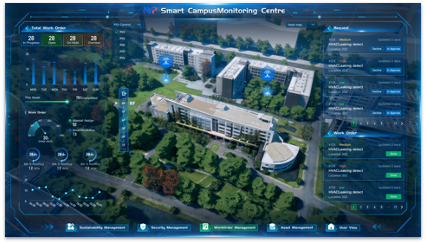
Digital twins create virtual replicas of physical buildings that update in real-time based on IoT sensor data, CMMS maintenance records, and building management system inputs. These sophisticated simulations enable facilities managers to visualise building performance, test operational scenarios, and optimise maintenance strategies without disrupting actual operations. The technology represents one of the most transformative PropTech innovations for facilities management.
The facilities management applications of digital twin technology extend across planning, operations, and optimisation. During capital planning, facilities managers use digital twins to simulate the impact of equipment upgrades or system replacements on overall building performance before committing capital expenditure. During emergency response, digital twins help identify affected systems and optimal technician response routes. During energy optimisation initiatives, digital twins model the combined impact of multiple efficiency measures to prioritise investments.
Leading commercial real estate portfolios are deploying digital twins to improve maintenance outcomes. One Singapore-based property management firm implemented digital twin technology across its 15-building office portfolio, achieving 18% reduction in preventive maintenance costs by optimising PM schedules based on simulated equipment wear patterns rather than fixed intervals. The digital twin identified that certain HVAC components in low-utilisation zones were being serviced far more frequently than necessary, while high-utilisation equipment needed more frequent attention.
Integration between digital twins and CMMS platforms creates powerful synergies. When technicians complete maintenance work orders in the CMMS, that activity updates the digital twin’s maintenance history. When the digital twin identifies optimisation opportunities through simulation, those recommendations flow automatically into the CMMS as planned maintenance work orders. This closed-loop integration ensures that insights lead directly to action.
AI and Machine Learning: Predictive Intelligence
Artificial intelligence and machine learning algorithms analyse the vast data streams generated by IoT sensors, CMMS systems, and building management platforms to identify patterns invisible to human observation. These predictive analytics capabilities represent the cutting edge of PropTech-enabled facilities management, with AI reshaping real estate strategy and decision-making as major investment firms including JLL Spark deploy capital specifically targeting AI-based PropTech solutions.
The most impactful AI applications focus on failure prediction and maintenance optimisation. Machine learning models trained on years of equipment performance data and maintenance history learn the subtle indicators that precede failures. When current sensor readings match these pre-failure patterns, AI systems generate predictive alerts that enable proactive intervention before breakdowns occur. This capability transforms maintenance from reactive emergency response to strategic prevention.
Energy optimisation represents another high-value AI application gaining momentum across the PropTech space. Machine learning algorithms analyse the relationship between weather forecasts, occupancy patterns, equipment operating parameters, and energy consumption to identify optimisation opportunities. These systems automatically adjust HVAC set points, lighting schedules, and equipment run times to minimise energy use while maintaining occupant comfort. Advanced sensing capabilities for temperature, humidity and noise will be adopted at higher rates as building systems evolve into integrated AI-driven ecosystems throughout 2026.
One healthcare facility portfolio in Australia implemented AI-powered predictive maintenance across critical HVAC and electrical systems. Over the first 18 months, the technology predicted 23 equipment failures before they occurred, preventing an estimated 340 hours of downtime and USD 180,000 in emergency repair costs. The system paid for itself within six months through avoided emergency service premiums alone.
The integration between AI analytics and work order management systems ensures that predictions translate directly into maintenance action. When AI identifies elevated failure risk for specific equipment, the CMMS automatically generates condition-based work orders with priority levels matching the predicted urgency. Technicians receive detailed diagnostic information to guide their troubleshooting, improving first-time fix rates and reducing diagnostic time.
Property Management Integration: Unified Operations
The true power of PropTech emerges when facilities management platforms integrate directly with property management systems, tenant experience portals, and financial management software. These integrations eliminate data silos, automate workflows, and create unified visibility across property operations. The integration imperative reflects a broader PropTech trend, with 85% of real estate investors increasing their technology spending by 2026 according to the JLL Global Real Estate Technology Survey.
Tenant Experience: From Request to Resolution
Modern tenants expect digital service delivery comparable to their consumer technology experiences. Tenant experience portals integrated with CMMS platforms enable this capability while improving facilities management efficiency. This alignment of tenant expectations with operational excellence represents one of PropTech’s most immediate value propositions.
Tenants submit maintenance requests through mobile apps or web portals, providing photos and detailed descriptions without phone calls or emails. These requests flow automatically into the CMMS as work orders with all relevant information attached. Tenants receive automated status updates as work orders progress through assignment, scheduling, and completion stages. After resolution, tenants provide feedback through the same digital interface, creating accountability and continuous improvement data.
This digital workflow delivers measurable benefits for both tenants and facilities teams. Tenants appreciate the transparency and communication, leading to higher satisfaction scores even when maintenance resolution times remain unchanged. Facilities managers gain structured request data that enables analysis of common issues, response time tracking, and resource allocation optimisation.
One commercial office building in Singapore implemented an integrated tenant portal and CMMS system, achieving 40% reduction in phone call volume to the facilities help desk, 25% improvement in tenant satisfaction scores, and 15% reduction in average work order resolution time due to better initial information quality from tenant submissions. These improvements directly support lease renewal rates, with properties in the top quartile for tenant satisfaction achieving renewal rates 15-20 percentage points higher than bottom quartile properties according to commercial real estate advisory research.
Financial Integration: Accurate Costing and Budgeting
Integration between CMMS platforms and property accounting systems provides the accurate cost tracking essential for property financial management. Every work order automatically captures labour hours, parts consumption, contractor costs, and overhead allocation. This granular cost data flows directly into the property accounting system, ensuring accurate expense allocation to properties, tenants, or cost centres.
The financial intelligence enabled by this integration transforms maintenance budgeting from guesswork to data-driven forecasting. Historical cost data by equipment type, system category, or property enables accurate budget projections. Trend analysis identifies properties or systems with escalating costs requiring capital investment. Total cost of ownership calculations inform equipment replacement decisions.
For properties with tenant maintenance recharges, integration between CMMS and accounting systems automates billback processes. Work orders tagged as tenant-billable automatically generate accounting entries with supporting documentation attached. This automation eliminates manual invoicing processes while ensuring accurate cost recovery.
Download the Full Report
Get the complete State of Maintenance 2026 report with all benchmark data and implementation frameworks.
Download Free ReportSee It In Action
Ready to join the facilities teams achieving 75% less unplanned downtime? Start your free 30-day trial.
Start Free TrialPropTech Impact: Measurable Operational Improvements
The business case for PropTech adoption in facilities management rests on measurable operational and financial improvements. Industry research and real-world implementations provide clear evidence of the value these technologies deliver, with buildings with integrated smart systems seeing value increases of up to 11% according to Deloitte research on IoT adoption in commercial real estate.
Operating Cost Reduction
PropTech-enabled facilities management consistently reduces property operating expenses across multiple categories. Predictive maintenance decreases emergency repair costs by 20-30% through earlier intervention before catastrophic failures occur. Energy management systems reduce utility expenses by 15-25% through optimised equipment operation and consumption monitoring. Improved parts inventory management reduces carrying costs by 10-15% while maintaining availability.
One Singapore-based property portfolio operator quantified the financial impact of its PropTech implementation across 12 commercial buildings over three years. Total operating cost per square metre decreased by 23%, driven by 29% reduction in reactive maintenance costs, 19% decrease in energy expenses, and 14% reduction in contractor costs through better work scope definition and competitive bidding enabled by detailed CMMS work order data.
The operating cost improvements align with broader PropTech market momentum. The U.S. proptech market size valued at USD 24.73 billion in 2026 is expected to reach USD 76.84 billion by 2034, growing at a strong CAGR of 18.50%, driven substantially by operational efficiency gains that directly impact property net operating income.
Asset Life Extension
PropTech solutions extend equipment lifecycles by ensuring optimal operating conditions and timely maintenance. IoT monitoring prevents the operational stress that accelerates wear. Predictive maintenance interventions address minor issues before they cause secondary damage. Condition-based servicing ensures equipment receives exactly the maintenance required rather than excessive or insufficient attention.
The financial impact of extended asset life significantly influences property capital expenditure requirements and cash flow. One healthcare facility operator documented that HVAC equipment in buildings with IoT monitoring and predictive maintenance averaged 18 years operational life before replacement, compared to 13 years in buildings without these technologies. This five-year life extension reduced annual capital expenditure by approximately USD 320,000 across the portfolio.
Tenant Retention and Satisfaction
PropTech investments improve tenant satisfaction through better service delivery, enhanced comfort, and responsive communication. Properties with digital tenant portals and integrated maintenance management achieve higher tenant satisfaction scores and longer lease tenures. The impact extends beyond soft metrics to hard financial outcomes.
The financial value of improved tenant retention is substantial. Every avoided tenant departure eliminates tenant improvement costs, brokerage commissions, and vacancy periods that collectively represent significant value. Properties with above-average tenant retention command premium valuations due to more stable cash flows and reduced operating risk.
Research by commercial real estate advisory firms indicates that properties in the top quartile for tenant satisfaction achieve lease renewal rates 15-20 percentage points higher than bottom quartile properties. For a commercial office building with 40 tenants, this difference translates to approximately 6-8 additional lease renewals annually, directly impacting property net operating income and valuation.

ESG and Sustainability: PropTech as Compliance Enabler
Environmental, social, and governance (ESG) requirements increasingly influence property operations, financing terms, and asset valuations. PropTech solutions provide the measurement, documentation, and optimisation capabilities essential for ESG compliance and sustainability reporting. Sustainability is shaping real estate strategy in 2026, with energy efficiency, decarbonisation and the convergence of buildings with power systems becoming critical to asset performance, cost management and long-term competitiveness according to JLL Spark’s PropTech forecast.
Environmental Performance Measurement
IoT sensors and energy management platforms provide the granular consumption data required for environmental reporting frameworks. Electricity, gas, and water monitoring at equipment level enables accurate carbon footprint calculations and energy intensity metrics. Refrigerant leak detection systems document compliance with environmental regulations. Waste management tracking provides data for circular economy initiatives.
This measurement capability supports both regulatory compliance and voluntary sustainability certifications. Properties pursuing Green Mark, LEED, or NABERS certifications require detailed energy and environmental data that PropTech systems provide automatically. The documentation burden that historically required months of manual data collection now occurs continuously through integrated platforms.
One Singapore commercial office portfolio achieved Green Mark Platinum certification for 8 of its 10 buildings within 18 months of implementing comprehensive IoT monitoring and CMMS integration. The facilities management team attributed success primarily to the automated data collection and documentation capabilities that would have been impractical with manual processes.
Predictive Maintenance and Resource Efficiency
The sustainability benefits of predictive maintenance extend beyond energy savings. Extending equipment lifecycles reduces manufacturing demand and disposal impact. Optimising parts inventory reduces waste from obsolete stock. Digital work orders eliminate paper consumption. Remote diagnostics reduce technician travel.
These operational improvements align perfectly with corporate sustainability commitments while delivering cost savings. Forward-thinking property owners position PropTech investments as sustainability initiatives that improve both environmental performance and financial returns, a rare combination that resonates with investors, tenants, and regulators.
Social and Governance Dimensions
PropTech solutions support the social and governance aspects of ESG frameworks through improved safety management, compliance documentation, and stakeholder transparency. Digital work order systems create audit trails demonstrating regulatory compliance for safety inspections, equipment certifications, and maintenance procedures. Mobile CMMS applications enable safety checklists and incident reporting that improve worker protection. Tenant portals provide transparency that enhances stakeholder relations.
These capabilities matter increasingly to institutional investors applying ESG criteria to property portfolio decisions. Properties with strong PropTech systems demonstrating operational excellence, compliance documentation, and stakeholder engagement command financing advantages and valuation premiums in capital markets.
Implementation Strategy: Building Your PropTech Ecosystem
The breadth of PropTech solutions available creates both opportunity and complexity. Successful implementations follow strategic approaches that prioritise foundational capabilities, ensure integration, and scale deliberately based on demonstrated value. However, 34% of organisations implementing smart building technology report lacking the talent and skills to integrate data science into their smart building platforms, highlighting the importance of structured implementation approaches that build organisational capability alongside technical deployment.
Phase 1: CMMS Foundation
Every PropTech journey begins with implementing reliable CMMS software if not already in place. This foundational platform provides the work order management, asset tracking, and maintenance history that all advanced technologies require. The CMMS serves as the data backbone that makes sophisticated analytics, IoT integration, and digital twins possible.
Selecting the right CMMS platform requires evaluating several critical factors. Integration capabilities determine how easily the system connects to IoT devices, property management software, and analytics platforms. Mobile functionality affects field technician adoption and data quality. Reporting capabilities influence management visibility and decision-making. User interface design impacts organisation-wide adoption.
The Infodeck CMMS platform provides the comprehensive foundation required for PropTech success, with native IoT integration, mobile-first design, and open APIs that enable direct connection to property management systems and advanced analytics platforms. Implementation typically requires 6-12 weeks including data migration, workflow configuration, and user training.
Phase 2: IoT Pilot Implementation
After establishing CMMS foundation, pilot IoT implementations on critical equipment provide immediate value while building organisational capability. Target equipment for initial IoT deployment based on business impact: critical systems where failures cause major disruption, high-energy-consuming equipment where optimisation delivers significant savings, or assets with high maintenance costs where condition monitoring could reduce expenses.
Start with 10-20 connected devices to validate technology, establish workflows, and demonstrate value before scaling. This measured approach manages risk while building organisational confidence and technical expertise. The pilot phase addresses the data readiness challenges that increasingly differentiate PropTech leaders from laggards, with data readiness rather than AI itself being the key differentiator according to smart building technology outlooks for 2026.
Successful IoT pilots follow structured implementation processes. Define specific business objectives beyond general “monitoring” goals. Establish baseline metrics for comparison. Train facilities staff on data interpretation and response protocols. Review pilot results after 90 days to quantify impact and inform scaling decisions.
Phase 3: Analytics and Optimisation
With CMMS and IoT foundations established, analytics capabilities unlock the predictive and optimisation value that delivers transformative results. Start with descriptive analytics that answer “what happened” questions: which equipment fails most frequently, what maintenance activities consume most resources, when do work order volumes peak.
Progress to diagnostic analytics that explain “why it happened”: what factors correlate with equipment failures, why certain buildings have higher maintenance costs, which maintenance practices associate with better outcomes. These insights drive process improvements and resource allocation decisions.
Finally, implement predictive analytics that forecast “what will happen”: which equipment faces elevated failure risk, when maintenance demand will exceed capacity, what interventions will deliver greatest impact. These capabilities enable the proactive, optimised maintenance operations that define PropTech excellence.
Phase 4: Integration and Ecosystem Expansion
The mature PropTech ecosystem integrates facilities management platforms with property management systems, financial software, tenant portals, and energy management platforms. These integrations eliminate manual data transfer, automate workflows, and create unified visibility. The integration imperative reflects PropTech market maturation, with approximately USD 4.3 billion in growth equity and debt investment flowing into the U.S. PropTech market in 2024 across 165+ investments as the ecosystem matures.
Prioritise integrations based on business value. Integration between tenant portals and CMMS eliminates manual work order entry while improving tenant experience. Integration between CMMS and accounting systems automates cost tracking and tenant billing. Integration between IoT platforms and CMMS enables automated condition-based work orders.
Plan for ongoing evolution rather than one-time implementation. PropTech capabilities advance continuously, and successful organisations maintain architectural flexibility that enables adopting new technologies without replacing existing systems. Many operators are shifting from major capital expenses to subscription-based building services by 2026, including everything from HVAC optimisation to full energy-as-a-service contracts, requiring integration architectures that accommodate evolving service delivery models.
Measuring Success: PropTech Performance Metrics
Demonstrating PropTech value requires establishing clear performance metrics before implementation and tracking improvements consistently. The most meaningful facilities management KPIs span operational efficiency, financial performance, and stakeholder satisfaction, providing the quantitative evidence essential for justifying continued investment and portfolio-wide expansion.
Operational Efficiency Metrics
Track these operational metrics to quantify PropTech impact on maintenance execution:
- Mean Time Between Failures (MTBF): Measures reliability improvement from predictive maintenance, with PropTech-enabled buildings typically achieving 25-40% improvement
- Preventive vs Reactive Maintenance Ratio: Target 70-80% preventive, declining reactive work indicating transition from reactive to proactive operations
- First-Time Fix Rate: Percentage of work orders completed without return visits, typically improving from 65-70% baseline to 85-90% with IoT diagnostics
- Schedule Compliance: Adherence to preventive maintenance schedules, with automated CMMS platforms achieving 90%+ compliance vs 60-70% manual tracking
- Work Order Cycle Time: Average time from request to completion, with integrated systems reducing cycles by 20-35%
- Emergency Work Order Percentage: Target below 10% of total work orders, down from 20-30% typical in reactive maintenance environments
Financial Performance Metrics
Monitor these financial metrics to demonstrate ROI and justify continued PropTech investment:
- Maintenance Cost per Square Metre: Total maintenance spending normalised by building area, typically declining 15-25% within 18-24 months of PropTech implementation
- Energy Cost per Square Metre: Utility expenses normalised by building area, with IoT-enabled optimisation reducing costs 15-25%
- Emergency vs Planned Maintenance Cost Ratio: Emergency work typically costs 3-5x planned maintenance; PropTech reduces emergency proportion from 40-50% to under 20% of total costs
- Asset Life vs Industry Benchmark: Equipment lifecycle extension percentage, typically 20-30% improvement vs manufacturer specifications
- Maintenance Labour Productivity: Work orders completed per technician per period, improving 25-35% with mobile CMMS and IoT diagnostics
- Inventory Turnover: Parts and supplies turnover rate, typically improving from 2-3x annually to 5-6x with automated replenishment
Stakeholder Satisfaction Metrics
Track satisfaction metrics that correlate with tenant retention and property valuations:
- Tenant Satisfaction Score: Regular surveys measuring maintenance service quality, with PropTech implementations achieving 25-40% improvement
- Average Response Time: Time from tenant request to initial response, declining from hours to minutes with automated CMMS workflows
- Work Order Satisfaction: Tenant ratings of completed maintenance work, typically improving from 3.5-4.0 to 4.5-4.8 on 5-point scales
- Service Request Volume: Declining volume suggests fewer recurring issues, with effective PropTech reducing requests 15-25%
- Complaint Escalation Rate: Percentage of requests escalated to property management, declining from 10-15% to under 5% with improved service delivery
Track these metrics quarterly and establish benchmarking against industry standards and peer properties. The most successful PropTech implementations demonstrate 15-30% improvement across multiple metrics within 18-24 months, creating compelling business cases for continued investment and portfolio-wide expansion.
The Future of PropTech in Facilities Management
PropTech evolution continues accelerating as technologies mature and new capabilities emerge. Understanding these trends helps facilities managers make technology investments that remain relevant as the industry advances, with AI-driven building management systems, energy-focused building retrofits, and real-time occupancy decisions expected to dominate PropTech innovation throughout 2026 and beyond.
Autonomous Building Systems
The convergence of AI, IoT, and building management systems is creating increasingly autonomous buildings that self-diagnose issues, optimise operations, and even execute certain maintenance tasks without human intervention. Advanced HVAC systems already adjust operations automatically based on occupancy patterns and weather forecasts. The next generation will diagnose component failures, order replacement parts, and schedule contractor service with minimal human oversight.
These autonomous capabilities don’t eliminate facilities management expertise but rather elevate it. Facilities managers transition from executing routine tasks to overseeing intelligent systems, handling complex exceptions, and driving continuous improvement based on system recommendations. This evolution reflects the broader PropTech talent transformation, with CBRE’s proptech investment dramatically changing the firm’s talent mix to include many new designers, engineers, product managers and data scientists alongside traditional facilities professionals.
Blockchain for Asset Management
Blockchain technology promises to transform property and equipment asset management through immutable maintenance records, automated compliance verification, and fractional ownership capabilities. Every maintenance activity recorded on blockchain creates permanent, tamper-proof documentation valuable for regulatory compliance, insurance claims, and property transactions.
Equipment manufacturers are beginning to implement blockchain-based asset passports that follow equipment throughout its lifecycle, automatically recording maintenance history, documenting warranty compliance, and verifying genuine parts usage. These capabilities will become increasingly important as sustainability regulations require lifecycle documentation and circular economy principles.
Augmented Reality for Maintenance Execution
Augmented reality (AR) applications overlay digital information onto physical environments, guiding technicians through complex maintenance procedures, displaying equipment specifications and maintenance history, and enabling remote expert assistance. Early AR implementations demonstrate 30-40% reductions in maintenance execution time for complex tasks and improved first-time fix rates for less-experienced technicians.
Integration between AR applications and CMMS platforms enables technicians to access work order details, asset information, and technical documentation hands-free while working on equipment. Remote experts can see exactly what field technicians observe and provide real-time guidance, reducing the skill gap challenges facing many facilities organisations.
Taking Action: Your PropTech Roadmap
The PropTech transformation of facilities management represents both opportunity and competitive necessity. Properties that embrace these technologies achieve measurable operational improvements, financial benefits, and market differentiation. Properties that delay adoption face escalating competitive disadvantage as tenant expectations, regulatory requirements, and investor preferences increasingly favour technology-enabled operations.
The PropTech market momentum supports this urgency. With the global PropTech market growing from USD 54.66 billion in 2026 to USD 185.31 billion by 2034, and 85% of real estate investors increasing their technology spending, the facilities management industry stands at an inflection point where PropTech adoption separates high-performing properties from struggling portfolios.
Your PropTech journey begins with honest assessment of current capabilities and clear definition of business objectives. What operational challenges cause greatest pain? Where do maintenance costs exceed benchmarks? Which equipment failures create most disruption? What tenant satisfaction issues require attention? These questions guide technology priorities that deliver meaningful impact.
Start with CMMS foundation if not already established, pilot IoT on critical equipment to demonstrate value, layer analytics capabilities to unlock predictive intelligence, and expand integrations to create connected workflows. This phased approach manages investment while building organisational capability and demonstrating value at each stage.
The facilities management industry stands at an inflection point where PropTech adoption separates high-performing properties from struggling portfolios. The organisations that embrace this transformation thoughtfully position themselves for sustained competitive advantage in an increasingly technology-driven market. With 115 million smart buildings expected by 2026 and 78% of businesses already adopting building technology, the question is not whether to adopt PropTech but how quickly your organisation can implement these transformative capabilities.
Ready to explore how PropTech solutions can transform your facilities management operations? Discover the Infodeck CMMS platform and see how our integrated approach to work orders, asset management, and IoT connectivity provides the foundation for PropTech excellence. Book a demo to discuss your specific PropTech roadmap with our facilities management technology specialists and join the thousands of organisations using property technology for competitive advantage.


