

Key Takeaways
- BMS, CMMS, and IoT platforms serve distinct but complementary roles in the smart building technology stack
- BMS detects issues and controls building systems, CMMS manages the response and maintenance workflows, IoT platforms connect and analyze data
- The building management system market reached $28.61 billion in 2026, growing 24.7% year-over-year
- Integration protocols like BACnet, Modbus, and MQTT enable communication between these systems
- IoT-native CMMS platforms eliminate the need for separate IoT middleware layers
When evaluating smart building technology, buyers often encounter three acronyms that sound similar but serve fundamentally different purposes: BMS (Building Management System), CMMS (Computerized Maintenance Management System), and IoT platforms. Understanding how these systems work together, and when you need each one, is critical for building a technology stack that actually delivers operational efficiency rather than creating data silos and integration headaches.
The confusion is understandable. All three systems deal with building operations, equipment monitoring, and data collection. But they operate at different layers of the technology stack, serve different users, and solve different problems. This guide breaks down the architecture, explains the integration protocols, and helps you determine which combination your facility needs.
The Three-Layer Smart Building Architecture
Smart buildings operate on a three to five-layer technology stack where each layer has specific responsibilities:
Layer 1: Field/Perception Layer (BMS) This is where building systems live. Your HVAC controllers, lighting panels, access control systems, and fire safety equipment all operate at this layer. The BMS coordinates these systems, executing control logic and collecting operational data from sensors.
Layer 2: Network/Transportation Layer (IoT Platform) This middleware layer translates protocols, aggregates data from multiple sources, and routes information between the field layer and the application layer. IoT platforms handle the complexity of connecting diverse systems that speak different protocols.
Layer 3: Application/Supervisory Layer (CMMS) This is where human workflows happen. Work order management, maintenance scheduling, spare parts inventory, technician dispatch, and equipment history all live at this layer. The CMMS receives alerts from the lower layers and translates them into actionable maintenance tasks.
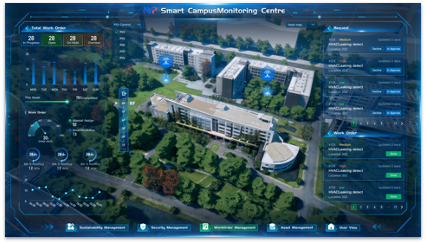
In modern smart building architectures, these layers must communicate smoothly. A sensor detects that a chiller is overheating (Layer 1), the IoT platform processes this data and determines it’s a maintenance issue (Layer 2), and the CMMS automatically creates a work order and assigns it to a technician with the right skills (Layer 3).
What a BMS Actually Does (and Doesn’t Do)
A Building Management System is the central command for a facility’s core systems: HVAC, lighting, security, and energy monitoring. Major players include Honeywell, Johnson Controls, Siemens, and Schneider Electric, each with proprietary systems that control billions of dollars in installed infrastructure.
BMS Core Capabilities
Real-Time System Control A BMS makes second-by-second decisions about building operations: adjusting damper positions, modulating chiller output, dimming lights based on occupancy, and responding to temperature setpoints. These control loops run continuously without human intervention.
Energy Optimization The BMS monitors energy consumption across all systems and automatically adjusts operations to minimize waste. It can shed non-critical loads during peak demand periods, optimize chiller sequencing, and implement night setback strategies.
Alarm Generation When parameters exceed thresholds, the BMS generates alerts: high temperature alarms, equipment fault codes, filter status warnings, and system failures. These alerts tell you what is happening but not what to do about it.
The Critical BMS Limitation
Here’s what a BMS cannot do: it cannot process information for maintenance purposes. When your BMS alerts you that AHU-3 has a high pressure differential across the filter, it has no concept of:
- Whether a work order already exists for this issue
- Which technician is qualified and available to respond
- Where replacement filters are stored in your inventory
- What the maintenance history of this unit looks like
- How long this issue has been recurring
- The expected repair procedure and required tools
The BMS tells you the chiller is overheating. It has no mechanism to schedule a technician, allocate spare parts, document the repair, or track whether the issue was resolved. These operational workflows require a different system entirely.
Start Free Trial
Experience the full platform with 30-day free access. No credit card required.
Start Free TrialBook a Demo
Get a personalized walkthrough from our team. See how Infodeck fits your operation.
Schedule DemoWhat a CMMS Actually Does (and Doesn’t Do)
A Computerized Maintenance Management System manages the human side of facility operations: maintenance requests, work orders, preventive maintenance schedules, inventory management, and equipment documentation. The global CMMS market reached approximately $1.46 billion in 2025, with projections to exceed $3.8 billion by 2034.
CMMS Core Capabilities
Work Order Management When a malfunction occurs, the CMMS immediately plans the operations necessary to return to normal: assigning technicians, providing work instructions, allocating spare parts, tracking labor hours, and documenting resolution.
Preventive Maintenance Scheduling The CMMS maintains a calendar of all scheduled maintenance: filter changes, belt inspections, lubrication routes, and equipment testing. It generates work orders automatically based on time intervals or meter readings.
Asset Lifecycle Management Every piece of equipment has a digital record: installation date, manufacturer information, warranty status, maintenance history, parts consumed, and total cost of ownership. This data informs replacement decisions and budget planning.
Inventory Control The CMMS tracks spare parts across multiple storerooms: current quantities, reorder points, unit costs, and consumption history. When technicians use parts on a work order, inventory levels automatically update.
The Critical CMMS Limitation
Traditional CMMS platforms cannot directly read building automation protocols. Your CMMS doesn’t speak BACnet or Modbus, which means it cannot:
- Automatically receive alerts from your BMS
- Monitor equipment runtime hours from controllers
- Pull temperature and pressure readings from sensors
- Detect equipment failures before someone reports them
- Trigger condition-based maintenance from real-time data
A conventional CMMS relies on humans to report problems, manually enter meter readings, and translate BMS alarms into work orders. This creates delays, transcription errors, and missed opportunities for proactive maintenance.
What an IoT Platform Actually Does (and Doesn’t Do)
IoT platforms sit between your building systems and your operational software, handling protocol translation, data aggregation, and analytics. Major platforms include AWS IoT, Microsoft Azure IoT, IBM Watson IoT, and Google Cloud IoT.
IoT Platform Core Capabilities
Protocol Translation IoT platforms speak multiple languages: BACnet, Modbus, MQTT, LoRaWAN, Zigbee, and proprietary protocols from equipment manufacturers. They translate between these protocols so different systems can communicate.
Data Aggregation and Storage The platform collects data from thousands of sensors and controllers, normalizes it into a consistent format, and stores it in time-series databases optimized for IoT workloads.
Real-Time Analytics IoT platforms apply rules engines, machine learning models, and anomaly detection algorithms to sensor data. They can identify patterns that indicate impending failures and trigger alerts based on complex conditions.
Edge Computing Some platforms process data at the edge (on-premise gateways) rather than sending everything to the cloud. This reduces latency, bandwidth costs, and dependency on internet connectivity.
The Critical IoT Platform Limitation
IoT platforms are excellent at collecting and analyzing data but terrible at workflow management. They don’t understand maintenance concepts like:
- Technician skills, availability, and scheduling
- Work order priority and approval workflows
- Spare parts inventory and procurement
- Maintenance procedures and safety protocols
- Labor hours, costs, and budget tracking
An IoT platform can tell you that predictive analytics indicate a pump bearing will fail within two weeks. It cannot create a work order, check if you have a spare bearing in stock, schedule a technician during a maintenance window, or document the repair.

The Integration Architecture: How These Systems Work Together
In a properly designed smart building stack, BMS and CMMS systems integrate to automate the maintenance response to facility issues. Here’s the data flow:
Step 1: Detection (BMS Layer) A pressure sensor on a chilled water loop detects that differential pressure has exceeded normal parameters for six consecutive hours. The BMS controller recognizes this as a potential strainer blockage and generates an alarm.
Step 2: Translation (IoT Layer) The BMS uses BACnet protocol to communicate the alarm. The IoT platform receives this BACnet message, translates it into a standard data format (typically JSON over REST API or MQTT), and enriches it with contextual information: equipment name, location, severity, and historical patterns.
Step 3: Action (CMMS Layer) The CMMS receives the enriched alert via API integration. It automatically creates a work order for “Inspect and clean chilled water strainer,” assigns it to a technician qualified for this task, checks inventory for replacement strainer elements, and sends a notification to the technician’s mobile device.
Step 4: Execution (Human Layer) The technician receives the work order with complete context: equipment location, likely problem, repair procedure, required tools, and spare parts. They perform the repair, update the work order status, and document findings.
Step 5: Closure Loop (Data Layer) The CMMS records the resolution, updates equipment history, adjusts inventory levels, and closes the work order. The BMS continues monitoring to verify the alarm has cleared. The IoT platform analyzes the event for pattern recognition and predictive model refinement.
This closed-loop process only works when all three layers can communicate. Missing any layer creates gaps in automation.
Protocol Deep Dive: The Languages Smart Buildings Speak
Understanding integration protocols is essential for evaluating vendor claims about “easy connectivity.” Here are the protocols you’ll encounter:
BACnet (Building Automation and Control Network)
BACnet is the most widely adopted open protocol for building automation, designed specifically for HVAC, lighting, access control, and fire safety systems. It defines objects (Analog Inputs, Binary Outputs, etc.) and services (Read Property, Write Property) that enable interoperability between manufacturers.
Where it’s used: Commercial BMS systems from Honeywell, Johnson Controls, Siemens, Trane, and Carrier Variants: BACnet/IP (over Ethernet), BACnet MS/TP (over RS-485 twisted pair) Strengths: Rich feature set, broad industry adoption, native support for complex building systems Limitations: Requires specialized knowledge to configure, limited support in IoT platforms without gateways
Modbus
Modbus is a simple, reliable industrial protocol originally developed for manufacturing equipment but widely adopted for utility metering, chillers, boilers, and VFDs in buildings.
Where it’s used: Industrial HVAC equipment, power meters, generators, and chillers Variants: Modbus RTU (serial), Modbus TCP (Ethernet) Strengths: Simple implementation, low cost, extensive device support Limitations: Limited functionality compared to BACnet, no native support for complex data structures
MQTT (Message Queuing Telemetry Transport)
MQTT is a lightweight publish-subscribe protocol optimized for IoT devices with limited bandwidth and processing power. It’s increasingly common in modern IoT sensors and edge devices.
Where it’s used: IoT sensors, smart meters, environmental monitors, wireless devices Strengths: Efficient bandwidth usage, support for unreliable networks, scalable architecture Limitations: Requires MQTT broker infrastructure, security implementation varies
LoRaWAN (Long Range Wide Area Network)
LoRaWAN is a low-power wireless protocol designed for IoT sensors that need long battery life and long-range communication. It’s ideal for wireless sensors in large buildings or campus environments.
Where it’s used: Wireless occupancy sensors, environmental monitors, leak detection, remote assets Strengths: Low power consumption (10-year battery life), long range (5-15 km), penetrates buildings well Limitations: Low data rates, not suitable for real-time control, requires gateway infrastructure
Protocol Translation Challenge
The fundamental integration problem is that these protocols don’t naturally interoperate. Your BACnet BMS cannot directly communicate with your Modbus chiller, and neither can talk to your MQTT IoT sensors without translation gateways.
Traditional approaches require middleware layers:
Option 1: Physical Protocol Gateways Hardware devices that translate between protocols (e.g., Modbus to BACnet gateways). These can cost $500-5,000 per building and require configuration for each integration point.
Option 2: IoT Platform Middleware Cloud-based platforms that connect to multiple protocols and provide unified APIs. These typically require annual licensing fees of $50,000+ for enterprise deployments.
Option 3: IoT-Native CMMS Modern CMMS platforms with built-in protocol support eliminate the need for separate middleware, reducing complexity and cost.
Start Free Trial
Experience the full platform with 30-day free access. No credit card required.
Start Free TrialBook a Demo
Get a personalized walkthrough from our team. See how Infodeck fits your operation.
Schedule DemoThe Case for IoT-Native CMMS: Collapsing the Stack
The three-layer architecture (BMS + IoT Platform + CMMS) was necessary when CMMS platforms couldn’t handle sensor integration. But maintaining separate systems creates problems:
Integration Complexity Every integration point is a potential failure point. Data must flow through multiple systems, each with its own authentication, data models, and error handling. A single misconfigured gateway can break the entire automation chain.
Data Latency When an alert must travel from BMS → Protocol Gateway → IoT Platform → API Integration → CMMS, response times suffer. Minutes can pass before a work order is created.
Vendor Lock-In Each layer often comes from a different vendor, creating dependencies on proprietary APIs and data formats. Switching vendors requires re-engineering integrations.
Cost Multiplication You’re paying licensing fees for three separate platforms, plus integration costs, plus ongoing support for multiple systems. The total cost of ownership is significantly higher than a unified solution.
Data Silos Equipment data lives in the BMS, maintenance history in the CMMS, and analytics in the IoT platform. Creating unified dashboards requires additional integration work.
The IoT-Native Approach
Modern CMMS platforms with IoT-native capabilities collapse the stack by embedding sensor integration directly into the maintenance management system:
Direct Protocol Support The CMMS natively speaks BACnet, Modbus, MQTT, and LoRaWAN, eliminating the need for protocol gateways or middleware platforms.
Unified Data Model Equipment records in the CMMS include both static information (manufacturer, model, warranty) and real-time data (temperature, runtime, status) from connected sensors.
Integrated Analytics Predictive maintenance algorithms run within the CMMS, using both sensor data and maintenance history to generate condition-based work orders.
Simplified Architecture Instead of BMS → IoT Platform → CMMS, you have BMS → CMMS. Two systems instead of three, with direct communication and no middleware licensing fees.
This approach is particularly effective in the Asia-Pacific region, where facilities management tech stacks are reaching new maturity levels as organizations integrate CMMS platforms, building automation systems, and IoT sensors into unified systems.
When You Need All Three vs. When CMMS + Basic BMS Is Enough
Not every facility needs a full three-layer stack. Here’s how to assess your requirements:
You Need a Full Three-Layer Stack When:
Multi-Vendor BMS Environment If you operate buildings with Honeywell BMS in one location, Johnson Controls in another, and Siemens in a third, an IoT platform provides the unified integration layer needed to consolidate data across disparate systems.
Advanced Analytics Requirements When you need sophisticated machine learning models, digital twin simulations, or custom analytics that go beyond standard CMMS capabilities, a specialized IoT platform may be warranted.
Massive Scale Organizations managing thousands of buildings with millions of data points may benefit from dedicated IoT infrastructure optimized for high-volume data ingestion and processing.
Legacy Systems Older BMS installations with proprietary protocols or limited connectivity may require IoT middleware to bridge to modern CMMS platforms.
CMMS + Basic BMS Is Sufficient When:
Single-Vendor BMS Environment If your entire portfolio runs on a single BMS platform (e.g., all Johnson Controls Metasys), direct BMS-CMMS integration is simpler and more cost-effective than adding middleware.
Standard Monitoring Requirements When your needs are limited to work order automation from BMS alarms, preventive maintenance scheduling, and basic equipment monitoring, IoT-native CMMS functionality is sufficient.
Limited IoT Sensor Deployment Facilities with primarily traditional BMS-controlled equipment and minimal wireless sensors don’t need extensive IoT platform capabilities.
Cost Sensitivity If budget constraints are significant, an IoT-native CMMS eliminates the licensing and integration costs associated with a separate IoT platform layer.
The Building Management System market reached $28.61 billion in 2026, growing 24.7% year-over-year, driven by AI-enabled optimization, IoT-connected automation devices, and energy-efficient retrofitting initiatives. But BMS investment alone doesn’t deliver operational efficiency without proper CMMS integration.

Real-World Integration: A Data Center Case Study
Consider a data center with critical cooling infrastructure. Here’s how the three-layer stack operates in practice:
The Infrastructure:
- BMS: Siemens Desigo CC controlling 20 precision air conditioning units
- IoT Sensors: Wireless temperature/humidity sensors via LoRaWAN (not connected to BMS)
- CMMS: Enterprise maintenance management platform
The Problem: The BMS monitors supply air temperature from PAC units but doesn’t track actual rack inlet temperatures. The wireless sensors provide this data but don’t integrate with either the BMS or CMMS. When hot spots develop, facilities receives alarms from both systems with no coordinated response.
The Integration Solution:
-
IoT Platform Layer (Option A): Deploy an IoT platform that connects to both Siemens BACnet/IP and LoRaWAN gateways. Configure rules that correlate BMS alerts with wireless sensor data and trigger CMMS work orders via API.
-
IoT-Native CMMS (Option B): Deploy a CMMS with native LoRaWAN support that also connects to the Siemens BMS via BACnet. Configure the CMMS to create work orders when rack temperatures exceed thresholds, whether detected by BMS or wireless sensors.
The Outcome Comparison:
Option A requires three system licenses, two integration projects, and ongoing support for multiple platforms. Data flows through four transformation steps before work orders are created.
Option B requires two system licenses (BMS + CMMS), one integration project, and a single vendor relationship. Data flows directly from sensors to work orders with lower latency and simpler troubleshooting.
For this specific use case, Option B delivered 40% lower total cost of ownership and 60% faster alert-to-work-order response times.
Evaluating Vendor Claims: Questions to Ask
When vendors claim their solutions integrate BMS, CMMS, and IoT platforms, dig deeper with these questions:
Protocol Support:
- Which protocols does your system natively support? (List specific versions: BACnet/IP, Modbus TCP, MQTT 3.1.1, LoRaWAN 1.0.3)
- Do you require protocol gateways or middleware for BMS integration?
- Can you demonstrate a working BACnet integration retrieving real-time points?
Data Flow:
- Describe the data flow from a BMS alarm to a completed work order. How many systems are involved?
- What happens if one integration point fails? Is there redundancy?
- How quickly can your system respond to a critical alarm (seconds, minutes, hours)?
Configuration Complexity:
- Who performs the integration work: your team, the customer’s team, or a third-party integrator?
- What is the typical timeline for integrating with an existing BMS?
- Are there per-integration-point costs or licensing limitations?
Analytics Capabilities:
- Does predictive maintenance use sensor data, maintenance history, or both?
- Can the system create condition-based work orders automatically, or does it only generate alerts?
- How do you handle false positives from analytical models?
Vendor Lock-In:
- Can you export data in standard formats (CSV, JSON) for migration?
- Do you provide API documentation for custom integrations?
- What happens to our integrations if we switch CMMS providers?
The Future: Interoperability as Expectation
In 2026, interoperability shifted from aspiration to expectation. Organizations now demand platforms built on open standards that unify data across regions, facilities, and equipment types. The trend is clear: unified, interoperable platforms that bridge disparate building systems are replacing isolated point solutions.
AI-Driven Integration Artificial intelligence continues moving from supporting role to central control layer, analyzing millions of data points to locate inefficiencies, predict equipment failures, and automate operational decisions. The focus is shifting from providing insights to actually automating actions.
No-Code Integration Platforms No-code Building Operating Systems can cut integration time by 50% and unify HVAC, elevators, IoT, and access control without extensive programming. This democratizes smart building technology for organizations without large IT departments.
Edge Computing Architecture Processing data at the edge (on-premise gateways) rather than sending everything to the cloud reduces latency, bandwidth costs, and dependency on internet connectivity. This is particularly important for critical facility operations that cannot tolerate cloud service outages.
Open Standards Mandate Building owners are increasingly rejecting proprietary protocols and vendor lock-in. The demand for BACnet, MQTT, and other open standards is forcing legacy vendors to adopt interoperable architectures.
Making the Right Choice for Your Facility
The BMS vs CMMS vs IoT platform question isn’t really about choosing one over the others. It’s about understanding how they work together and selecting the architecture that matches your operational requirements without unnecessary complexity.
Start with your maintenance workflows. If your primary need is managing work orders, scheduling preventive maintenance, tracking inventory, and documenting repairs, the CMMS is your foundation. Layer in IoT capabilities as needed.
Assess your BMS maturity. If you have a modern, well-maintained BMS with standard protocols, direct BMS-CMMS integration may be sufficient. Legacy systems with limited connectivity require middleware.
Consider your IoT ambitions. If you’re deploying extensive wireless sensor networks, implementing digital twin technology, or running advanced analytics, evaluate dedicated IoT platforms. If your needs are more modest, IoT-native CMMS functionality may suffice.
Calculate total cost of ownership. Don’t just compare license fees. Include integration costs, ongoing support, training, and the overhead of managing multiple vendor relationships.
The global IoT market is projected to surpass $602 billion in 2026, and BMS market growth continues at 24.7% annually. But technology investment only delivers value when systems actually work together. The smart building technology stack isn’t about having every layer. It’s about having the right layers that actually communicate.
For facilities teams looking to modernize their operations, Infodeck’s IoT-native CMMS platform provides direct BMS integration without middleware complexity. Built-in support for BACnet, Modbus, MQTT, and LoRaWAN eliminates the need for separate IoT platforms while delivering the maintenance management capabilities that BMS systems lack.
Book a demo to see how a unified platform simplifies your smart building technology stack.
Sources
- BMS and CMMS Differences - Yuman
- CMMS Integration Guide 2025 - MaintainX
- Smart Building Technology Stack - Occuspace
- BMS Market Report 2026 - Globe Newswire
- Facilities Management Software 2026 - Monday.com
- Smart Building Technology 2026 Outlook - Cohesion
- BACnet vs Modbus Comparison - EMQ
- Smart Building Predictions 2026 - Facility Executive


