

Key Takeaways
- Traditional BMS controls HVAC, lighting, and fire systems in silos, while iBMS unifies all building systems with analytics and AI for 15-30% energy savings
- The global intelligent building management market is projected to reach USD 27.1 billion by 2025, growing at a 12.3% CAGR according to MarketsandMarkets
- iBMS paired with CMMS creates a closed-loop system where sensor anomalies automatically generate work orders, cutting response times from hours to minutes
- Singapore's BCA Green Mark 2021 framework increasingly rewards smart building capabilities that only iBMS can deliver at scale
- Migration from traditional BMS to iBMS does not require ripping out existing infrastructure; most modern iBMS platforms use open protocols like BACnet and Modbus to layer intelligence on top
If you manage a commercial building, hospital, or campus, you already know the building management system is the nervous system of your facility. It keeps the HVAC humming, the lights on, and the fire alarms ready.
But here is the question nobody asked ten years ago: what if your BMS could actually think?
That is the promise behind the intelligent building management system, or iBMS. And it is not just marketing fluff. The shift from traditional BMS to iBMS represents a fundamental change in how facilities teams operate, maintain, and optimize their buildings.
According to a MarketsandMarkets report on intelligent building automation, the global intelligent building management market is projected to reach USD 27.1 billion by 2025, growing at a compound annual growth rate of 12.3%. That kind of growth does not happen without real results behind it.
In this guide, we will break down the real differences between traditional BMS and iBMS, explore how an intelligent building management system integrates with CMMS platforms like Infodeck, and walk through a practical migration path for facilities teams considering the upgrade.
What Is a Traditional BMS?
A Building Management System (BMS) — sometimes called a Building Automation System (BAS) — is a centralized platform that monitors and controls a building’s mechanical and electrical equipment. Think of it as the facility’s autopilot. It follows rules you set, and it follows them reliably.
Core Functions of Traditional BMS
Traditional BMS typically handles four main building systems:
| Building System | What BMS Controls | Typical Sensors |
|---|---|---|
| HVAC | Heating, ventilation, air conditioning setpoints and schedules | Temperature, humidity, CO2, airflow |
| Lighting | On/off schedules, dimming, daylight harvesting | Occupancy, lux level, time-of-day |
| Fire & Life Safety | Alarm monitoring, sprinkler status, smoke detection | Smoke, heat, gas, water flow |
| Electrical | Power monitoring, emergency generator status, UPS | Voltage, current, power factor |
The key word here is control. A traditional BMS excels at executing predefined rules. If the temperature in Zone 3 exceeds 24 degrees Celsius, the BMS opens the cooling valve. If it is 7 PM on a weekday, the BMS dims the lobby lights to 40%.
These rule-based automations, defined under standards like ASHRAE Guideline 36, have been the backbone of commercial building operations for decades. They work. But they have hard limits.
Where Traditional BMS Stops
Here is the thing about rule-based systems: they can only be as smart as the rules you write.
A traditional BMS does not learn from patterns. It does not correlate data across systems. If your chiller is slowly degrading over six months, the BMS will not flag it until the temperature threshold is actually breached. By that point, you are already in reactive mode — exactly the situation a good preventive maintenance program is designed to prevent.
Traditional BMS also creates data silos. The HVAC system generates data. The lighting system generates data. The fire system generates data. But these streams rarely talk to each other in any meaningful way. Your facilities team ends up manually correlating information from multiple dashboards, multiple vendors, and multiple protocols.
What Is an iBMS?
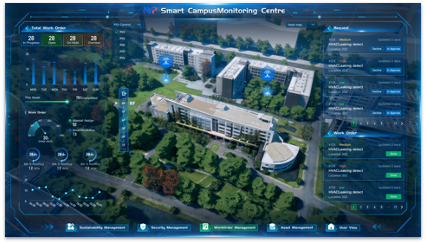
An intelligent Building Management System (iBMS) takes everything a traditional BMS does and layers analytics, machine learning, and cross-system integration on top.

If traditional BMS is autopilot, iBMS is the co-pilot that actually understands where you are going.
How iBMS Goes Beyond Traditional BMS
An iBMS does not just execute rules. It:
- Analyzes patterns across all building systems simultaneously
- Predicts failures before they cause downtime using machine learning models
- Optimizes energy in real time based on occupancy, weather, and utility rates
- Correlates data across HVAC, lighting, security, and elevator systems
- Generates actionable insights for facilities managers, not just raw data
- Integrates with maintenance systems like CMMS platforms to close the loop between detection and resolution
According to the Continental Automated Buildings Association (CABA), an intelligent building is one that “provides a productive and cost-effective environment through optimization of its four basic elements — structure, systems, services, and management — and the interrelationships between them.”
That last part is critical. The interrelationships. Traditional BMS manages individual systems. iBMS manages the relationships between them.
The Technology Stack Behind iBMS
A modern iBMS typically includes these layers:
| Layer | Purpose | Technology Examples |
|---|---|---|
| Field Devices | Physical sensors and actuators | Temperature probes, occupancy sensors, smart meters, VAV controllers |
| Communication | Data transport protocols | BACnet, Modbus, LonWorks, MQTT, OPC-UA |
| Integration | Unified data collection | IoT gateways, protocol translators, edge computing devices |
| Analytics | Pattern recognition and optimization | Machine learning models, fault detection and diagnostics (FDD), digital twins |
| Visualization | Dashboard and alerting | Web-based dashboards, mobile apps, GIS-based floor plans |
| Action | Automated and manual responses | Auto-tuning algorithms, work order generation, energy scheduling |
The analytics layer is what separates iBMS from traditional BMS. Technologies like Fault Detection and Diagnostics (FDD) — supported by standards like ASHRAE RP-1312 — allow the system to identify equipment problems at the earliest stages, often weeks before a human operator would notice.
Key Differences: Traditional BMS vs iBMS
Let us put these two approaches side by side. This is the comparison that matters when you are evaluating your building automation strategy.
| Capability | Traditional BMS | iBMS (Intelligent BMS) |
|---|---|---|
| System control | Rule-based setpoint management | Adaptive, AI-optimized control |
| Data handling | Siloed per subsystem | Unified cross-system analytics |
| Fault detection | Threshold alarms only | Predictive fault detection & diagnostics |
| Energy optimization | Scheduled on/off, basic sequencing | Real-time optimization with weather, occupancy, and rate data |
| Maintenance approach | Reactive (fix when broken) | Predictive (fix before failure) |
| Communication protocols | Often proprietary or limited | Open protocols (BACnet, MQTT, REST APIs) |
| CMMS integration | Manual or basic alarm forwarding | Automated work order generation with full diagnostics |
| Occupant experience | Static comfort settings | Dynamic comfort optimization per zone |
| Reporting | Basic trend logs | AI-powered insights, benchmarking, energy analytics |
| Scalability | Hardware-limited | Cloud-scalable, edge computing capable |
| Typical energy savings | 10-15% vs no automation | 15-30% vs traditional BMS baseline |
| Implementation cost | USD 2.50-7.00/sq ft | USD 5.00-15.00/sq ft |
The energy savings figures come from research by Lawrence Berkeley National Laboratory (LBNL), which has extensively studied building energy performance and fault detection technologies. Their research shows that advanced analytics and FDD can reduce HVAC energy consumption by 10-30% compared to buildings using only conventional controls.
Download the Full Report
Get 100+ data points, verifiable sources, and actionable frameworks in a single PDF.
Get the ReportSee It In Action
Watch how facilities teams achieve 75% less unplanned downtime with Infodeck.
Book a DemoWhy Traditional BMS Falls Short for Modern Facilities
If traditional BMS has been working for decades, why change? Three forces are making the upgrade increasingly urgent.

1. Energy Regulations Are Getting Stricter
Singapore’s Building and Construction Authority (BCA) has progressively tightened energy efficiency requirements through the Green Mark certification scheme. The Green Mark 2021 framework places greater emphasis on smart building capabilities, including real-time energy monitoring, data analytics, and intelligent controls.
For facilities targeting Green Mark Platinum or above, a traditional BMS with basic scheduling is often no longer sufficient. You need the kind of granular, adaptive optimization that only iBMS can deliver.
This is not unique to Singapore. Globally, building performance standards from the EU Energy Performance of Buildings Directive (EPBD) to California’s Title 24 are pushing the same direction: buildings need to be smarter, not just automated.
2. Reactive Maintenance Is Too Expensive
Here is a number that should keep every facilities director awake: according to research published in Plant Engineering’s maintenance surveys, unplanned downtime costs industrial facilities an average of USD 250,000 per hour. Commercial buildings face lower but still significant costs in the form of tenant complaints, comfort failures, energy waste, and emergency repair premiums.
Traditional BMS only tells you something is wrong after a threshold is breached. By that point, the damage is often already done. The compressor has already overheated. The air handler has already been running inefficiently for weeks.
An iBMS with predictive analytics catches these degradation patterns early. And when it is connected to a CMMS with IoT monitoring capabilities, the entire workflow from detection to resolution becomes automated.
3. Occupant Expectations Have Changed
Post-pandemic, building occupants expect more from their environments. They want personalized comfort, good indoor air quality, and responsiveness when something feels off. A traditional BMS running on fixed schedules cannot adapt to the dynamic occupancy patterns of modern hybrid workplaces.
iBMS uses real-time occupancy data to adjust HVAC and lighting on the fly. Meeting room booked for 4 but only 2 showed up? The iBMS adjusts ventilation and cooling accordingly. That is not just comfort — it is measurable energy savings on every unoccupied or partially occupied zone.
How iBMS Integrates with CMMS
This is where things get really interesting for facilities teams. An iBMS alone makes your building smarter. But an iBMS connected to a CMMS makes your maintenance operation smarter.
The Closed-Loop Workflow
Think of it as a continuous feedback loop:
iBMS detects an issue (e.g., chiller vibration exceeding normal range) —> CMMS receives the alert with full diagnostic context —> Work order auto-generates with priority, location, and sensor data attached —> Technician responds with the right parts and information —> CMMS logs the resolution and updates asset history —> iBMS adjusts its predictive models based on the outcome
This closed loop eliminates the manual handoffs that slow down maintenance teams. No more checking the BMS dashboard, writing an email to maintenance, waiting for someone to create a work order, and hoping the technician has the context they need.
With Infodeck’s BMS integration capabilities, this workflow runs automatically. Sensor data from BACnet- and Modbus-compatible BMS systems feeds directly into the CMMS, where smart workflows handle prioritization and assignment.
What the Integration Looks Like in Practice
Here is a real-world example of how iBMS-CMMS integration works for a commercial building:
| Time | iBMS Action | CMMS Action | Outcome |
|---|---|---|---|
| 06:00 | Detects AHU-03 supply air temp trending 2 degrees above setpoint over 3 days | Logs trending alert, flags for review | Early warning captured |
| 06:15 | Fault detection model identifies probable filter clogging based on pressure differential + temp trend | Auto-generates preventive work order: “Inspect/replace AHU-03 filters” with sensor data attached | Maintenance scheduled before failure |
| 08:30 | Continues monitoring, adjusts other AHUs to compensate | Assigns work order to available technician via mobile CMMS app | Technician receives alert with full context |
| 10:00 | Confirms airflow restored after filter replacement | Closes work order, updates asset maintenance log | Resolution documented, predictive model refined |
Without iBMS-CMMS integration, this scenario plays out very differently. The filter would keep clogging. Energy consumption would creep up. Tenants on that floor would start complaining about warmth. Eventually, someone would submit a complaint, and the maintenance team would begin troubleshooting from scratch — days or weeks after the problem started.
For more on how IoT sensor data feeds into maintenance workflows, see our guide on IoT sensors for predictive maintenance.
Why Native Integration Matters
Not all CMMS-BMS integrations are created equal. Some platforms bolt on BMS connectivity as an afterthought, requiring middleware, custom APIs, and constant maintenance of the integration itself. Others, like Infodeck, build IoT and BMS integration natively into the platform architecture.
The difference shows up in three areas:
- Response time: Native integration processes sensor alerts in seconds. Bolt-on solutions may take minutes or require manual intervention.
- Data richness: Native platforms attach full sensor context (trend data, related readings, historical baselines) to work orders automatically.
- Reliability: Fewer integration layers mean fewer points of failure. When your building has a critical fault at 2 AM, the last thing you need is a middleware timeout.
For a deeper dive into how IoT-native architecture compares to bolt-on approaches, we have written an entire guide on the subject. You can also explore Infodeck’s IoT device management capabilities and smart workflow configuration in our help documentation.
Real-World Benefits of iBMS Implementation
Let us move from theory to results. Here are the measurable benefits facilities teams report after implementing iBMS with CMMS integration.
Energy Cost Reduction: 15-30%
The biggest and most immediately visible benefit. iBMS achieves energy savings through:
- Demand-controlled ventilation: Adjusting fresh air based on actual CO2 levels, not fixed schedules
- Optimal start/stop: Using weather forecasts and thermal modeling to start HVAC at the latest possible time while still achieving comfort by occupancy
- Chiller plant optimization: Sequencing chillers, pumps, and cooling towers based on real-time load rather than conservative fixed sequences
- Lighting optimization: Daylight harvesting and occupancy-based dimming across all zones
For a 50,000 square meter commercial building in Singapore spending approximately SGD 2.4 million annually on energy, a 20% reduction translates to SGD 480,000 in annual savings.
Maintenance Cost Reduction: 20-40%
When you catch problems early, you spend less on emergency repairs. iBMS-driven predictive maintenance delivers savings by:
- Reducing emergency callouts by catching failures before they happen
- Extending equipment lifespan through optimized operating conditions
- Improving technician productivity with diagnostic context attached to every work order
- Reducing parts waste by replacing components based on condition, not arbitrary schedules
These savings compound when paired with a CMMS that can reduce equipment downtime through automated workflows and intelligent scheduling.
Improved Occupant Satisfaction
Comfortable occupants are productive occupants. And in commercial real estate, comfort directly impacts tenant retention. iBMS delivers measurable comfort improvements through:
- Faster complaint resolution: Automated fault detection identifies the root cause before the complaint even arrives
- Personalized zone control: Different floors or areas can have different comfort profiles based on actual usage
- Indoor air quality monitoring: CO2, PM2.5, and VOC levels tracked in real time, not just assumed adequate
Regulatory Compliance
In Singapore, compliance with BCA’s energy efficiency requirements is not optional. iBMS provides the data trail that auditors need:
- Automated energy reporting aligned with BCA Green Mark criteria
- Historical trend data demonstrating continuous improvement
- Equipment performance documentation meeting compliance standards
- Carbon emissions tracking for emerging ESG reporting requirements
Start Free Trial
Experience the full platform with 30-day free access. No credit card required.
Start Free TrialBook a Demo
Get a personalized walkthrough from our team. See how Infodeck fits your operation.
Schedule DemoMaking the Transition: BMS to iBMS Migration Path
If you are running a traditional BMS and the business case for iBMS is clear, the next question is practical: how do you actually make the switch?
Good news: you do not have to rip everything out and start over.
Phase 1: Assessment and Planning (Month 1-2)
Before touching any hardware, you need a clear picture of what you have and where you want to go.
Technical audit:
- Document existing BMS controllers, sensors, and protocols
- Identify which field devices support open protocols (BACnet, Modbus, LonWorks)
- Map current data flows and integration points
- Assess network infrastructure (bandwidth, IP addressing, cybersecurity)
Performance baseline:
- Establish current energy consumption benchmarks by system
- Document existing maintenance KPIs (MTTR, MTBF, PM compliance rate)
- Record occupant comfort complaints over the past 12 months
- Calculate current maintenance cost per square meter
This baseline is critical. Without it, you cannot measure the ROI of your iBMS investment. For guidance on establishing maintenance benchmarks, see our maintenance KPIs guide.
Phase 2: Analytics Layer Deployment (Month 2-4)
The first tangible step is adding intelligence on top of your existing BMS.
What gets deployed:
- IoT gateway devices connecting existing BMS to cloud analytics
- Fault detection and diagnostics (FDD) software
- Energy analytics dashboards
- Initial machine learning models trained on your building’s historical data
What stays the same:
- Existing BMS controllers continue operating
- Field sensors and actuators remain in place
- Control sequences continue running as before
This is the low-risk, high-reward phase. You are adding visibility and intelligence without changing the control infrastructure that keeps your building running.
Phase 3: CMMS Integration (Month 3-5)
With the analytics layer producing actionable insights, you now connect it to your maintenance operation.
Integration points:
- Fault alerts from iBMS automatically create work orders in the CMMS
- Sensor trend data attaches to asset records for historical context
- Work order priorities adjust based on fault severity and impact
- Completed maintenance actions feed back to the iBMS for model refinement
This is where Infodeck’s IoT management capabilities become particularly valuable. The platform supports direct BMS data ingestion through BACnet and Modbus protocols, eliminating the need for custom middleware.
Phase 4: Advanced Optimization (Month 5-12)
With data flowing and the closed loop operational, you can now deploy advanced iBMS capabilities:
- Predictive chiller optimization: Machine learning models that sequence equipment based on predicted load
- Adaptive comfort controls: Zone-level adjustments based on real-time occupancy and weather
- Digital twin integration: Virtual building models for scenario testing and commissioning
- Automated reporting: Compliance reports generated automatically for BCA Green Mark and other certifications
Migration Timeline Summary
| Phase | Timeline | Investment Level | Risk Level | Expected ROI |
|---|---|---|---|---|
| Assessment & Planning | Month 1-2 | Low (consulting) | Minimal | Baseline established |
| Analytics Layer | Month 2-4 | Medium (software + IoT gateways) | Low | 5-10% energy savings identified |
| CMMS Integration | Month 3-5 | Medium (platform subscription) | Low | 20-30% reduction in reactive maintenance |
| Advanced Optimization | Month 5-12 | Medium-High (ML models, digital twin) | Moderate | 15-30% total energy savings realized |
Choosing the Right iBMS + CMMS Combination
Not every iBMS and CMMS pair works well together. When evaluating your options, ask these questions:
Protocol support: Does the CMMS natively support BACnet, Modbus, and MQTT? Or does it require middleware for every connection?
Data depth: When a fault is detected, does the CMMS receive just an alarm code, or full sensor context including trend data, related readings, and historical baselines?
Automation capability: Can the system auto-generate work orders with correct priority, location, asset details, and diagnostic data? Or does someone still need to manually create tickets?
Scalability: As you add more sensors and analytics capabilities, does the integration scale, or do you hit performance walls?
Infodeck’s approach is to build BMS and IoT connectivity natively into the CMMS platform, not as an add-on module. This means sensor data flows directly into asset management, work order generation, and analytics without translation layers or middleware dependencies. You can compare how this differs from other CMMS approaches in our platform comparison pages.
The bottom line? Your building management system should not just keep the lights on and the air cold. It should actively help you save energy, prevent equipment failures, and keep occupants comfortable.
If you are still running a traditional BMS, the gap between what you have and what is possible is growing wider every year. The good news is that the migration path is incremental, not all-or-nothing.
Ready to see how a CMMS with native BMS integration closes the loop between building intelligence and maintenance action? Book a demo to explore how Infodeck connects your building systems to your maintenance workflows — or view our pricing plans to see which plan fits your facility.
Sources and References
- MarketsandMarkets — Intelligent Building Automation Technologies Market Report — Market sizing and growth projections for intelligent building management.
- ASHRAE Guideline 36 — High-Performance Sequences of Operation for HVAC Systems — Industry standard for BMS control sequences.
- ASHRAE Technical Resources and Research — Research projects including fault detection and diagnostics (FDD) for HVAC systems.
- CABA — Continental Automated Buildings Association — Definition and research on intelligent buildings.
- Lawrence Berkeley National Laboratory — Building Technology and Urban Systems — Research on building energy performance and advanced controls.
- BCA Singapore — Green Mark Certification Scheme — Singapore’s green building standard and energy efficiency requirements.
- Plant Engineering — Maintenance and Reliability Research — Industry surveys on maintenance costs and downtime impact.
- Infodeck IoT Management Documentation — Help documentation for IoT device and sensor management in Infodeck.


