

Key Takeaways
- The facility management software market includes 8+ major categories (CMMS, EAM, CAFM, IWMS, BMS, iBMS, Digital Twin, ITSM), each serving different organizational needs
- CMMS focuses on maintenance tracking, EAM covers full asset lifecycle, CAFM optimizes space management, and IWMS integrates everything for enterprise organizations
- Market size is projected to reach $4.97-11.7 billion by 2030-2033, with cloud adoption at 76% and smart building integration driving rapid growth
- Selection criteria depend on organization size, industry, budget, and whether you prioritize maintenance (CMMS), space planning (CAFM), or enterprise integration (IWMS)
- Most SMBs reading this guide will find CMMS meets their needs; CAFM suits real estate teams; EAM fits manufacturing; IWMS is for multi-site enterprises
- Modern platforms blur category lines. IoT-native CMMS systems now offer features that traditionally required EAM or BMS integration
If you’ve spent any time researching facility management software, you’ve probably encountered an alphabet soup of acronyms: CMMS, EAM, CAFM, IWMS, BMS, iBMS, ITSM, and more. Each vendor seems to use different terminology, and what one company calls “CMMS” another labels “EAM” or “facility management software.”
You’re not alone in the confusion. According to Eptura’s 2025 Workplace Index, about 50% of businesses use an average of 17 standalone workplace technology solutions, and the struggle to understand which tools they actually need is slowing down implementation and ROI.
This guide cuts through the jargon. We’ll explain every major facility management software category, show you exactly who uses each type, and help you figure out which one you actually need. Think of this as the Rosetta Stone for facility management software. By the end, you’ll speak fluent “FM tech.”
The Facility Management Software Market: A Complete Taxonomy
Before we dive into individual categories, let’s establish the big picture. Facility management software has evolved over four decades, with each era introducing new acronyms to solve emerging problems:
1980s-1990s: The Control Era
- BMS (Building Management System) emerged to automate HVAC, lighting, and security systems
- Focus: Equipment control and energy efficiency
1990s-2000s: The Maintenance Era
- CMMS (Computerized Maintenance Management System) digitized paper-based maintenance logs
- Focus: Work order tracking and preventive maintenance scheduling
2000s-2010s: The Asset Era
- EAM (Enterprise Asset Management) expanded beyond maintenance to full lifecycle asset management
- CAFM (Computer-Aided Facility Management) added space planning and workplace optimization
- Focus: ROI optimization and strategic asset planning
2010s-2020s: The Integration Era
- IWMS (Integrated Workplace Management System) combined multiple functions into enterprise platforms
- iBMS (Integrated Building Management System) added cross-system intelligence
- Focus: Data centralization and enterprise-wide visibility
2020s-Present: The Intelligence Era
- Digital Twin Platforms create virtual building replicas with real-time data
- IoT-Native CMMS blur traditional category boundaries
- AI-Powered Platforms add predictive analytics and automation
- Focus: Predictive insights and autonomous operations
The global facility management software market reflects this evolution. According to market research, the market was valued at $4.5 billion in 2024 and is projected to reach $11.7 billion by 2033, growing at 11.2% CAGR. Cloud adoption reached 76% among new buyers in 2024, and the global shift toward smart buildings (expected to exceed 240 million units by 2026) is accelerating platform integration.
Now let’s break down each category.
CMMS: Computerized Maintenance Management System
Definition
CMMS is software focused on scheduling, tracking, and documenting maintenance activities. It’s the digital replacement for paper work orders, maintenance logbooks, and spreadsheet-based tracking systems.
Who Uses It
- Facilities teams at schools, hospitals, hotels, and commercial buildings (typically 1-50 buildings)
- Small to mid-sized organizations with 2-20 maintenance staff
- Industries: Education, healthcare, hospitality, property management, manufacturing facilities
Core Capabilities
- Work order management (create, assign, track, close)
- Preventive maintenance scheduling (time-based and meter-based)
- Asset tracking and maintenance history
- Inventory management for spare parts
- Mobile apps for technicians in the field
- Basic reporting (work order completion, PM compliance, labor hours)
What It Doesn’t Do
- Space planning and floor plan management (that’s CAFM)
- Full asset lifecycle from procurement to disposal (that’s EAM)
- Real estate portfolio management (that’s IWMS)
- Direct equipment control (that’s BMS)
Typical Cost
$20-75 per user per month for cloud-based systems. Entry-level systems start around $2,000-5,000 for initial setup; enterprise CMMS can run $50,000+ for large implementations.
When You Need It
If your maintenance team is drowning in paper work orders, forgetting PM tasks, or you’re constantly asking “Who fixed that chiller last time?”, you need CMMS. It’s the baseline for any organization that maintains physical assets.
Real-world indicator: If you have 3+ buildings or 2+ maintenance staff, you’ve likely outgrown spreadsheets.
Download the Full Report
Get the complete State of Maintenance 2026 report with all benchmark data and implementation frameworks.
Download Free ReportSee It In Action
Ready to join the facilities teams achieving 75% less unplanned downtime? Start your free 30-day trial.
Start Free TrialEAM: Enterprise Asset Management
Definition
EAM supports the full lifecycle of assets from acquisition to retirement, integrating maintenance with procurement, financial management, warranty tracking, depreciation, and risk assessment.
Who Uses It
- Asset-intensive industries: Manufacturing plants, utilities, transportation, oil and gas
- Organizations with high-value equipment requiring ROI optimization
- Multi-site enterprises with complex asset portfolios (thousands of assets across dozens of locations)
Core Capabilities
- Everything CMMS does (work orders, PM, asset tracking), PLUS:
- Asset lifecycle management (acquisition, commissioning, operation, retirement)
- Financial integration (asset depreciation, capitalization, warranty management)
- Procurement and supply chain integration
- Failure analysis and root cause tracking
- Asset performance analytics and KPI dashboards
- Multi-site asset portfolio visibility
CMMS vs. EAM: The Key Difference
Think of it this way: CMMS is the mechanic fixing your car; EAM is the fleet manager deciding which cars to buy, when to replace them, and calculating total cost of ownership.
According to Camcode, “CMMS is focused on the maintenance phase of the asset lifecycle, offering strong tools for scheduling, tracking, and documenting maintenance activities. EAM encompasses the entire asset lifecycle, integrating maintenance with procurement, financial management, and risk assessment.”
Typical Cost
$75-150+ per user per month for cloud EAM; enterprise implementations often exceed $100,000 for software, customization, and integration with ERP systems like SAP or Oracle.
When You Need It
If you’re managing thousands of assets across multiple locations, need to justify capital expenditures with ROI data, or your CFO asks questions like “What’s our asset utilization rate?” or “When should we replace this equipment to optimize lifecycle costs?”, you need EAM.
Real-world indicator: Manufacturing plants, utilities, and asset-intensive enterprises with 10+ sites and dedicated asset management teams typically require EAM.
CAFM: Computer-Aided Facility Management
Definition
CAFM is designed for space management, floor planning, workplace optimization, and occupant services. It’s focused on the space and people side of facility management, rather than equipment maintenance.
Who Uses It
- Corporate real estate teams managing office space utilization
- Commercial real estate portfolios optimizing lease costs
- Coworking spaces managing desk reservations and room bookings
- Universities allocating classroom and lab space
- Healthcare facilities managing patient room assignments
Core Capabilities
- Interactive floor plans and space visualization
- Desk and room reservation systems
- Space utilization tracking (which areas are used vs. vacant)
- Move management (tracking employee relocations)
- Lease management and real estate lifecycle
- Occupancy cost analysis (cost per square foot, per employee)
- Workplace experience features (hot-desking, hybrid workplace tools)
What Makes CAFM Different
According to IBM, “CAFM differs from CMMS. CMMS software is primarily focused on preventive and corrective maintenance of technical equipment, while CAFM software covers a broader functional scope: space management, user services, work environment, and occupant well-being.”
CAFM can include basic maintenance tracking, but its superpower is spatial intelligence. If you need to answer questions like “How many square feet per employee do we have?” or “Which floors are underutilized so we can consolidate?”, that’s CAFM territory.
Typical Cost
$15-60 per user per month for cloud CAFM; enterprise space management platforms range from $20,000-100,000+ depending on portfolio size and integration needs.
When You Need It
If your organization is struggling with:
- High real estate costs and unclear space utilization
- Hybrid workplace planning (who’s in the office when?)
- Desk and room booking chaos
- Lease management across multiple properties
- Space optimization to reduce square footage costs
Real-world indicator: Corporate facilities teams managing 50,000+ square feet or multiple office locations typically adopt CAFM.
IWMS: Integrated Workplace Management System
Definition
Gartner defines IWMS as “an enterprise software solution that supports the lifecycle management of corporate real estate (CRE) assets.” More practically, IWMS combines CMMS maintenance capabilities, CAFM space management, real estate portfolio management, capital project management, and sustainability tracking into a single integrated platform.
Who Uses It
- Multi-site enterprises (Fortune 1000 companies, government agencies)
- Organizations with 5+ locations requiring centralized data
- Industries with heavy compliance requirements (healthcare systems, financial services, government)
- Real estate-intensive businesses (retail chains, hotel groups, corporate campuses)
Core Capabilities
An IWMS integrates five key components of functionality from a single technology platform and database:
- Real Estate & Lease Management (portfolio tracking, lease administration, financial planning)
- Space Management (floor plans, occupancy tracking, move management)
- Maintenance Management (work orders, PM schedules, asset tracking, essentially CMMS)
- Capital Project Management (renovation tracking, project budgets, contractor management)
- Sustainability & Energy Management (utility tracking, carbon footprint, ESG reporting)
IWMS vs. CMMS vs. CAFM: The Integration Difference
According to eFacility, “CAFM and CMMS are effective for single-site or smaller operations, while EAM scales to support multi-site, multi-region organizations.” IWMS goes further by unifying real estate, maintenance, space, and energy into one system.
Think of it as: CMMS is the maintenance department’s tool, CAFM is the space planning team’s tool, and IWMS is the enterprise platform that connects facilities, real estate, finance, and operations.
Typical Cost
$50-150+ per user per month; enterprise implementations typically start at $250,000+ for software, implementation, and integration with ERP systems. Mind Commerce reports the global IWMS market will reach $11.2 billion by 2026.
When You Need It
According to Eptura, “Go with IWMS if your organization is looking to holistically optimize operations across multiple areas, needs enterprise-level scalability and integrations, strategic analytics, or has more complex real estate, space, and compliance needs.”
Real-world indicator: If you manage 5+ locations, have separate teams for facilities/real estate/capital projects, or your CFO asks for real estate portfolio ROI analysis, you need IWMS.
Download the Full Report
Get the complete State of Maintenance 2026 report with all benchmark data and implementation frameworks.
Download Free ReportSee It In Action
Ready to join the facilities teams achieving 75% less unplanned downtime? Start your free 30-day trial.
Start Free TrialBMS: Building Management System (and iBMS)
Definition
BMS is a computer-based control system that monitors and automates HVAC, lighting, security, fire safety, and other building systems. It operates at the equipment and sensor layer: think thermostats, motion sensors, access card readers, and valve actuators.
BMS vs. iBMS
- BMS (Building Management System): Controls individual building systems (HVAC, lighting, security) with basic scheduling and monitoring
- iBMS (Integrated Building Management System): Adds cross-system intelligence and automation. According to i-scoop, “While a BMS would be able to turn on the heat and lights at a certain time in the morning, iBMS can use much more complex logic to achieve more granular controls. An IBMS can turn on the heat and lights when a certain person comes into the office, then adjust the brightness and temperature levels to that individual’s personal preference.”
Who Uses It
- Building owners and operators managing energy costs
- Facility managers in hospitals, universities, corporate campuses, data centers
- Smart building initiatives requiring real-time equipment monitoring
- Industries with strict environmental controls (healthcare, life sciences, museums)
Core Capabilities
- Real-time monitoring of HVAC, lighting, power systems
- Automated control of setpoints and schedules
- Energy consumption tracking and optimization
- Alarm generation for equipment faults
- Integration with IoT sensors (temperature, humidity, occupancy, air quality)
BMS vs. CMMS: Complementary, Not Competing
BMS controls equipment; CMMS manages maintenance.
Here’s the relationship:
- BMS: Detects that AHU-3 temperature is out of range and generates an alarm
- CMMS: Creates a work order for a technician to inspect and repair AHU-3, logs the repair history, and schedules the next PM task
According to Buildings Magazine, modern iBMS platforms with AI-driven analytics deployed in 42% of new systems in 2023, enabling predictive insights that feed directly into CMMS work order generation.
Typical Cost
$2-10 per square foot for BMS installation; annual software licensing $5,000-50,000+ depending on building size and complexity. iBMS with advanced analytics adds 20-40% to costs.
When You Need It
If you’re spending $50,000+ annually on energy costs, struggling with occupant comfort complaints, or need 24/7 monitoring of critical environments (like data centers or hospitals), you need BMS.
Real-world indicator: Buildings over 100,000 square feet or facilities with critical environmental controls (hospitals, labs, data centers) typically have BMS installed.

Digital Twin Platforms
Definition
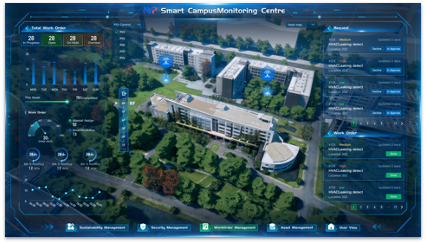
Digital twins create virtual replicas of physical buildings using real-time IoT sensor data, enabling “what-if” scenario planning, predictive maintenance, and operational optimization. They integrate data from BMS, CMMS, CAFM, and IoT devices into a unified 3D visualization.
Who Uses It
- Smart building initiatives at corporate campuses and commercial real estate portfolios
- Infrastructure operators managing airports, transit systems, utility grids
- Asset-intensive industries seeking predictive maintenance insights
- Early adopters in Fortune 500 facilities departments
Core Capabilities
- Real-time 3D building visualization with live sensor data overlays
- Predictive maintenance using AI analysis of equipment performance trends
- Energy optimization through simulation of HVAC/lighting scenarios
- Space utilization heat maps showing actual vs. planned occupancy
- Integration with BMS, CMMS, and IoT platforms
Market Adoption
According to Certis Solutions, “Digital twins are no longer confined to design and planning phases. They are now data-driven, automated, and operational systems that serve as a foundation for strategic infrastructure management.”
Research shows digital twins could improve operational efficiency by 20-30% on large infrastructure programs, and smart building upgrades can reduce maintenance costs by 20% while cutting energy use 20-30%.
Typical Cost
$50,000-500,000+ for initial digital twin creation; ongoing subscription $10,000-100,000+ annually depending on building size and data integration complexity.
When You Need It
If you’re managing 500,000+ square feet, spending $500,000+ annually on energy/maintenance, or pursuing smart building/ESG initiatives requiring detailed operational analytics, digital twins provide ROI.
Real-world indicator: Typically adopted by enterprise facilities with existing BMS/CMMS infrastructure seeking predictive insights and operational optimization.
Other Acronyms in the Ecosystem
ITSM (IT Service Management)
ServiceNow and similar platforms manage IT support tickets, asset tracking for computers/phones, and change management. ITSM overlaps with facilities when IT and operations teams share ticketing systems for workplace services (e.g., desk moves, AV equipment requests).
CPMS (Connected Portfolio Management System)
A term coined by Verdantix for next-generation platforms combining IWMS, IoT, and AI-powered analytics across real estate portfolios.
FM Software (Generic Facility Management Software)
An umbrella term often used interchangeably with CMMS or CAFM. When vendors say “FM software,” ask which category they actually fit. It’s marketing terminology, not a distinct product category.
SmartFM Platform
Marketing terminology for CMMS/CAFM platforms with IoT integration and mobile apps. No formal definition exists; evaluate based on actual feature sets rather than branding.
The Master Comparison Table
Here’s every platform type side-by-side:
| Category | Primary Focus | Typical Users | Organization Size | Typical Cost/User/Mo | Key Differentiator |
|---|---|---|---|---|---|
| CMMS | Maintenance tracking & PM scheduling | Facilities teams, maintenance staff | 1-50 buildings, 2-20 staff | $20-75 | Work order management |
| EAM | Full asset lifecycle management | Asset-intensive industries | Enterprise (1000+ assets) | $75-150+ | Financial integration & ROI optimization |
| CAFM | Space planning & workplace optimization | Real estate teams, space planners | 50,000+ sq ft or 5+ locations | $15-60 | Interactive floor plans & space analytics |
| IWMS | Enterprise-wide workplace integration | Multi-site enterprises, Fortune 1000 | 5+ locations, 100+ staff | $50-150+ | Unified real estate + maintenance + space |
| BMS | Building systems control & automation | Building operators, energy managers | 100,000+ sq ft buildings | $2-10/sq ft install | Real-time equipment control |
| iBMS | Intelligent cross-system automation | Smart building initiatives | Large campuses, critical facilities | +20-40% vs BMS | AI-driven automation & orchestration |
| Digital Twin | Virtual building replica with real-time data | Innovation teams, asset operators | 500,000+ sq ft portfolios | $50k-500k+ setup | Predictive analytics & simulation |
| ITSM | IT service desk & asset management | IT departments | Any size (IT-focused) | $20-100+ | IT asset lifecycle & ticketing |
How to Choose: Decision Framework
Here’s a practical decision tree based on your primary pain point:
Start With Your Biggest Problem
Problem: Maintenance is chaotic (missed PMs, lost work orders, no asset history) → Solution: CMMS → Learn how CMMS replaces spreadsheets
Problem: High real estate costs, unclear space utilization, hybrid workplace planning → Solution: CAFM → See how space optimization works
Problem: Need to justify asset purchases with ROI data, manage procurement integration → Solution: EAM → Understand EAM vs CMMS differences
Problem: Managing multiple sites with different systems, need enterprise visibility → Solution: IWMS → Explore enterprise facility management
Problem: High energy costs, need real-time building control and monitoring → Solution: BMS/iBMS → See smart building integration
Problem: Need predictive insights and operational optimization across large portfolio → Solution: Digital Twin Platform → Learn about digital twin capabilities
Organization Size Quick Reference
- 1-3 buildings, 1-5 maintenance staff: CMMS (consider affordable cloud options)
- 3-10 buildings, 5-20 staff: CMMS + mobile apps
- 10-50 buildings, dedicated facilities team: CMMS + CAFM (or light IWMS)
- 50+ buildings, enterprise scale: IWMS (with integrated maintenance, space, and real estate modules)
- Asset-intensive manufacturing/utilities: EAM (regardless of building count)
- Corporate real estate teams: CAFM (even if you outsource maintenance)
Budget Considerations
According to research, cloud adoption reached 76% in 2024, making software more affordable than ever. Here’s realistic budget planning:
Annual Software Budget Guidelines:
- CMMS: $2,000-20,000/year (10-20 users at $20-75/user/month)
- CAFM: $5,000-30,000/year (space management teams)
- EAM: $30,000-200,000+/year (enterprise asset teams)
- IWMS: $100,000-1M+/year (multi-site enterprises)
- BMS: $5,000-50,000/year licensing (plus $2-10/sq ft installation)
Don’t forget implementation costs: Plan 0.5-2x annual software cost for initial setup, training, and data migration. See total cost of ownership analysis.
Industry-Specific Recommendations
Education (Schools, Universities) → CMMS for maintenance tracking + CAFM for classroom/lab space allocation → See education facility management guide
Healthcare (Hospitals, Clinics) → CMMS with strong compliance features + BMS for environmental monitoring (OR suites, pharmacies) → Learn about healthcare maintenance
Hospitality (Hotels, Resorts) → CMMS for guest room maintenance + basic CAFM for event space management → See hotel maintenance systems
Manufacturing → EAM for production equipment lifecycle management → Explore manufacturing CMMS
Commercial Real Estate → CAFM for tenant space management + CMMS for building maintenance OR IWMS for portfolio-wide integration → See CRE facility management
Property Management (Strata, Condos) → CMMS with owner/tenant portal features → Learn about strata management
Government & Municipal → IWMS for multi-facility visibility + compliance reporting → See government facility systems
Data Centers → BMS/iBMS for 24/7 monitoring + CMMS for maintenance tracking + Digital Twin for predictive insights → Explore data center facilities management
The Honest Truth: Where Infodeck Fits
We’re Infodeck, a modern CMMS platform with IoT-native capabilities. Here’s our honest positioning:
Choose Infodeck if:
- You need work order management, PM scheduling, and asset tracking (core CMMS)
- You want IoT sensor integration without expensive bolt-on modules (we’re IoT-native)
- You manage 1-50 buildings with 2-100 maintenance staff
- You need mobile apps for technicians working in the field
- Your budget is $2,000-30,000/year for facilities software
Choose something else if:
- You need space planning and floor plan visualization → Consider CAFM (or IWMS if enterprise)
- You need full asset lifecycle with financial/procurement integration → Consider EAM
- You manage 100+ locations requiring enterprise integration → Consider IWMS
- You need real-time equipment control and automation → Consider BMS (which can integrate with CMMS)
We won’t try to sell you features you don’t need. If you’re reading this guide because your maintenance is chaotic, work orders are on sticky notes, and PMs are forgotten, start a free trial of Infodeck CMMS. If you need more than maintenance management, we’ll help you find the right solution.
The Evolution: How Categories Are Blurring
Here’s an important insight: Traditional category boundaries are dissolving. Modern platforms increasingly cross traditional lines:
IoT-Native CMMS → Includes capabilities traditionally requiring BMS integration Our IoT integration guide explains how sensor data flows directly into work orders without separate BMS platforms.
Smart CAFM → Adds maintenance modules that overlap with CMMS Space management platforms now include basic work order tracking for facilities requests.
PropTech Platforms → Combine elements of CMMS, CAFM, tenant portals, and IoT Modern PropTech solutions integrate formerly separate categories.
IWMS Vendors → Offering “IWMS Lite” versions competing with standalone CMMS/CAFM Enterprise platforms now sell modular implementations that start at CMMS scale.
The takeaway: Don’t get too caught up in acronym purity. Focus on:
- Core capabilities you need today (work orders? space planning? enterprise integration?)
- Growth path for tomorrow (will you scale to multiple sites? add space management?)
- Integration requirements (does it connect with your BMS, ERP, or other systems?)
Our vendor selection guide walks through evaluation criteria beyond category labels.
Common Implementation Mistakes to Avoid
After reviewing hundreds of facility management software implementations, we’ve seen these patterns:
Mistake 1: Buying Too Much Software Too Soon
What happens: Organizations buy IWMS for 5 buildings because a vendor convinces them they’ll “grow into it.” Reality: They use 20% of features, overwhelm staff with complexity, and abandon the system within 18 months. Fix: Start with CMMS, prove ROI, then scale up if needed. See change management guide.
Mistake 2: Treating Software as the Solution (Not a Tool)
What happens: Leadership expects software to “fix maintenance” without process improvements or staff training. Reality: Bad processes digitized = faster bad processes. Software amplifies your existing systems, good or bad. Fix: Document current workflows, identify improvement opportunities, then configure software to support better processes.
Mistake 3: Ignoring Mobile Requirements
What happens: Desktop-only systems are selected because they’re cheaper or familiar to office staff. Reality: Technicians work in the field, not at desks. They stop using software that requires returning to an office to update work orders. Fix: Prioritize mobile-first CMMS with offline capabilities and photo documentation.
Mistake 4: Underestimating Data Migration
What happens: Organizations assume they can “just import” years of spreadsheet data or legacy system records. Reality: 40-60% of implementation time goes to data cleanup, standardization, and migration. Garbage in = garbage out. Fix: Plan 3-6 months for data cleanup. Start with critical assets, not comprehensive historical data. See data quality guide.
Mistake 5: Skipping the IT-Operations Alignment Conversation
What happens: IT selects software based on technical specs; Operations complains it doesn’t meet workflow needs. Reality: Facilities software sits at the intersection of IT and operations. Both need input. Fix: Establish IT-Operations governance early with clear decision-making authority.

Implementation Roadmap: What to Expect
Realistic timelines by software category:
CMMS Implementation
- Phase 1 (Months 1-2): Software selection, vendor demos, contract
- Phase 2 (Months 2-4): Data migration, configuration, pilot testing
- Phase 3 (Months 4-6): Staff training, full rollout, refinement
- Total: 4-6 months to full adoption
CAFM Implementation
- Phase 1 (Months 1-3): Floor plan digitization, space data collection
- Phase 2 (Months 3-6): Software configuration, reservation system setup
- Phase 3 (Months 6-9): Integration with HR/badge systems, user training
- Total: 6-9 months to full adoption
EAM Implementation
- Phase 1 (Months 1-4): ERP integration planning, asset data audit
- Phase 2 (Months 4-9): System configuration, financial integration
- Phase 3 (Months 9-15): Phased rollout by site/department, process optimization
- Total: 12-18 months to enterprise-wide adoption
IWMS Implementation
- Phase 1 (Months 1-6): Requirements gathering across facilities/real estate/finance
- Phase 2 (Months 6-12): Module configuration (real estate, space, maintenance, projects)
- Phase 3 (Months 12-24): Phased rollout, integration with ERP/financial systems
- Total: 18-24+ months to full enterprise adoption
BMS Installation
- Phase 1 (Months 1-3): System design, hardware procurement
- Phase 2 (Months 3-9): Installation, sensor/controller setup, commissioning
- Phase 3 (Months 9-12): Integration with CMMS/IWMS, optimization
- Total: 9-12 months for large buildings
See our implementation checklist for detailed planning.
ROI Expectations by Platform Type
What kind of return can you expect? Here’s data from IFMA research and vendor case studies:
CMMS ROI
- 15-25% reduction in reactive maintenance (shift to preventive)
- 10-20% labor productivity improvement (mobile access, automated scheduling)
- 5-15% reduction in equipment downtime
- Payback period: 6-18 months
- Calculate your CMMS ROI
CAFM ROI
- 15-30% space utilization improvement (identify underutilized areas)
- 10-25% reduction in real estate costs (space consolidation opportunities)
- 20-40% faster space allocation and move management
- Payback period: 12-24 months
EAM ROI
- 20-35% reduction in asset lifecycle costs (optimized replacement timing)
- 15-25% improvement in asset uptime
- 10-20% reduction in spare parts inventory costs
- Payback period: 18-36 months
IWMS ROI
- 15-25% operational cost reduction across facilities portfolio
- 20-30% improvement in compliance reporting efficiency
- 10-20% reduction in real estate costs (portfolio optimization)
- Payback period: 24-48 months
BMS/iBMS ROI
- 20-30% energy cost reduction (verified by research)
- 15-25% reduction in HVAC maintenance costs (early fault detection)
- 20% reduction in maintenance costs with smart building upgrades
- Payback period: 3-7 years (higher upfront cost, long-term savings)
Digital Twin ROI
- 20-30% operational efficiency improvement (infrastructure research)
- 15-25% reduction in unplanned downtime (predictive maintenance)
- 10-20% energy optimization beyond standard BMS
- Payback period: 3-5+ years (requires mature data infrastructure)
The Regional Perspective
Software adoption varies significantly by region:
North America
- Mature CMMS market, high cloud adoption (76%)
- Growing IWMS adoption in enterprise facilities
- Strong focus on compliance (OSHA, EPA) features
- See North American compliance requirements
Europe
- Emphasis on energy management and sustainability (IWMS/BMS integration)
- BMS mandatory for large buildings (EU regulations from 2025)
- Strong CAFM adoption for space optimization
- Digital twin early adopters in smart cities
Asia-Pacific
- Rapid smart building adoption (Singapore, Hong Kong, Japan lead)
- Growing CMMS adoption in emerging markets (SEA)
- Strong mobile-first requirements for distributed facilities teams
- See Asia-Pacific regional guides
Middle East
- Focus on district cooling and energy management (BMS priority)
- Large-scale developments driving IWMS adoption
- See Middle East facility management
Future Trends: What’s Next for 2026-2030
Based on IFMA research and market analysis:
AI Adoption Acceleration Currently, 59.1% of facility managers report no AI strategy. By 2028, AI-powered predictive maintenance will be standard in CMMS/EAM platforms, not a premium feature.
Category Convergence Expect “CMMS with CAFM-lite” and “CAFM with maintenance modules” to blur distinctions. The question won’t be “Which category?” but “Which capabilities do I need?”
IoT-Native Becomes Default By 2027-2028, IoT sensor integration will be standard in CMMS (not bolt-on). IoT-native platforms will replace legacy “CMMS + integration middleware” architectures.
Mobile-First Architecture Desktop-optional, mobile-first CMMS will become the norm. Technicians expect consumer-app experiences. Mobile capabilities will differentiate vendors.
Subscription Fatigue Backlash As organizations manage 17+ workplace software subscriptions, consolidation pressure will favor platforms with broader capabilities (IWMS-lite, integrated CMMS+CAFM).
ESG Reporting Integration Sustainability tracking will become mandatory in IWMS/BMS. Expect carbon footprint calculation, energy benchmarking, and ESG compliance reporting as standard features.
Frequently Asked Questions (Extended)
Can I start with CMMS and upgrade to IWMS later?
Yes, this is a common path. Many organizations start with standalone CMMS, prove ROI, then either integrate CMMS with CAFM or migrate to IWMS as they scale. Look for CMMS vendors with upgrade paths or open APIs for future integration.
Do I need both BMS and CMMS?
If you have a BMS, you should also have CMMS. They’re complementary: BMS monitors and controls equipment in real-time; CMMS manages the maintenance activities for that equipment. Modern platforms integrate via API so BMS alarms automatically generate CMMS work orders.
What if I’m only managing 1-2 buildings?
Start with cloud CMMS. Even small facilities benefit from organized work orders, PM tracking, and mobile access. Affordable CMMS options start at $2,000-5,000/year and pay for themselves in prevented breakdowns and compliance readiness.
Is “free CMMS” really free?
No. Free CMMS platforms typically limit users, features, or data storage, then charge for essentials like mobile apps, reporting, or integrations. Budget $20-50/user/month for production-ready CMMS with full capabilities.
How long until I see ROI?
CMMS typically pays back in 6-18 months through reduced reactive maintenance and labor efficiency. Larger platforms (EAM, IWMS) take 18-48 months due to higher implementation costs but deliver larger portfolio-wide savings.
Should IT or Operations own facility management software?
Both. IT-Operations governance is critical. IT handles security, infrastructure, integrations; Operations defines workflows, reports, and feature requirements. Establish joint decision-making from day one.
Taking the Next Step
If you’ve made it this far, you now speak fluent “facility management software.” Here’s your action plan:
Step 1: Identify Your Primary Need
- Maintenance chaos → CMMS
- Space costs/utilization → CAFM
- Asset ROI/lifecycle → EAM
- Multi-site enterprise integration → IWMS
- Energy costs/building control → BMS
- Predictive insights → Digital Twin
Step 2: Set a Realistic Budget
- CMMS: $2,000-20,000/year (small-mid size)
- CAFM: $5,000-30,000/year (corporate space teams)
- EAM: $30,000-200,000+/year (asset-intensive)
- IWMS: $100,000-1M+/year (enterprise)
- BMS: $5,000-50,000/year + installation
- Add 0.5-2x first-year cost for implementation
Step 3: Get Your Team Aligned
- Facilities leadership defines operational requirements
- IT reviews security, infrastructure, integration needs
- Finance approves budget and ROI expectations
- Establish governance structure
Step 4: Vendor Evaluation
- Demo 3-5 vendors in your category
- Test mobile app (if CMMS) or space visualization (if CAFM)
- Request customer references in your industry
- Use our vendor selection checklist
Step 5: Plan for Change Management
Software doesn’t fail. Change management fails. Budget time for:
- Staff training (2-4 weeks)
- Process documentation
- Data migration (3-6 months)
- See change management guide
Ready to Start with CMMS?
If you’ve identified CMMS as your starting point, welcome. Most organizations reading this guide need modern, mobile-first CMMS with IoT capabilities, not enterprise IWMS or complex EAM systems.
Infodeck is a modern CMMS platform built for facilities teams managing 1-50 buildings:
- Work order management with mobile apps for technicians
- Preventive maintenance scheduling (time-based and meter-based)
- Asset tracking and maintenance history with QR code scanning
- IoT sensor integration (native, not bolt-on)
- Inventory management for spare parts and tools
Try Infodeck free for 30 days - no credit card required:
We won’t try to sell you features you don’t need. If CAFM or IWMS is the better fit, we’ll tell you.
Sources
- Eptura: Differences Between EAM, CMMS, IWMS and CAFM
- Accruent: CMMS, CAFM and EAM Guide
- Global Facility Management Software Market Report 2026-2033
- Gartner Peer Insights: Enterprise Asset Management Software Reviews
- IFMA: Challenges Facing Facility Managers in 2025
- ServiceNow: What is IWMS?
- i-scoop: Integrated Building Management and BMS Systems Explained
- Infraspeak: What is a Building Management System (BMS)?
- Wikipedia: Computer-aided Facility Management
- IBM: What Is Computer-Aided Facility Management (CAFM)?
- Certis Solutions: How Digital Twins Are Transforming Infrastructure in 2026
- Matterport: Digital Twin Facility Management
- Buildings Magazine: Spatial Digital Twins Redefine Facility Management
- Camcode: CMMS vs. EAM - Which One is Right for Your Business?
- eFacility: Difference Between CMMS, EAM, CAFM, IWMS Software


