

Key Takeaways
- Organizations using CMMS analytics report 25-35% better resource allocation by identifying patterns in work order data
- The five essential maintenance KPIs every dashboard needs: MTBF, MTTR, PM compliance rate, backlog ratio, and cost per asset
- Trending analysis on work order completion times reveals systemic issues like training gaps or parts availability problems
- Asset performance scoring combines failure frequency, repair cost, and downtime to prioritize replacement decisions
- Scheduled automated reports eliminate hours of manual data compilation and ensure stakeholders get consistent metrics
Modern CMMS platforms capture thousands of data points every day. Every work order closed, preventive maintenance task completed, and part requisitioned generates valuable information. Yet despite this wealth of data, many maintenance teams struggle to extract actionable insights. The gap between data collection and decision-making costs organizations millions in missed optimization opportunities. CMMS analytics and maintenance reporting bridge this gap, transforming raw operational data into strategic intelligence that drives measurable improvements.
Organizations that master CMMS data analytics report 25-35% better resource allocation by identifying patterns invisible to manual tracking methods. According to UpKeep’s 2024 State of Maintenance Report, around 70% of plants have implemented CMMS or EAM systems, with PM completion being the most commonly tracked KPI used by 56% of facilities. They catch asset degradation trends months before failures occur. They optimize technician schedules based on actual workload patterns rather than assumptions. Most importantly, they make evidence-based decisions about capital investments, staffing levels, and preventive maintenance strategies.
This comprehensive guide covers the essential framework for turning maintenance data into decisions. You’ll learn which KPIs matter most, how to build effective dashboards, what analytics reveal about operational health, and how to establish reporting rhythms that keep stakeholders informed without drowning them in numbers.
Why Most Maintenance Teams Are Data-Rich But Insight-Poor
The paradox of modern maintenance management is that organizations have more data than ever before yet struggle to answer basic strategic questions. Can we defer this capital project another year? Are we overstaffed or understaffed? Which assets are costing us the most? Why did our reactive maintenance spike last quarter?
The reporting gap stems from three fundamental problems. First, data lives in disconnected systems. Work order information sits in the CMMS. Energy consumption data comes from the building automation system. Parts inventory exists in a separate procurement platform. Without integration, building a complete operational picture requires hours of manual data extraction and spreadsheet wrangling.
Second, spreadsheet-based reporting doesn’t scale. The facilities manager who maintains a monthly Excel dashboard spends 6-8 hours compiling data from various sources, standardizing formats, updating formulas, and generating charts. This manual process is error-prone, time-consuming, and impossible to perform in real-time. By the time the report reaches stakeholders, the data is already outdated.
Third, many teams track activities rather than outcomes. They report how many work orders were completed or how many PMs were scheduled without connecting those activities to business impact. Did completing 847 work orders last month improve equipment uptime? Did the 94% PM compliance rate reduce emergency breakdowns? Without outcome-focused analytics, maintenance remains a cost center rather than a value driver.
The transition from data-rich to insight-rich requires three foundational shifts. Centralize data capture in a single CMMS platform with integrated modules for work orders, assets, inventory, and scheduling. Automate report generation so insights are available on-demand rather than monthly. Focus metrics on business outcomes like uptime, total cost of ownership, and risk mitigation rather than activity counts.
The Five Essential Maintenance KPIs
Effective maintenance reporting starts with tracking the right metrics. While dozens of KPIs exist, five core indicators provide comprehensive insight into operational health. These metrics form the foundation of every maintenance dashboard.
Mean Time Between Failures (MTBF) measures reliability. Calculate it as total operating hours divided by number of failures during a period. If a pump operates 8,760 hours per year with 4 failures, MTBF is 2,190 hours. Higher MTBF indicates better reliability. Industry benchmarks vary by asset type, but declining MTBF trends signal degradation requiring intervention. Track MTBF at the asset level to identify chronic problem equipment and at the system level to measure overall program effectiveness.
Mean Time To Repair (MTTR) measures efficiency. Calculate it as total repair time divided by number of repairs. If those 4 pump failures required 2, 3.5, 4, and 2.5 hours to fix, MTTR is 3 hours. Lower MTTR indicates efficient repair processes. MTTR trends reveal technician skill levels, parts availability issues, and equipment complexity problems. World-class maintenance organizations achieve MTTR under 2 hours for common equipment through standardized repair procedures and strategic spare parts inventory.
Preventive Maintenance Compliance Rate measures program discipline. Calculate it as PM tasks completed on schedule divided by total scheduled PM tasks, multiplied by 100. If you scheduled 400 PMs last month and completed 368 on time, compliance is 92%. Industry benchmark is 90% or higher. Compliance below 80% indicates resource constraints, scheduling problems, or poor work prioritization. Track compliance by asset class to identify which equipment types are being neglected.
Backlog Ratio measures workload health. Calculate it as total estimated hours for open work orders divided by total available technician hours per week. If you have 320 hours of backlog and 4 technicians working 40 hours weekly, backlog ratio is 2 weeks. Healthy backlog is 1-2 weeks. Under 1 week suggests overstaffing or insufficient work planning. Over 4 weeks indicates understaffing or inefficient work processes. Monitor backlog ratio by priority level to ensure emergency and urgent work isn’t accumulating.
Cost Per Asset measures financial efficiency. Calculate total maintenance cost (labor, parts, contractor services) divided by number of assets maintained. If annual maintenance spending is $1.2 million for 400 assets, cost per asset is $3,000. Track this metric over time to identify cost inflation trends and compare it against asset replacement value to inform capital planning decisions. When maintenance cost exceeds 50-60% of asset replacement value annually, replacement becomes more economical than continued repairs.
Here’s how these KPIs work together to provide operational insight:
| KPI | Calculation | Good Range | What It Reveals |
|---|---|---|---|
| MTBF | Operating hours / Number of failures | Varies by asset; trend more important | Equipment reliability |
| MTTR | Total repair time / Number of repairs | Under 4 hours for most equipment | Repair efficiency |
| PM Compliance | (On-time PMs / Scheduled PMs) x 100 | 90% or higher | Program discipline |
| Backlog Ratio | Open work hours / Weekly technician hours | 1-2 weeks | Resource adequacy |
| Cost Per Asset | Total maintenance cost / Number of assets | Varies by industry | Financial efficiency |
Modern CMMS platforms calculate these KPIs automatically from work order data. The real value comes from tracking trends over time and drilling down into anomalies. When MTBF drops for a specific asset class, investigate root causes. When MTTR increases, analyze what changed in repair processes or parts availability. When PM compliance falls, examine scheduling practices and resource allocation.

Work Order Analytics: Beyond Counting Tickets
Work orders are the operational heartbeat of maintenance management. Every request, every completed task, every hour logged generates data that reveals patterns about equipment health, resource utilization, and process efficiency. Yet most organizations only scratch the surface of work order analytics, reporting simple counts and averages that miss the deeper insights.
Completion time trending reveals systemic issues invisible to averages. Your average work order completion time might be 4.2 hours, which seems reasonable. But plot completion times on a trend chart and you might discover that HVAC work orders consistently take 6-8 hours while electrical work averages 2 hours. This pattern suggests skill gaps in HVAC maintenance or more complex equipment issues requiring deeper investigation. Trending also exposes seasonal patterns. If completion times spike every summer, you might need temporary staffing during peak cooling season.
Response time analysis measures how quickly maintenance responds after requests are submitted. Calculate it as the time between work order creation and first technician action. Industry best practice is under 30 minutes for emergencies, under 4 hours for urgent requests, and under 24 hours for routine work. Track response times by priority level and location. Facilities farther from the maintenance shop typically show longer response times, suggesting the need for distributed parts storage or zone-based technician assignments.
Category and cause code analysis uncovers recurring problems. If “HVAC - No Cooling” appears 47 times in quarterly data, you have a systemic issue requiring investigation. Are filters not being changed on schedule? Is the chiller undersized? Are occupants adjusting thermostats inappropriately? Drill down into work order descriptions and technician notes to identify root causes. The work order management module should categorize every request using standardized taxonomies that enable this analysis.
Repeat work order detection identifies incomplete repairs. When the same asset generates multiple work orders for similar problems within 30 days, something went wrong with the initial repair. Either the technician misdiagnosed the problem, installed a defective part, or addressed symptoms rather than root causes. Flag repeat work orders automatically and route them to senior technicians for quality assurance review.
Emergency vs. planned work ratio measures program maturity. Calculate the percentage of total work orders classified as emergencies. World-class maintenance organizations operate with under 20% emergency work. If your ratio exceeds 40%, your preventive maintenance program isn’t preventing failures. This metric directly correlates with maintenance costs since emergency repairs typically cost 3-5 times more than planned maintenance due to overtime, expedited parts shipping, and productivity disruptions. Research from MaintainX’s maintenance KPI guide shows that 41% of plants allocate more than 10% of their annual operating budget to maintenance tasks and services.
Work order aging analysis prevents backlog accumulation. Generate a report showing open work orders grouped by age: 0-7 days, 8-14 days, 15-30 days, 31-60 days, over 60 days. Healthy maintenance operations have most work orders in the 0-7 day bucket with minimal accumulation in older categories. Work orders sitting open for over 60 days often indicate parts availability problems, scope uncertainties, or deferred maintenance decisions that should be explicitly addressed rather than lingering in indefinite backlog.
Download the Full Report
Get the complete State of Maintenance 2026 report with all benchmark data and implementation frameworks.
Download Free ReportSee It In Action
Ready to join the facilities teams achieving 75% less unplanned downtime? Start your free 30-day trial.
Start Free TrialAsset Performance Scoring and Lifecycle Analytics
Individual work orders tell stories about specific failures. Asset-level analytics reveal the bigger picture of equipment health, total cost of ownership, and optimal replacement timing. This perspective shift from tasks to assets enables strategic capital planning and preventive maintenance optimization.
Failure frequency tracking identifies chronic problem equipment. Generate a report showing failure counts by asset for the past 12 months. Assets with 6-plus failures annually are candidates for replacement evaluation or preventive maintenance intensification. But frequency alone doesn’t tell the complete story. A printer that jams weekly creates frustration but minimal cost. A boiler that fails twice annually could represent hundreds of thousands in emergency repair costs and facility disruption.
Repair cost trending adds financial perspective. Calculate cumulative maintenance cost per asset over rolling 12-month periods. Plot this as a trend line showing whether maintenance costs are stable, increasing, or decreasing. Increasing cost trends signal equipment degradation requiring capital planning attention. Compare maintenance cost against asset replacement value to calculate the maintenance-to-replacement ratio. When this ratio exceeds 50% annually, replacement typically becomes more economical than continued repairs.
Downtime impact analysis quantifies operational consequences. For each asset failure, record downtime duration and affected operations. An elevator failure in a 20-story office building affects hundreds of occupants and violates accessibility requirements. A redundant pump failure might have zero downtime impact if the backup operates without interruption. Multiply downtime hours by operational impact scoring to create weighted downtime metrics that prioritize assets by business criticality rather than maintenance frequency alone.
Asset performance scoring combines multiple factors into a single health indicator. Create a scoring algorithm that weights failure frequency, repair costs, downtime impact, age, and condition assessment ratings:
Asset Score = (40% x Failure Score) + (30% x Cost Score) +
              (20% x Downtime Score) + (10% x Age Score)

Where each component is scaled 0-100 (lower is worse)
Assets scoring below 40 are red-flagged for immediate replacement consideration. Scores between 40-60 warrant enhanced preventive maintenance. Scores above 60 indicate healthy assets requiring only standard PM. This scoring methodology enables objective prioritization of limited capital budgets based on data rather than loudest complaints or newest equipment.
Lifecycle cost projection informs long-term capital planning. For each major asset class, model expected maintenance costs over remaining useful life based on historical patterns and industry benchmarks. A 15-year-old roof might have 10 years of remaining life but require increasing annual repairs. Project those repair costs forward and compare the total to replacement cost. Often the breakeven point arrives earlier than expected, justifying proactive replacement that avoids emergency failures during peak weather conditions.
The asset tracking capabilities in modern CMMS platforms capture all the data required for these analyses automatically. Every work order links to an asset record. Every parts transaction updates asset cost history. Every PM completion adds to lifecycle documentation. The analytics simply surface patterns already present in your operational data.
Technician and Resource Analytics
Maintenance effectiveness depends on people as much as equipment. Technician analytics reveal workload distribution, skill utilization, productivity patterns, and training needs that directly impact service delivery quality and operational costs.
Workload distribution analysis ensures balanced task assignment. Generate a report showing total work order hours assigned to each technician over the past month. Ideally, workload varies by no more than 10-15% between team members. If one technician is assigned 180 hours while another has 120 hours, investigate why.
Completion rate tracking measures individual productivity. Calculate the percentage of assigned work orders completed on time by each technician. World-class performers achieve 95%-plus on-time completion. Rates below 80% indicate problems requiring investigation.
Skill utilization analysis optimizes talent deployment. Tag each work order with required skill categories: HVAC, electrical, plumbing, carpentry, general maintenance. Then analyze what percentage of each technician’s time aligns with their primary skills versus working outside their expertise. A certified electrician spending 40% of time on general maintenance represents underutilized expertise.
Overtime pattern analysis identifies workload problems before they create burnout. Generate a monthly report showing overtime hours by technician. Occasional overtime during emergencies is normal. Consistent overtime suggests chronic understaffing or poor work planning.
First-time fix rate measures diagnostic accuracy and preparedness. Calculate the percentage of work orders completed in a single visit without follow-up trips. Industry benchmark is 80% or higher. Low first-time fix rates indicate technicians lack diagnostic tools, don’t have necessary parts on hand, or need additional training.
Contractor vs. in-house analysis informs staffing strategy. Calculate what percentage of maintenance work (by hours and by cost) is performed by contractors versus in-house staff. If 30% of your maintenance budget goes to HVAC contractors, consider whether hiring an in-house HVAC specialist would be more cost-effective.
Resource analytics become especially powerful when combined with work order and asset analytics. If specific assets consistently require longer repair times, provide technicians with specialized training for those equipment types. If workload spikes occur during certain seasons, plan staffing adjustments or contractor support in advance.
Cost Analytics: From Reactive to Strategic
Maintenance departments are often viewed as cost centers rather than value creators. Cost analytics change this perception by connecting maintenance spending to business outcomes and revealing the financial impact of operational decisions.
Reactive vs. preventive cost ratio is the single most important financial metric. Calculate total spending on emergency and corrective maintenance divided by total spending on preventive maintenance. Industry best practice is a 40:60 or 30:70 ratio. If you’re spending 70% on reactive work and only 30% on preventive work, you’re trapped in a breakdown maintenance cycle that costs 2-3 times more than necessary. Each 10% shift from reactive to preventive typically reduces total maintenance costs by 5-8%. According to WorkTrek’s maintenance cost statistics, organizations using data-driven maintenance reporting see significant reductions in unplanned downtime and emergency repair expenses.
Cost per square meter enables facility benchmarking. Calculate total annual maintenance spending divided by facility square meters. Industry benchmarks vary significantly by facility type:
| Facility Type | Annual Maintenance Cost per Sq Meter |
|---|---|
| Office buildings | $15-25 |
| Healthcare facilities | $40-60 |
| Manufacturing plants | $25-40 |
| Educational institutions | $20-35 |
If your costs significantly exceed benchmark ranges, investigate whether you have aging equipment requiring replacement, inefficient maintenance processes, or costs that should be allocated to other departments.
Budget variance analysis tracks spending against projections. Generate monthly reports comparing actual spending to budgeted amounts by category: labor, parts, contractors, utilities, capital improvements. Variances exceeding 10% require investigation.
Cost avoidance tracking measures preventive maintenance value. When preventive maintenance identifies developing problems before failure, estimate the avoided emergency repair cost. Track these cost avoidance events monthly and sum them annually. Organizations with mature PM programs typically document cost avoidance 2-3 times higher than preventive maintenance spending, providing powerful budget justification.
Total Cost of Ownership (TCO) analysis informs capital planning decisions. For major equipment decisions, calculate TCO over expected asset life:
TCO = Purchase Price + Installation Cost +
      (Annual Maintenance x Years) +
      (Annual Energy Cost x Years) +
      Disposal Cost - Salvage Value
The CMMS ROI calculation becomes straightforward when you have accurate cost analytics. Track baseline metrics before CMMS implementation, then measure improvement in reactive maintenance costs, overtime spending, parts inventory carrying costs, and equipment uptime. Most organizations achieve CMMS ROI within 6-12 months through operational efficiency gains and reduced emergency spending.
Download the Full Report
Get 100+ data points, verifiable sources, and actionable frameworks in a single PDF.
Get the ReportSee It In Action
Watch how facilities teams achieve 75% less unplanned downtime with Infodeck.
Book a DemoBuilding Effective CMMS Dashboards
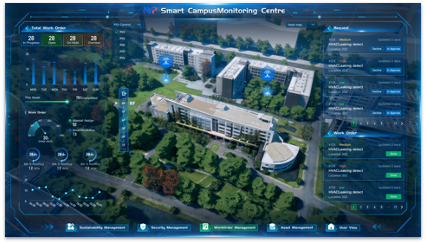
The best analytics are useless if they’re not accessible to decision-makers when decisions need to be made. Effective dashboards transform raw CMMS data into visual insights that drive immediate action and strategic planning.
Real-time vs. periodic reporting serves different needs. Real-time dashboards display current operational status: open emergency work orders, today’s completed PMs, current technician locations, assets down for repair. Facilities managers check real-time dashboards multiple times daily to manage immediate operations. Periodic dashboards show trends and patterns: monthly KPI performance, quarterly cost analysis, year-over-year comparisons. Senior leadership reviews periodic dashboards during strategic planning sessions.
Role-based dashboard design ensures users see relevant information. A maintenance technician dashboard emphasizes their assigned work orders, parts availability, and asset history. A facilities manager dashboard highlights team workload, PM compliance, and open work order aging. An executive dashboard focuses on financial metrics, key performance trends, and risk indicators.
Visualization best practices make data instantly comprehensible:
- Gauges: Single KPI value compared to target (PM compliance: 92% vs 90% target)
- Trend lines: Changes over time (MTTR trending down over 6 months)
- Bar charts: Comparisons between categories (maintenance cost by building)
- Pie charts: Distribution across categories (work orders by priority level)
- Heat maps: Patterns across two dimensions (work orders by day of week and hour)
- Pareto charts: Identifying vital few from trivial many (80% of failures come from 20% of assets)
Dashboard layout hierarchy guides the eye to most important information. Place critical metrics in the top-left corner where eyes naturally land. Use color strategically: red for alerts requiring immediate attention, yellow for warnings trending negative, green for metrics meeting targets. Avoid cluttered dashboards with 20-plus widgets competing for attention.
Drill-down capability enables root cause investigation. A dashboard showing 68% PM compliance is concerning. Click that metric to see PM compliance by asset class and discover that HVAC is at 45% while other categories exceed 90%. Click HVAC to see which specific assets are missing PMs. This investigative path transforms surface-level dashboard alerts into actionable work plans.
Dashboard examples for different roles:
Maintenance Technician Dashboard:
- My open work orders (by priority)
- Today’s PM schedule
- Parts on order for my jobs
- Recent work history for currently assigned assets
Facilities Manager Dashboard:
- Open work order summary by priority and age
- Today’s PM completion status
- Technician workload distribution
- Emergency work order trending (past 30 days)
- Budget spending vs. plan (monthly)
- Top 10 assets by maintenance cost (YTD)
Executive Dashboard:
- Reactive vs. preventive maintenance ratio
- Total maintenance cost trending
- Critical equipment uptime percentage
- PM compliance rate
- Deferred maintenance backlog value
Modern CMMS platforms include dashboard builders that let you create custom views without programming. But effective dashboards require clear thinking about what decisions each role makes and what information drives those decisions.

Automated Reporting and Stakeholder Communication
Manual report generation consumes hours that could be spent improving operations. Automated reporting ensures stakeholders receive consistent, timely information while freeing maintenance leaders to focus on strategic activities.
Scheduled report distribution eliminates manual report creation. Configure your CMMS to automatically generate and email reports on defined schedules:
- Daily: Emergency work order summary (emailed to facilities manager by 8 AM)
- Weekly: PM completion status, technician workload summary (Monday morning)
- Monthly: KPI dashboard, cost summary, asset performance report (first business day of month)
- Quarterly: Comprehensive operations review, budget variance analysis (within 5 days of quarter end)
- Annually: Year-in-review summary, capital planning recommendations (January)
Executive summary formats communicate with senior leadership effectively. Executives don’t need raw data or detailed charts. They need high-level insights and recommended actions. Design executive summaries that fit on one page:
- Overall Status: Green/Yellow/Red indicator with brief explanation
- Key Metrics: 3-5 critical KPIs with trend indicators (up/down arrows)
- Notable Issues: 2-3 problems requiring attention or decisions
- Wins: 1-2 positive developments or improvements
- Requests: Specific decisions or resources needed
Narrative context transforms numbers into stories. Instead of just showing “Backlog reduced from 3.2 weeks to 1.8 weeks,” add narrative: “We reduced backlog by 44% through improved work planning and strategic parts inventory investments. This means faster response to your requests and fewer disruptions from emergency repairs.” Context helps non-technical stakeholders understand what metrics mean for their experience.
Feedback loops close the communication circle. After distributing reports, create opportunities for stakeholders to ask questions and provide input. Host monthly operations reviews where department heads can discuss maintenance priorities. This two-way communication reveals whether your reporting actually meets stakeholder information needs or requires adjustment.
From Data to Action: Making Analytics Drive Decisions
Analytics generate insights. Insights enable better decisions. But insights alone don’t improve operations. Organizations that successfully use CMMS analytics establish systematic processes that turn data into action.
Decision frameworks structure how analytics inform choices. When evaluating whether to repair or replace equipment, use a standardized decision tree:
- Is the equipment failure imminent or already occurred?
- What is the current maintenance-to-replacement ratio?
- How many years of expected remaining useful life?
- Is the equipment mission-critical?
- Are parts still available and supported?
- Does replacement offer energy or operational efficiency gains?
Answer these questions using CMMS data on failure history, repair costs, asset age, and downtime impact.
Continuous improvement loops ensure insights lead to action. Establish monthly operations reviews following this structure:
- Review KPIs: What changed from last month? Are trends positive or negative?
- Investigate anomalies: Why did this metric spike or drop significantly?
- Identify root causes: What operational factors drove the changes?
- Determine actions: What specific changes will address problems?
- Assign ownership: Who will implement each action by when?
- Track follow-up: Review action items from last month’s meeting
Predictive analytics moves from reactive to proactive decision-making. Once you have 12-plus months of historical data, identify patterns that predict future problems. If air handler failures always increase in August and September due to cooling season stress, schedule additional preventive inspections in July. Pattern recognition enables intervention before failures occur. Industry research from eMaint’s KPI guide demonstrates that facilities tracking three to five critical KPIs like OEE, MTBF, and planned maintenance percentage avoid data overload while maintaining comprehensive performance visibility.
Benchmarking provides external perspective. Compare your maintenance KPIs against industry standards published by SMRP (Society for Maintenance and Reliability Professionals) and IFMA (International Facility Management Association). If your MTTR is 6 hours while industry median is 3.5 hours, investigate why. External benchmarks reveal blind spots that internal trending alone might miss.
According to research from Deloitte on maintenance analytics, facilities using advanced CMMS analytics report:
- 25-35% reduction in maintenance costs
- 35-45% reduction in equipment downtime
- 20-30% increase in asset lifespan
- 40-50% improvement in maintenance planning accuracy
These improvements don’t come from analytics alone. They come from decisions informed by analytics, actions taken based on insights, and continuous refinement based on measured outcomes.
CMMS data analytics and maintenance reporting transform maintenance from a reactive cost center into a strategic asset management function. The five essential KPIs provide foundational insight into operational health. Work order analytics reveal patterns driving service delivery. Asset performance scoring guides capital planning decisions. Technician analytics optimize resource deployment. Cost analytics connect spending to business outcomes. Effective dashboards make insights accessible to decision-makers at every level.
The journey from data-rich to insight-rich requires three commitments. First, centralize operational data in a comprehensive CMMS platform that integrates work orders, assets, inventory, and scheduling. Second, define the specific decisions that analytics should inform and design dashboards that support those decisions. Third, establish organizational discipline around regular review, root cause investigation, and evidence-based action.
Start your free trial to experience how Infodeck’s analytics and reporting capabilities transform maintenance data into actionable intelligence that drives operational excellence.


