
Start here
The short version
Short answer: Learn how CMMS software helps data center facilities teams manage cooling systems, power infrastructure, and compliance with 99.999% uptime requirements.
What to check as you read
- Data center maintenance demands 99.999% uptime, requiring redundant systems and zero-tolerance maintenance protocols
- CMMS integration with DCIM and BMS platforms creates unified visibility across power, cooling, and IT infrastructure
- Cooling system maintenance represents 40% of data center operational costs and is the leading cause of unplanned outages
- Compliance frameworks including SOC 2, ISO 27001, and Uptime Institute tiers mandate documented maintenance procedures
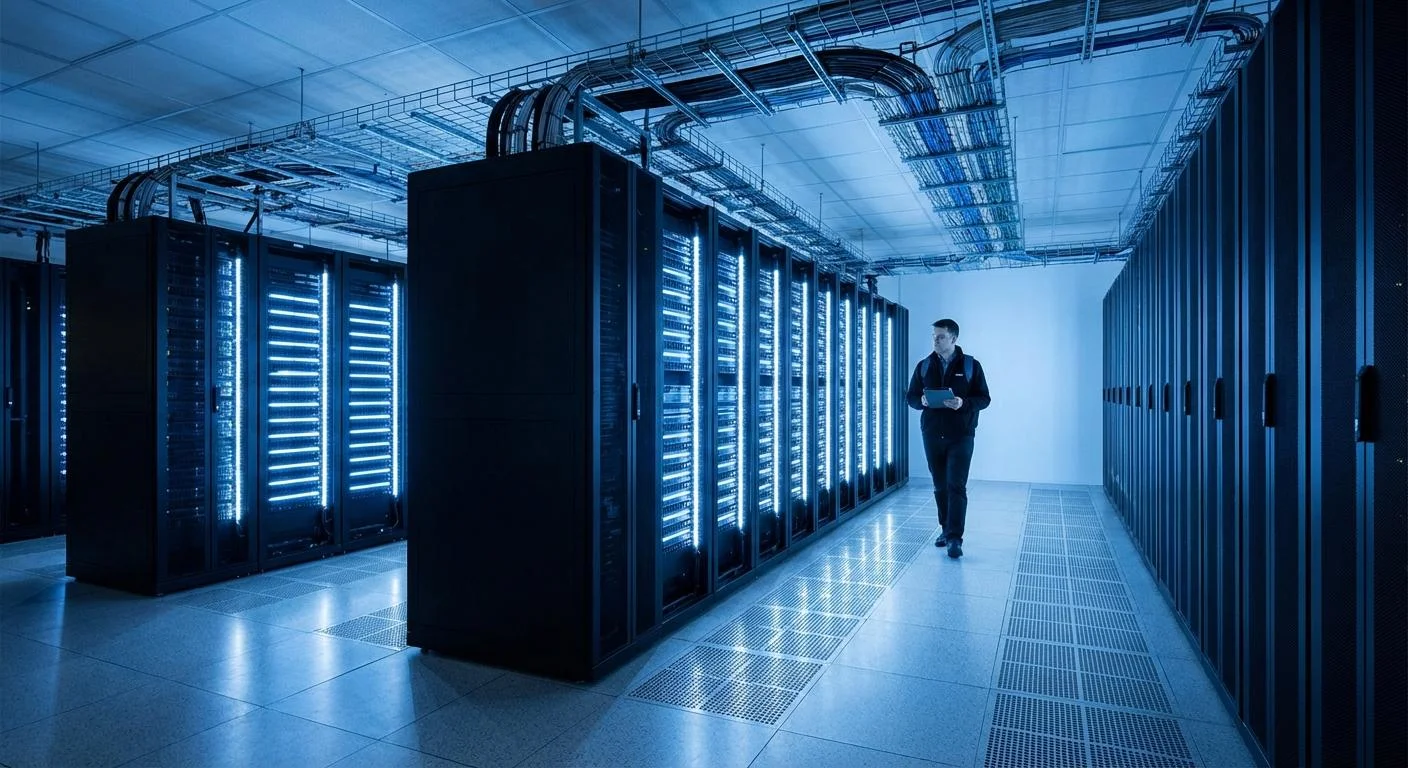
Data centers represent the most mission-critical facilities in modern infrastructure. When a manufacturing plant experiences maintenance-related downtime, production pauses. When a data center fails, entire businesses cease functioning. Financial transactions halt. Cloud services disappear. Communication networks collapse. This zero-tolerance environment demands maintenance management that transcends traditional facilities operations.
The stakes are quantifiable and severe. According to the Uptime Institute’s 2024 Global Data Center Survey, 60% of data center outages now cost more than $100,000, with one-third exceeding $250,000 per incident. For hyperscale and colocation providers, significant outages routinely surpass $1 million when accounting for SLA penalties, emergency repair costs, and reputational damage. ITIC’s 2024 research reveals that 97% of large enterprises say a single hour of downtime costs their company over $100,000.
The leading causes of these catastrophic failures are preventable through disciplined maintenance: power system failures account for 43% of unplanned outages, cooling system failures represent 15%, and network infrastructure issues comprise 11%. Each category falls squarely within the domain of facilities maintenance management.
Traditional paper-based or spreadsheet-driven maintenance programmes cannot meet data center requirements. The complexity of managing thousands of interdependent assets, the necessity of maintaining N+1 or 2N redundancy without testing redundant systems into failure, and the documentation demands of compliance frameworks require purpose-built CMMS software for data center facilities management.
The Unique Maintenance Challenge of Data Centers
Data center maintenance differs fundamentally from other facilities environments in ways that reshape every aspect of maintenance operations.
Uptime Requirements Redefine Maintenance Windows
Most facilities accept scheduled maintenance windows with reasonable notice. Data centers operate under SLAs that promise 99.99% to 99.999% uptime, leaving annual downtime budgets measured in minutes rather than hours. Tier III data centers target 99.982% uptime, permitting just 1.6 hours of downtime annually. Tier IV facilities promise 99.995% uptime, allowing only 26 minutes per year. According to Compass Facilities’ 2025 data center insights, 44% of companies now strive for 99.999% uptime, equivalent to just 5.26 minutes of annual unplanned downtime per server.
These constraints eliminate traditional maintenance approaches. You cannot shut down a data hall to service the cooling system. You cannot take the primary electrical distribution offline for testing. Every maintenance activity must be performed on energised, operational systems or must use redundant infrastructure that itself requires testing and maintenance.
This creates the central paradox of data center maintenance: you must maintain and test redundant systems to ensure they function when needed, but testing redundant systems inherently creates brief windows where redundancy is compromised. A CMMS designed for data center operations addresses this through maintenance scheduling that respects redundancy groups, ensuring never more than one component in a redundant set undergoes maintenance simultaneously.
Redundancy Management Multiplies Asset Complexity
A typical office building might have two air handling units serving a floor. A Tier III data center has N+1 cooling redundancy, meaning if five CRAC units are required for thermal load, six are installed. Tier IV facilities employ 2N redundancy, installing twelve units for that same load. Each unit requires identical maintenance schedules, but coordination ensures coverage remains uncompromised.
Power distribution follows similar patterns. UPS systems operate in redundant configurations with automatic transfer switches, multiple PDU feeds per rack, and generator backup with separate fuel systems. A single 500-rack data center might contain more than 2,000 power-related assets requiring individual maintenance tracking, each representing a potential single point of failure if maintenance lapses.
Managing this complexity in spreadsheets becomes impossible at scale. Asset tracking software purpose-built for data centers organises equipment by redundancy group, criticality tier, and dependencies, enabling schedulers to maintain coverage while performing necessary maintenance.
Environmental Precision Demands Continuous Monitoring
Office buildings tolerate temperature fluctuations of several degrees. Data centers operate within specifications measured in single degrees Celsius. ASHRAE TC 9.9 guidelines recommend maintaining server inlet temperatures between 18°C and 27°C with relative humidity between 20% and 80%, but high-density compute environments demand tighter tolerances.
Exceeding upper thermal limits triggers server throttling, reducing processing capacity. Sustained temperature excursions cause hardware failures. Humidity below specification generates electrostatic discharge risks. Humidity above specification promotes condensation and corrosion. The environmental control systems maintaining these parameters require maintenance that cannot compromise their operation.
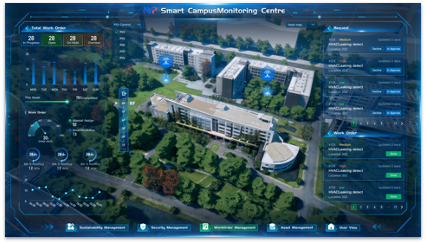
This is where CMMS integration with building management systems and IoT sensor networks becomes essential. IoT sensors for predictive maintenance continuously monitor thousands of data points across the facility, automatically generating work orders when parameters drift outside acceptable ranges before they impact operations.
Cooling System Maintenance: The Highest-Stakes Priority
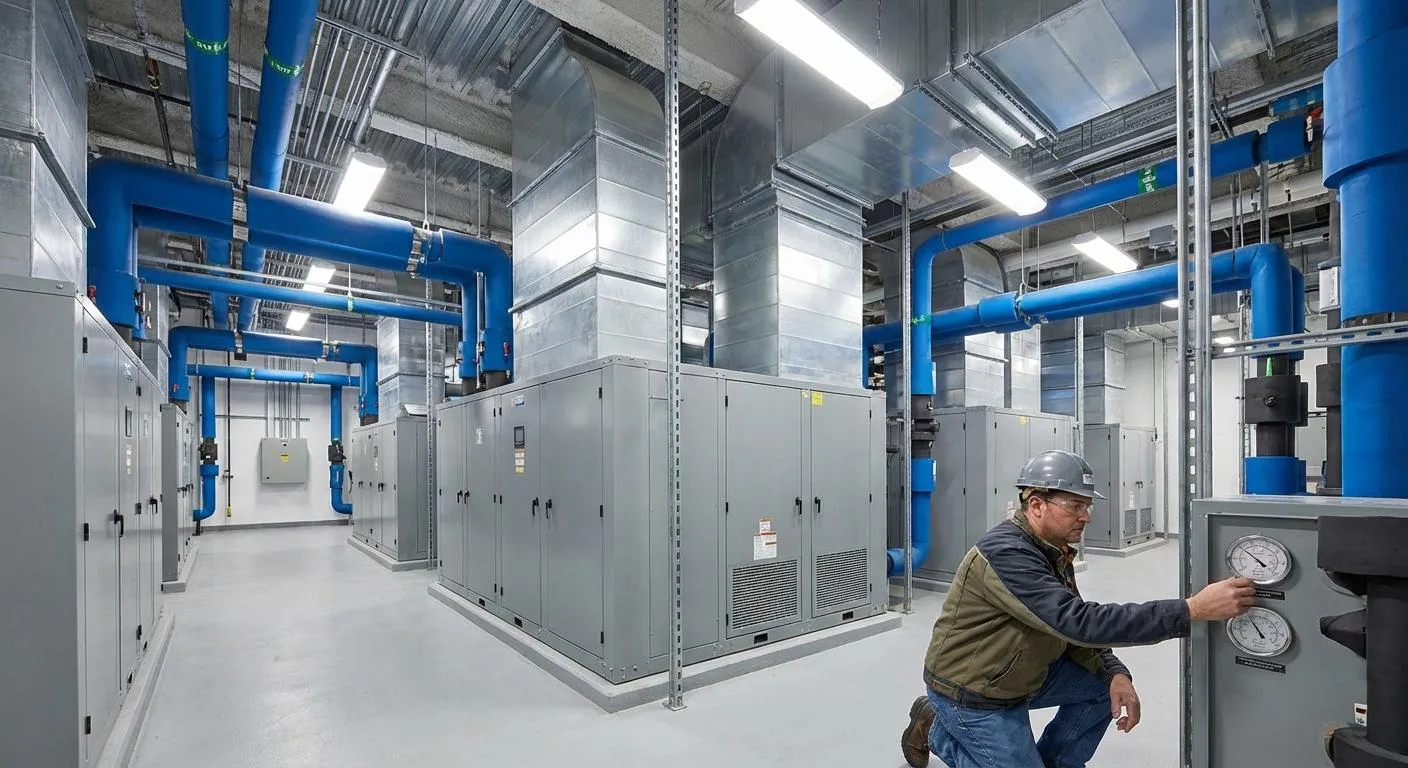
Cooling system failures represent the most common cause of data center outages that are maintenance-preventable. Unlike power systems where UPS and generator redundancy provide minutes to hours of backup capacity, cooling system failures impact temperatures within minutes. High-density racks exceeding 10kW can experience dangerous temperature rises in under 90 seconds if airflow ceases.
CRAC and CRAH Unit Maintenance Protocols
Computer Room Air Conditioning units and Computer Room Air Handling units form the frontline of data center thermal management. CRAC units use refrigerant-based cooling with compressors, while CRAH units circulate chilled water without compressors. Both require rigorous maintenance schedules.
Monthly CRAC unit maintenance includes filter replacement or cleaning, condensate drain inspection, refrigerant level checks, and electrical connection thermal scanning. Quarterly maintenance adds evaporator and condenser coil cleaning, fan motor bearing lubrication, and control system calibration. Annual maintenance encompasses compressor oil analysis, refrigerant quality testing, and safety control verification.
CRAH units follow similar schedules with emphasis on water-side maintenance. Monthly inspections verify water flow rates, valve operation, and heat exchanger approach temperatures. Quarterly maintenance includes water treatment chemical testing and adjustment, strainer cleaning, and pump seal inspection.
A preventive maintenance programme for a 50-unit cooling system generates approximately 600 scheduled tasks annually for the CRAC/CRAH units alone, before accounting for supporting infrastructure. Managing this volume requires automated scheduling that accounts for redundancy groups and ensures maintenance activities distribute evenly across available labour hours.
Chiller Plant and Heat Rejection Maintenance
Larger data centers employ central chilled water plants with mechanical or magnetic bearing chillers, cooling towers, condenser water loops, and complex control systems. These systems demand specialised maintenance protocols.
Chiller maintenance centres on preserving efficiency and preventing refrigerant loss. Monthly inspections verify operating pressures and temperatures, check oil levels in compressor systems, and inspect for refrigerant leaks using electronic detection. Quarterly maintenance includes heat exchanger tube bundle inspection, water treatment verification, and electrical component thermal imaging. Annual maintenance encompasses oil analysis, vibration analysis of rotating components, and complete refrigerant system leak testing.
Cooling towers require particularly aggressive maintenance due to exposure to outdoor air, water chemistry challenges, and biological growth risks. Weekly maintenance includes visual inspection for biological growth and basin cleanliness. Monthly maintenance adds drift eliminator inspection, water quality testing, and fan gearbox lubrication. Quarterly maintenance includes fill media inspection and cleaning, along with water distribution system verification.
Neglecting cooling tower maintenance creates cascading failures. Biological growth reduces heat rejection efficiency, forcing chillers to work harder and increasing energy consumption. Scale buildup on heat exchanger surfaces reduces thermal transfer, eventually causing high-pressure safeties to trip and shut down chillers. During peak cooling demand periods, a single chiller failure in an N+1 configuration eliminates redundancy. A second failure causes a thermal overload event.
Economiser and Free Cooling System Maintenance
Many modern data centers incorporate airside or waterside economisers to reduce cooling energy consumption by using outside air when ambient conditions permit. These systems introduce additional maintenance complexity.
Airside economisers require damper actuator maintenance to prevent binding, filter systems capable of handling outdoor air contamination, and controls that prevent mixed air temperature or humidity from exceeding safe parameters. Damper failures that allow uncontrolled outside air can introduce excessive humidity, particulate contamination, or thermal shock.
Waterside economisers using cooling towers or dry coolers for direct cooling require meticulous water treatment maintenance. Corrosion or scaling in plate heat exchangers can reduce thermal efficiency or cause complete blockage. Temperature sensor calibration becomes critical as control errors can introduce water at temperatures outside the safe range for IT equipment.
Best practice treats economiser systems as equally critical to primary cooling infrastructure, applying the same rigorous preventive maintenance scheduling and documentation standards used for CRAC/CRAH units and chillers.
Power Infrastructure Maintenance: Managing the Electrical Backbone
Data center power infrastructure operates at scales and redundancy levels uncommon in other facilities. A 10MW data center consumes as much electricity as a small town, distributed through layers of transformation, switching, UPS systems, and power distribution units to individual racks. Each layer requires maintenance that cannot compromise reliability.
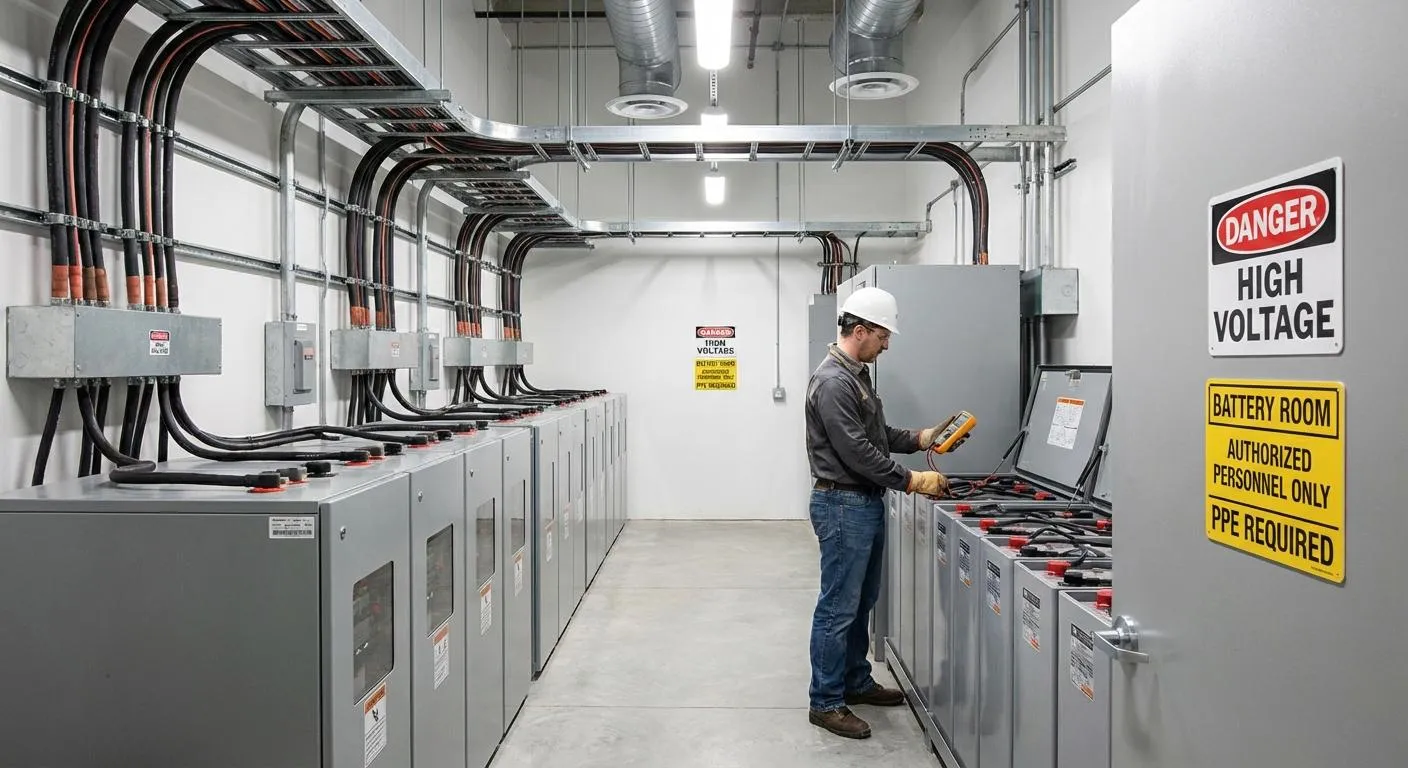
UPS System Maintenance and Battery Management
Uninterruptible Power Supply systems provide the critical bridge between utility power failure and generator startup, typically rated for 10-15 minutes of runtime at full load. UPS failures account for a disproportionate share of power-related outages because many organisations neglect battery maintenance until failure occurs.
Modern data centers employ modular UPS systems in N+1 or 2N configurations. A 2MW electrical load might be served by six 400kW UPS modules where five provide capacity and one serves as redundant backup. Each module requires monthly maintenance including visual inspection, battery voltage testing, alarm verification, and cooling fan cleaning.
Battery strings demand the most intensive maintenance attention. Monthly inspections measure individual battery cell voltages and temperatures, identifying weak cells before they fail and damage adjacent cells in the string. Quarterly maintenance includes torque verification on all battery connections, as loose connections generate heat and eventual failure. Annual maintenance encompasses full discharge testing to verify actual runtime capacity matches design specifications.
Battery thermal management proves particularly critical. Every 8°C increase above 25°C ambient halves battery life expectancy. CMMS-based maintenance must track battery room temperatures and trigger alerts when temperatures exceed optimal ranges, generating work orders for HVAC investigation before temperature exposure degrades battery capacity.
PDU and Electrical Distribution Maintenance
Power Distribution Units transform and distribute electrical power from UPS systems to individual server racks. Cabinet PDUs within racks provide circuit-level monitoring and control. Both require systematic maintenance to prevent failures that can affect multiple racks or entire rows.
Monthly PDU maintenance includes thermal imaging of all connections and breakers to identify developing hot spots before they cause failures. Infrared cameras reveal loose connections, overloaded circuits, and failing breakers invisible to visual inspection. Quarterly maintenance adds torque verification on bus bar connections and breaker testing under load.
Cabinet PDUs with intelligent monitoring capabilities require firmware updates, sensor calibration verification, and network connectivity testing. As these devices increasingly integrate with DCIM platforms for real-time power monitoring, CMMS integration with DCIM systems creates bidirectional workflows where power anomalies detected by DCIM automatically generate CMMS work orders for investigation.
Generator and Transfer Switch Testing
Emergency generators provide the final backstop against extended utility outages. Tier III and IV data centers maintain N+1 or 2N generator capacity with dedicated fuel systems, automatic transfer switches, and synchronisation controls enabling parallel operation.
Generator maintenance follows manufacturers’ recommendations but typically includes weekly automated test runs under no load, monthly load bank testing at 30-50% capacity, and quarterly testing at full rated load. Annual maintenance encompasses oil and filter changes, coolant system service, fuel system cleaning, and governor calibration.
Automatic transfer switches require monthly operational testing, verifying they correctly sense utility failure and transfer load to generator power within required timeframes. Annual maintenance includes contact inspection, timing verification, and coordination testing with upstream and downstream protective devices.
Fuel system maintenance prevents the most common generator failure mode: fuel starvation or contamination. Monthly fuel tank inspections check for water accumulation and biological growth. Quarterly fuel sampling tests for contamination and degradation. Annual fuel polishing removes water and particulates ensuring reliable operation during actual outages.
Download the Full Report
Get 100+ data points, verifiable sources, and actionable frameworks in a single PDF.
Get the ReportSee It In Action
See how Infodeck keeps the request, work order, owner, and proof on one record.
Book a DemoIntegrating CMMS with DCIM and BMS Platforms
Data center operations typically employ three major software platforms: CMMS for maintenance management, DCIM for infrastructure monitoring and capacity planning, and BMS for building automation and environmental control. Operating these platforms in silos creates inefficiency and increases risk. Integration creates unified visibility and automated workflows.
Creating Unified Asset Visibility
DCIM platforms maintain detailed inventories of racks, servers, network equipment, power distribution, and cooling infrastructure with real-time monitoring of power consumption, temperatures, and capacity utilisation. CMMS platforms track maintenance history, scheduled tasks, spare parts inventory, and technician assignments for physical infrastructure.
These datasets overlap but serve different purposes. DCIM answers “what is the current state?” while CMMS answers “what maintenance is required to maintain that state?” Integration links these views, enabling facilities teams to see both real-time conditions and maintenance status for each asset.
When DCIM detects a CRAC unit operating with higher-than-normal head pressure, integrated CMMS can immediately display the maintenance history, showing when filters were last changed, when coils were last cleaned, and when refrigerant was last tested. This context accelerates diagnosis and resolution.
Automated Work Order Generation from Monitoring Alerts
The most powerful integration capability is automated work order creation. When BMS sensors detect temperature deviations, when DCIM identifies power distribution approaching capacity thresholds, or when UPS systems report battery voltage anomalies, integrated systems automatically generate CMMS work orders with full context.
This automation ensures no alerts are lost in email queues or forgotten during shift changes. Work orders arrive in technician queues with complete information: which sensor triggered the alert, what threshold was exceeded, what asset is affected, and what maintenance history might be relevant.
Advanced integrations enable bi-directional data flow. When technicians complete work orders, resolution details flow back to DCIM and BMS platforms, creating complete event histories that combine automated monitoring with human investigation and resolution.
Capacity Planning and Maintenance Coordination
DCIM capacity planning identifies when power or cooling infrastructure approaches limits, triggering expansion projects. CMMS maintenance data informs these plans by revealing which existing systems are nearing end-of-life and should be replaced rather than supplemented.
Integration prevents maintenance activities from disrupting capacity planning. When DCIM identifies a row approaching thermal capacity limits, integrated CMMS can flag that the planned maintenance shutdown of a CRAC unit serving that row should be rescheduled or that temporary supplemental cooling should be deployed during maintenance.
This coordination becomes critical as data centers increase density. A row of racks averaging 8kW per cabinet can tolerate brief cooling interruptions. A row averaging 15kW per cabinet cannot. Maintenance scheduling must account for current and planned density levels, data only available through DCIM integration.
Compliance Documentation and Audit Trail Requirements
Data center compliance frameworks uniformly require documented, auditable maintenance programmes. Meeting these requirements demands CMMS capabilities that extend beyond basic work order tracking into comprehensive documentation and reporting.
SOC 2 and ISO 27001 Maintenance Requirements
SOC 2 Type II audits evaluate security controls over a period of time, including physical and environmental protections. Auditors examine whether maintenance procedures exist, whether they are followed consistently, and whether documentation proves compliance. ISO 27001 Annex A.11 physical security controls similarly require documented environmental protection measures.
CMMS systems must capture not just that maintenance occurred but detailed evidence of what was done, who performed it, what readings were taken, and what parts were replaced. Compliance-grade documentation includes:
- Timestamped work order completion with technician identification
- Photographic evidence of conditions before and after maintenance
- Actual sensor readings and test results, not just pass/fail indicators
- Parts consumed with serial numbers for critical components
- Sign-off approval for critical system maintenance by authorised personnel
For facilities requiring compliance documentation, CMMS platforms must support custom forms, mandatory fields, photo attachments, and electronic signature workflows that ensure complete documentation becomes impossible to bypass.
Uptime Institute Tier Certification Maintenance Standards
The Uptime Institute’s Tier Classification System defines four levels of infrastructure redundancy and fault tolerance, each imposing progressively rigorous maintenance requirements.
Tier I facilities with no redundancy require basic planned maintenance but may schedule downtime for maintenance activities. Tier II facilities with N+1 component redundancy must maintain redundant capacity during maintenance. Tier III facilities with concurrent maintainability must demonstrate the ability to perform any planned maintenance activity without impacting IT operations. Tier IV facilities with fault tolerance must withstand any single failure without impacting operations.
Each tier certification requires documented maintenance procedures proving that maintenance activities preserve the required redundancy and fault tolerance levels. CMMS scheduling must demonstrably prevent simultaneous maintenance on components within redundancy groups. Work order documentation must prove that redundancy was verified before beginning maintenance and confirmed after completion.
Annual Tier certification audits examine CMMS maintenance records, verifying procedures were followed and redundancy was never compromised. Facilities that cannot produce complete documentation risk losing certifications that customers may require contractually.
Change Management in Mission-Critical Environments
Beyond routine maintenance, data centers require rigorous change management processes for modifications, upgrades, and non-standard maintenance activities. Industry frameworks including ITIL define change management procedures that CMMS platforms must support.
Change management workflows require maintenance requests to undergo risk assessment, technical review, and approval before execution. High-risk changes require detailed implementation plans, backout procedures, and verification testing protocols. CMMS change management modules support these workflows, routing change requests through approval chains and documenting each stage.
For data centers subject to regulatory oversight or serving industries with strict compliance requirements (financial services, healthcare, government), change management documentation becomes part of the permanent audit trail. CMMS data analytics and reporting must enable facilities to demonstrate that all infrastructure changes followed approved procedures and that failures or incidents were properly investigated.
Environmental Monitoring and IoT Sensor Integration
Data centers deploy sensor networks far denser than typical facilities, monitoring thousands of data points continuously. These sensors generate value only when integrated into maintenance workflows that act on the data they produce.
Temperature and Humidity Monitoring Networks
Modern data centers deploy sensors at rack level, row level, and room level to create comprehensive thermal maps. Hot spot detection identifies localised cooling deficiencies. Humidity sensors distributed throughout the facility detect areas approaching dew point where condensation risks exist.
Best practice positions temperature sensors at rack inlet heights matching server intake positions, typically at floor level, mid-rack, and top-of-rack locations. This vertical temperature profiling reveals stratification issues or airflow short-circuits that compromise cooling efficiency.
When sensors detect temperatures exceeding ASHRAE recommended maximums, integrated CMMS workflows automatically generate investigation work orders assigned to facilities technicians. The work order includes sensor identification, current readings, trend data showing how quickly temperatures are rising, and location information enabling rapid response.
Power Monitoring and Electrical Anomaly Detection
Circuit-level power monitoring via intelligent PDUs detects load imbalances, power quality issues, and consumption trends indicating developing failures. Harmonic distortion, voltage sags, and frequency variations can indicate upstream electrical problems requiring investigation.
Thermal runaway conditions where electrical faults generate heat that increases resistance that generates more heat appear first as gradual power consumption increases detected by monitoring systems. Early detection via automated monitoring prevents progression to catastrophic failure.
Integration between power monitoring platforms and CMMS creates automatic responses. When intelligent PDUs detect circuit loads exceeding 80% of rated capacity, work orders generate for load balancing investigation. When harmonic distortion exceeds acceptable thresholds, work orders trigger power quality analysis. These automated workflows prevent monitoring data from becoming overwhelming noise, filtering for actionable intelligence.
Vibration Analysis and Predictive Maintenance
Rotating equipment including cooling tower fans, chiller compressors, pump motors, and generator sets benefit from vibration analysis that detects bearing wear, shaft misalignment, and imbalance before catastrophic failure occurs.
Permanently mounted vibration sensors on critical rotating equipment enable continuous monitoring with automatic work order generation when vibration signatures indicate developing problems. Portable vibration analysis performed during scheduled maintenance rounds provides deeper diagnostic data.
CMMS IoT integration capabilities allow vibration data to populate asset maintenance histories, creating trend analyses showing gradual deterioration over time. Predictive maintenance programmes use this data to schedule bearing replacements or motor overhauls during planned maintenance windows before emergency failures force unplanned downtime.
Book a Demo
See how Infodeck handles the requests, work, and records your operation already runs.
Book a DemoView Pricing
Review plan scope, quotas, and the operating scale each Infodeck plan is built for.
View PricingHot Aisle Cold Aisle Containment and Airflow Management
Physical airflow management significantly impacts cooling system efficiency and effectiveness. Disciplined maintenance of containment systems, blanking panels, and cable management directly affects both cooling costs and thermal stability.
Containment System Maintenance
Hot aisle or cold aisle containment systems use physical barriers to separate hot exhaust air from cold supply air, preventing mixing that reduces cooling efficiency. Hard-walled containment with doors and ceiling panels requires maintenance to preserve sealing effectiveness.
Quarterly inspections verify door seals remain intact without gaps, ceiling panel supports remain secure, and acrylic or polycarbonate panels remain undamaged. Damaged seals or panels create bypass airflow that undermines containment effectiveness, forcing cooling systems to work harder to maintain temperatures.
Containment systems also require access control maintenance. Door closers must function correctly to prevent doors remaining propped open. Automatic door releases connected to fire suppression systems require annual testing to ensure they operate correctly during emergencies.
Blanking Panel Discipline
Empty rack spaces create airflow short-circuits where cold supply air flows directly to the hot aisle without cooling IT equipment, wasting cooling capacity. Blanking panels seal these openings, forcing air through populated equipment.
Blanking panel installation seems simple but requires disciplined maintenance. As equipment is installed and removed, technicians must install or remove blanking panels correspondingly. Work order procedures for equipment installations and decommissions must include blanking panel verification as mandatory completion steps.
Monthly data hall walkthrough inspections identify missing or damaged blanking panels, generating work orders for remediation. Thermal imaging during these inspections reveals hot spots caused by airflow bypass, visually confirming containment integrity.
Cable Management and Floor Plenum Blockage
Raised floor data centers supply cold air through perforated floor tiles. Cable pathways beneath the floor can obstruct airflow, creating cold spots where excessive air supplies and hot spots where supply is restricted.
Maintenance procedures for under-floor cable installations must require minimum clearance distances from perforated tiles and cable routing that avoids creating dams blocking airflow. As cable density increases over time, periodic under-floor inspections identify blockages requiring remediation.
Advanced facilities employ computational fluid dynamics modeling to optimise floor tile placement and verify cable routes do not compromise airflow. Maintenance-driven changes to cable routing or tile placement use these models to verify thermal impact before implementation, preventing changes that solve one problem while creating another.
Measuring CMMS Impact on Data Center Operations
Implementing CMMS software for data center maintenance management delivers measurable operational improvements across multiple dimensions. Quantifying these improvements justifies investment and guides continuous optimisation.
Mean Time Between Failures and Mean Time to Repair
CMMS maintenance history data enables calculation of MTBF for critical systems, revealing which equipment consistently fails prematurely and requires replacement or redesign. Facilities can identify whether specific CRAC unit models, UPS battery brands, or cooling tower fills demonstrate higher reliability.
MTTR metrics reveal how quickly facilities teams respond to and resolve failures. After CMMS implementation, facilities typically observe 30-40% reductions in MTTR as technicians access complete equipment histories, maintenance procedures, and parts availability instantly via mobile devices rather than searching filing cabinets or institutional knowledge. Maintenance World’s 2025 analysis shows that 65% of companies now use CMMS to manage maintenance activities and optimize operational costs.
Trending these metrics over time demonstrates continuous improvement or highlights degradation requiring management attention. For facilities calculating CMMS ROI, reductions in unplanned downtime frequency and duration translate directly to avoided losses measured against SLA penalties and business impact.
Preventive Maintenance Compliance Rates
The percentage of scheduled preventive maintenance tasks completed on time measures programme discipline. Best-in-class data centers achieve greater than 98% PM compliance, while facilities with manual or spreadsheet-based systems often fall below 80%.
CMMS automated scheduling, mobile work order access, and management visibility drive PM compliance improvements. Technicians cannot claim they forgot scheduled tasks when work orders arrive automatically. Managers identify compliance issues in real-time rather than discovering them during audits.
High PM compliance correlates strongly with reduced emergency maintenance frequency. Data centers achieving greater than 95% PM compliance experience 40-60% fewer emergency maintenance events than facilities below 80% compliance, demonstrating that disciplined preventive maintenance prevents failures.
Energy Efficiency and PUE Improvement
Power Usage Effectiveness, the ratio of total facility power consumption to IT equipment power consumption, serves as the primary data center efficiency metric. Well-maintained cooling systems, optimised airflow management, and properly functioning economisers directly improve PUE.
CMMS-managed maintenance programmes that include filter replacement scheduling, coil cleaning, damper calibration, and heat exchanger maintenance keep cooling systems operating at design efficiency. Facilities report PUE improvements of 0.1 to 0.3 points after implementing disciplined CMMS-managed cooling system maintenance, translating to significant energy cost savings.
For a 5MW data center with a PUE of 1.6, improving to 1.5 through better maintenance reduces annual electricity consumption by approximately 4.4 million kWh. At Singapore commercial electricity rates, this represents more than $500,000 in annual savings, far exceeding CMMS software costs. According to Thunder Said Energy’s data center economics research, operational costs for a 30MW facility run approximately $100M annually, with 40% allocated to maintenance activities.
Selecting CMMS Software for Data Center Environments
Not all CMMS platforms address data center requirements equally. Evaluating solutions requires focus on capabilities critical to mission-critical infrastructure maintenance.
Critical Evaluation Criteria
Redundancy group management enables scheduling that respects N+1 or 2N configurations, preventing simultaneous maintenance on components within redundancy sets. The CMMS must support tagging assets into redundancy groups and enforcing scheduling rules that maintain required availability.
Integration capabilities with DCIM platforms, BMS systems, and monitoring tools determine whether the CMMS operates as part of a unified operations ecosystem or remains a disconnected silo. API availability, pre-built connectors to major DCIM vendors, and support for industry-standard protocols enable integration.
Mobile-first design recognises that data center technicians work in equipment rooms, not offices. The CMMS must provide full functionality via mobile devices including work order acceptance, procedure access, parts lookup, photo documentation, and completion reporting without requiring return to workstations.
Compliance documentation capabilities including mandatory fields, custom forms, electronic signatures, and photo attachments ensure work order completion captures audit-grade documentation. The platform must support workflow approvals for high-risk maintenance activities.
Asset hierarchy modeling must accommodate data center complexity including hierarchical relationships between generators, transfer switches, UPS systems, PDUs, and cabinet PDUs. Technicians must navigate asset relationships intuitively during troubleshooting.
Implementation Best Practices
Successful CMMS implementations in data center environments follow structured approaches that minimise disruption while maximising adoption.
Asset data migration represents the largest implementation challenge. Data centers contain thousands of assets with complex relationships and configurations. Automated data import from existing DCIM platforms accelerates deployment while ensuring accuracy. Manual data entry guarantees errors and extended timelines.
Preventive maintenance template libraries based on manufacturer recommendations and industry best practices accelerate PM programme setup. Rather than creating maintenance procedures from scratch, facilities adapt proven templates to their specific equipment, cutting implementation time from months to weeks.
Phased rollout strategies begin with a subset of critical systems, demonstrating value and refining processes before expanding to the full facility. Typical sequences start with UPS and battery systems due to high failure consequences and clear maintenance requirements, expand to cooling systems, then encompass electrical distribution and building systems.
Training programmes must address multiple user personas including technicians performing work, planners scheduling maintenance, supervisors approving high-risk activities, and management reviewing performance metrics. Role-based training ensures each user group understands functions relevant to their responsibilities.
Building Maintenance Excellence in Critical Infrastructure
Data center facilities management represents the apex of maintenance complexity and consequence. The intersection of extreme uptime requirements, infrastructure redundancy, environmental precision, regulatory compliance, and operational scale creates challenges that manual or basic CMMS systems cannot address effectively.
Purpose-built CMMS platforms designed for critical infrastructure transform maintenance from reactive scrambling to disciplined programmes that measurably improve reliability, reduce costs, and ensure compliance. Integration with DCIM and BMS platforms creates unified operations ecosystems where monitoring data automatically triggers maintenance workflows and maintenance outcomes inform capacity planning.
For facilities teams managing data centers, the question is not whether to implement CMMS software but which platform delivers the capabilities that mission-critical infrastructure demands. Redundancy awareness, IoT integration, mobile accessibility, compliance documentation, and proven integration with DCIM platforms separate solutions built for data centers from general-purpose maintenance systems adapted reluctantly to data center requirements.
As data centers increase density, adopt liquid cooling, integrate renewable energy sources, and operate under increasingly stringent compliance frameworks, the maintenance management systems supporting them must evolve correspondingly. The facilities teams that build maintenance excellence today position their organisations for the infrastructure challenges ahead.
Book a 30-minute demo to discover how Infodeck CMMS delivers the capabilities data center facilities teams need to maintain critical infrastructure with confidence. Or explore our pricing to find the plan that fits your facility’s scale and requirements.
Frequently Asked Questions
What is the difference between CMMS and DCIM for data centers?
How often should data center cooling systems be maintained?
What compliance standards require CMMS documentation in data centers?
What is the cost of unplanned downtime in a data center?
Can IoT sensors replace manual data center inspections?
From guide to workflow
See where this work lives in Infodeck
When the idea becomes daily work, Infodeck keeps requests, owners, updates, and proof on one operating record.
Preventive maintenance
Plan recurring work and condition-based maintenance before issues become urgent.
View preventive maintenanceGovernance and proof
Keep contractor activity, approvals, permits, and audit trails accountable.
View governanceIndustry pages
See how the operating record changes across healthcare, education, hospitality, and more.
View industries

