


Start here
The short version
Short answer: Maintenance safety and LOTO program guide. Build lockout/tagout procedures, confined space protocols, and permit-to-work systems with CMMS tracking.
What to check as you read
- LOTO procedures prevent approximately 120 fatalities and 50,000 injuries annually by controlling hazardous energy during maintenance
- CMMS-integrated LOTO tracking ensures every work order on energised equipment automatically triggers safety protocol verification
- Permit-to-work systems for hot work, confined space, and electrical isolation must be digitally tracked with mandatory sign-offs
- Annual LOTO procedure audits are required by OSHA 1910.147 and must verify that each energy control procedure remains accurate
Maintenance work environments contain inherent hazards that have resulted in thousands of preventable injuries and deaths over the decades. The unexpected energisation of equipment during service, accidental release of stored energy, and failure to control hazardous substances continue to claim lives despite well-established safety protocols. The Occupational Safety and Health Administration (OSHA) estimates that compliance with lockout/tagout standards prevents approximately 120 fatalities and 50,000 injuries annually in the United States alone.
A comprehensive maintenance safety program goes beyond basic lockout/tagout compliance to create a systematic approach to hazard identification, risk mitigation, and continuous safety improvement. These programmes integrate engineering controls, administrative procedures, personal protective equipment requirements, and digital tracking systems that ensure every maintenance task receives appropriate safety oversight before work begins.
Modern CMMS platforms have transformed safety compliance from paper-based checklists to automated workflows that embed safety procedures directly into maintenance operations. When properly configured, these systems make it impossible to skip safety verification steps, automatically track permit-to-work requirements, and create comprehensive audit trails that satisfy regulatory inspection requirements while protecting workers from harm.
Understanding Lockout/Tagout Fundamentals
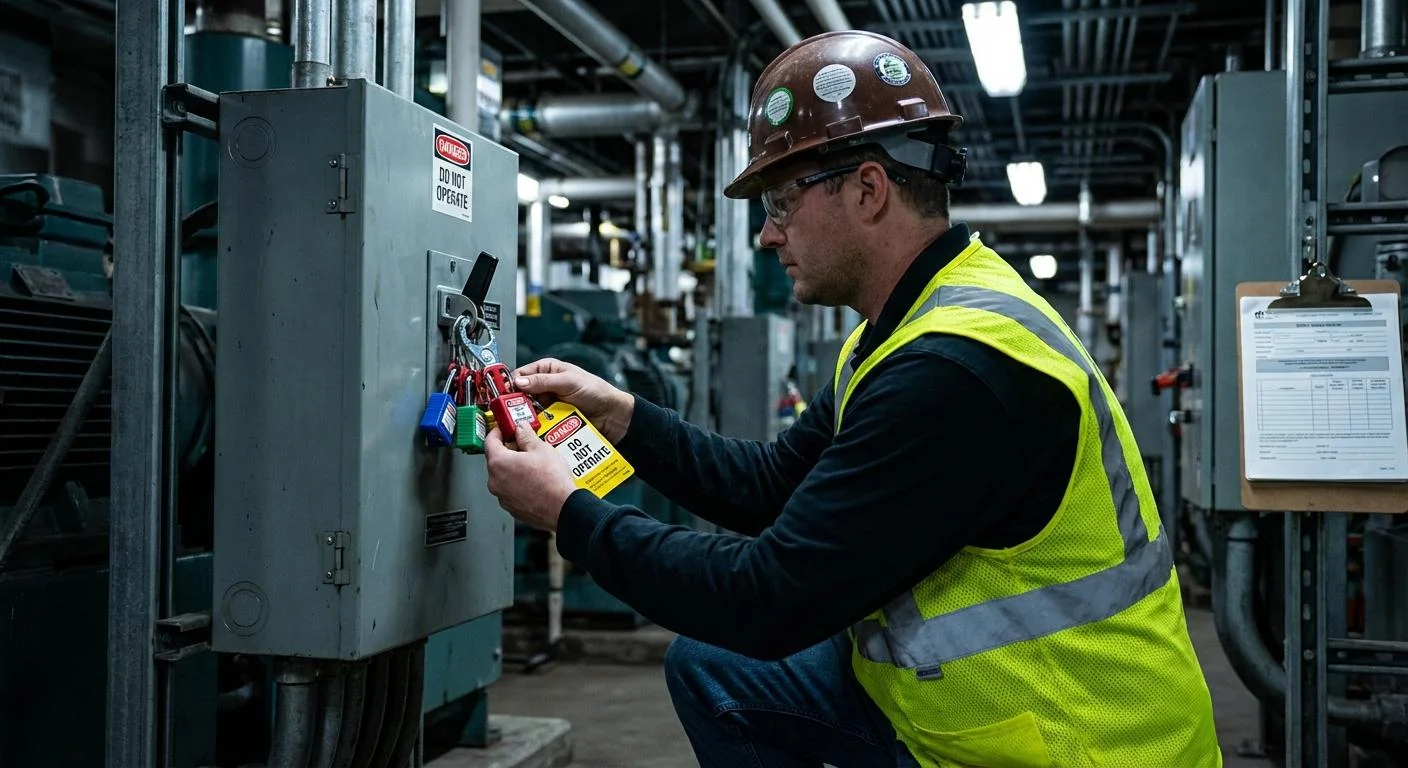
Lockout/tagout (LOTO) refers to specific practices and procedures that safeguard employees from the unexpected energisation, start-up, or release of stored energy during maintenance and servicing activities. The concept seems straightforward, yet LOTO violations consistently rank among OSHA’s top 10 most frequently cited standards, with penalties regularly exceeding $15,000 per violation.
The control of hazardous energy requires identifying all energy sources that power or are stored in equipment, then systematically isolating, locking, and verifying the absence of each energy type before maintenance begins. This process becomes complex when dealing with industrial equipment that may have electrical power feeds, hydraulic accumulators maintaining pressure, pneumatic lines containing compressed air, mechanical springs under tension, thermal energy in heated components, and chemical energy in process materials.
OSHA Standard 1910.147 establishes minimum performance requirements for controlling hazardous energy. The standard applies to general industry and requires employers to establish an energy control programme with three core components: documented energy control procedures for each piece of equipment, comprehensive employee training with certification records, and annual periodic inspections that verify procedure accuracy and employee knowledge.
According to OSHA’s Control of Hazardous Energy standard, the written energy control procedures must clearly identify the scope of equipment covered, the specific procedural steps for shutting down and isolating energy sources, the placement and removal of lockout/tagout devices, and the testing procedures to verify isolation effectiveness before work begins.
Types of Hazardous Energy in Maintenance Environments
Electrical energy represents the most commonly recognised hazard in maintenance work, but facilities managers must account for multiple energy types that can cause serious injury or death if not properly controlled. Each energy type requires specific isolation methods, verification procedures, and protective equipment.
Mechanical energy includes rotating equipment like motors, pumps, and fans, as well as linear motion from conveyors, pistons, and actuators. Even after electrical power is removed, flywheels continue spinning, belts remain under tension, and gravity can cause suspended loads to fall. Effective mechanical isolation requires physically blocking moving parts, releasing spring tension, and securing suspended components.
Hydraulic and pneumatic energy pose particular risks because pressure can remain in systems long after pumps stop operating. Accumulators specifically designed to store pressurised fluid can contain enough energy to cause severe crushing injuries or equipment damage if released unexpectedly. Proper isolation requires closing supply valves, bleeding residual pressure through controlled release points, and verifying zero pressure with gauges before opening lines or removing components.
Thermal energy from heated or cooled processes creates burn hazards and pressure risks. Steam systems, heat exchangers, ovens, and refrigeration equipment must cool to safe temperatures before maintenance begins. Chemical energy from reactive materials, corrosive substances, and flammable liquids requires additional isolation measures including line breaking procedures, material drainage, and atmospheric testing.
The National Institute for Occupational Safety and Health (NIOSH) emphasises that comprehensive hazard energy control must address all energy sources simultaneously. Isolating electrical power while neglecting stored hydraulic pressure has resulted in numerous severe injuries when pressurised components failed during disassembly.
Developing Machine-Specific LOTO Procedures
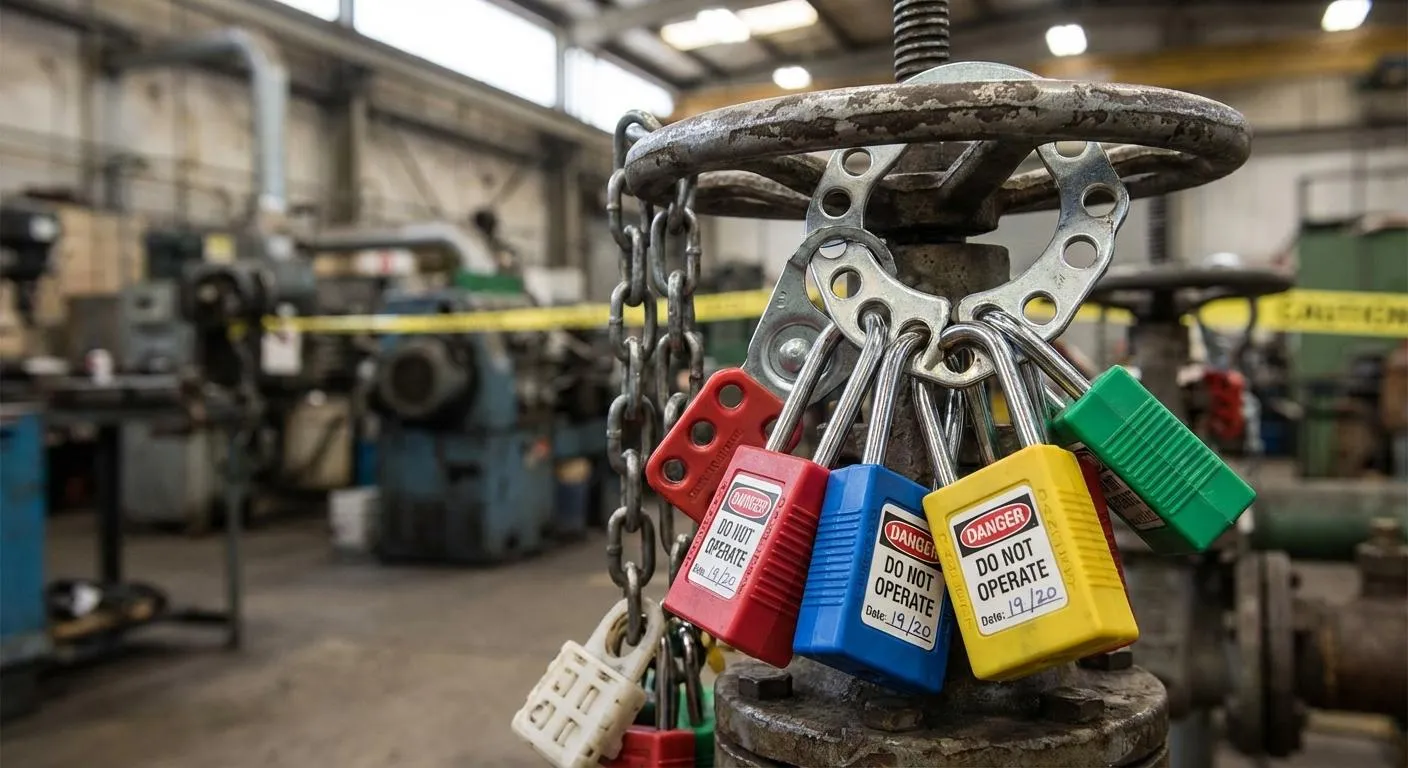
Generic lockout/tagout procedures that provide general guidance without equipment-specific details do not satisfy OSHA requirements and create dangerous knowledge gaps for maintenance technicians. Each piece of equipment requiring servicing must have a documented procedure that identifies every energy source, specifies the exact location of isolation devices, describes verification methods, and outlines the proper sequence for applying and removing locks.
The procedure development process begins with a comprehensive energy assessment conducted by personnel thoroughly familiar with the equipment. This assessment identifies every electrical disconnect, valve, breaker, pressure relief point, and mechanical blocking location required to achieve complete isolation. For complex equipment with multiple energy sources, this often requires reviewing electrical drawings, hydraulic schematics, and mechanical assemblies.
Written procedures must specify not just what to isolate, but where isolation devices are located and how to verify effectiveness. Instead of stating “isolate electrical power,” an effective procedure reads “Open main disconnect DS-3 located in electrical room 2B, apply personal lock, verify zero voltage at terminal block TB-1 inside control cabinet using calibrated multimeter.” This specificity eliminates ambiguity and ensures consistent execution regardless of which technician performs the work.
Asset management systems integrated with LOTO procedures attach the specific safety documents directly to equipment records. When a technician creates a work order for maintenance on a particular asset, the system automatically retrieves and displays the approved LOTO procedure, making it impossible to proceed without acknowledging the safety requirements.
The Canadian Centre for Occupational Health and Safety provides detailed guidance on developing effective lockout procedures that address complex situations including shift changes, temporary removal of locks during testing, and group lockout scenarios involving multiple trades working simultaneously.
Implementing Permit-to-Work Systems for High-Risk Activities
Certain maintenance tasks carry risks beyond standard energy isolation and require additional layers of authorisation, hazard analysis, and control verification before work begins. Permit-to-work systems create formal documentation that work conditions have been assessed, appropriate precautions implemented, and responsible parties notified before high-hazard activities commence.
Hot work permits govern activities that produce flames, sparks, or heat sufficient to ignite flammable materials. Welding, cutting, grinding, and torch operations require atmospheric testing to verify absence of flammable vapours, removal of combustible materials from the work area, placement of fire extinguishers and fire watch personnel, and specific authorisation from facility management acknowledging the fire risk.
Confined space entry permits address the unique hazards of working in tanks, vessels, silos, pits, and other enclosed spaces with limited access and egress. OSHA Standard 1910.146 requires atmospheric testing for oxygen levels, flammable gases, and toxic substances before entry and continuous monitoring during occupancy. The permit must identify the attendant stationed outside the space, emergency rescue procedures, communication methods, and the maximum duration of the permit.
Electrical isolation permits, also called electrical safe work permits, document verification that electrical equipment has been de-energised, tested to confirm zero voltage, and locked out in accordance with NFPA 70E standards. These permits are particularly important for work on high voltage systems where the consequences of inadequate isolation can be fatal.
Excavation permits address underground hazards including utility strikes, cave-ins, and hazardous atmosphere accumulation in trenches. The National Fire Protection Association’s NFPA 70E standard provides comprehensive guidance on electrical safety requirements including safe work practices, arc flash hazard analysis, and personal protective equipment selection.
Digital Permit Management in CMMS Platforms
Paper-based permit systems create compliance gaps through lost documents, expired authorisations that remain posted, and inability to track trends across permit types. Modern work order management systems integrate permit-to-work requirements directly into maintenance workflows, automatically determining when permits are required based on work type, location, and equipment characteristics.
When a technician creates a work order for hot work in a production area, the CMMS immediately flags the permit requirement and generates a digital permit form with mandatory fields for atmospheric testing results, fire watch assignment, and management authorisation. The work order cannot be marked in progress until all permit requirements are satisfied and approvals obtained.
This digital approach creates several safety advantages. First, the system automatically tracks permit expiration times and sends notifications when permits require renewal or closure. Second, management can review all active permits in real-time to understand exactly what high-risk work is currently underway across the facility. Third, historical permit data enables trending analysis to identify areas with frequent confined space entries or hot work activities that may benefit from engineering controls.
Infodeck’s preventive maintenance platform includes configurable permit-to-work workflows that adapt to facility-specific requirements while maintaining compliance with multiple regulatory frameworks including OSHA, NFPA, and local jurisdictions. The system automatically attaches relevant safety data sheets, emergency response procedures, and equipment-specific hazard assessments to each permit.
SafeWork Australia’s guidance on permit to work systems emphasises that permits serve not just as authorisation documents but as critical communication tools that ensure all parties understand the hazards present and the controls implemented to manage risks.
CMMS Integration for Safety Compliance Tracking
Maintenance safety programmes generate enormous documentation requirements: LOTO procedure reviews, training records, equipment certifications, inspection reports, incident investigations, and corrective action tracking. Managing this documentation through spreadsheets and filing cabinets creates compliance risks and makes it nearly impossible to quickly demonstrate regulatory compliance during inspections.
Comprehensive CMMS platforms transform safety management from administrative burden to strategic advantage by embedding safety requirements directly into maintenance workflows. Rather than treating safety as a separate function requiring duplicate data entry, modern systems integrate safety verification as mandatory workflow steps that cannot be bypassed.
Embedding LOTO Checklists in Work Orders
The most effective approach to LOTO compliance embeds energy control procedures as mandatory checklists within work orders. When a maintenance planner creates a work order for equipment requiring energy isolation, the CMMS automatically retrieves the approved LOTO procedure and converts each isolation step into a checklist item that must be physically checked off with timestamp and technician identification before proceeding.
For a chiller maintenance work order, the embedded checklist might include: “Open electrical disconnect DS-12 and apply personal lock - Tech ID and timestamp required,” “Close refrigerant isolation valves V-34 and V-35 - Tech ID and timestamp required,” “Verify zero voltage at starter terminals using calibrated meter - Test result and meter ID required,” and “Verify zero pressure on gauges - Pressure reading required.”
This granular documentation creates several benefits. Technicians receive step-by-step guidance eliminating reliance on memory. Supervisors can verify that procedures were followed correctly by reviewing completed checklists. Safety managers can analyse LOTO execution time to identify procedures that may need simplification. Regulatory inspectors receive immediate evidence of programme effectiveness.
Some organisations report that CMMS-driven LOTO checklists reduced average isolation time by 15-20% while simultaneously improving compliance documentation, as technicians no longer need to reference separate paper procedures and transcribe information to compliance logs after completing work.
Managing Lock and Tag Inventory
OSHA requires that lockout devices be standardised, durable, substantial enough to prevent removal without excessive force, and identifiable to specific employees. Managing hundreds of personal locks, group lockout boxes, valve lockout devices, and electrical lockout devices requires inventory tracking that prevents unauthorised use while ensuring adequate supply.
Modern CMMS platforms track safety device inventory similar to spare parts management. Each lock receives a unique identifier associated with the employee authorised to use it. When a technician checks out their personal lock for a maintenance task, the system records the lock ID, equipment being serviced, and expected return date. Locks not returned within the scheduled maintenance window trigger alerts to investigate whether the equipment remains locked out intentionally or whether the lock should have been removed.
Specialised lockout devices for specific equipment types (valve lockouts, breaker lockouts, plug lockouts) are managed as calibrated tools requiring periodic inspection and replacement when damaged. The system tracks device locations, inspection due dates, and usage history to identify devices requiring replacement due to wear or obsolescence.
Training Certification and Competency Management
OSHA mandates initial training for all employees affected by LOTO procedures, with retraining required whenever procedures change, new equipment is introduced, or when periodic inspections reveal inadequate knowledge. Tracking training status across hundreds of employees and dozens of equipment-specific procedures becomes overwhelming without digital systems.
Preventive maintenance software manages training requirements by linking certifications to work assignment eligibility. If a technician attempts to be assigned a work order requiring LOTO on a particular equipment type, the system verifies that the technician has completed training on that specific procedure within the required timeframe. Work orders cannot be assigned to technicians lacking current certification.
The system automatically schedules annual refresher training based on initial training dates and sends notifications 30 days before certifications expire. When procedures are updated, the CMMS identifies all employees certified on the previous version and flags them for retraining before they can work on that equipment again.
This automated approach eliminates manual training matrix management while ensuring that only qualified personnel perform hazardous energy control. During OSHA inspections, facilities can instantly generate reports showing that every technician who performed LOTO procedures held current, documented training at the time they conducted the work.
Download the Full Report
Get 100+ data points, verifiable sources, and actionable frameworks in a single PDF.
Get the ReportSee It In Action
See how Infodeck keeps the request, work order, owner, and proof on one record.
Book a DemoGroup Lockout and Shift Change Procedures
Standard LOTO procedures assume a single technician isolates equipment, performs maintenance, and restores the equipment to service during a single shift. Real-world maintenance frequently involves multiple trades working simultaneously on different aspects of complex equipment, or extended outages that span multiple shifts requiring lock transfers without compromising safety.
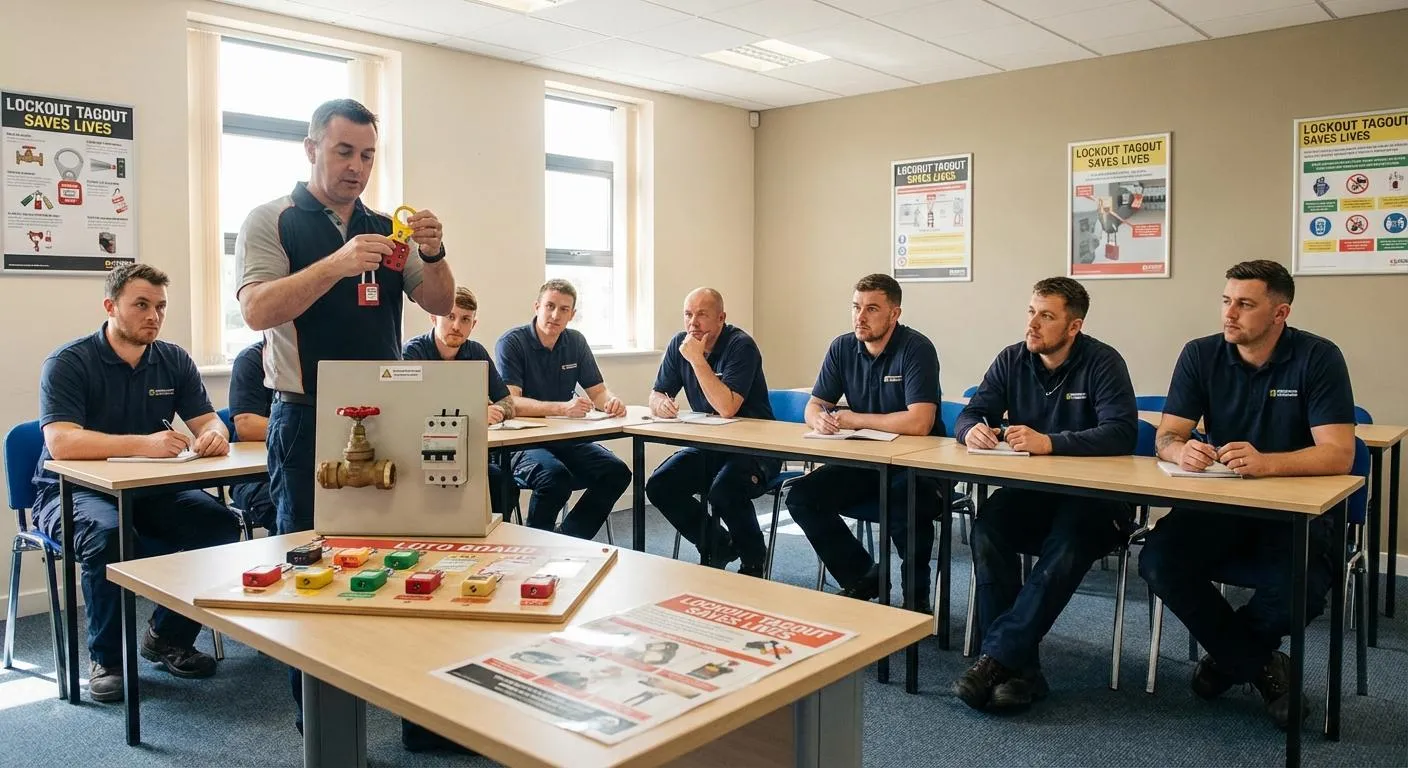
Group lockout procedures address scenarios where several employees work on the same equipment simultaneously. The procedure typically employs a primary lockout device (often a multi-lock hasp or group lockout box) that holds all energy isolation points in the locked position. Each participating employee applies their personal lock to this primary device. The equipment cannot be re-energised until every employee removes their personal lock, ensuring that no one can restore power while any worker remains at risk.
The group lockout coordinator, typically the senior technician or shift supervisor, bears responsibility for verifying that all energy sources are isolated before work begins and that every employee has applied their personal lock. When the job spans multiple shifts, outgoing employees remove their locks only after verifying that incoming employees who will continue the work have applied their locks to the primary device.
CMMS systems manage group lockout through parent-child work order relationships. The parent work order represents the overall outage and tracks the primary isolation. Child work orders represent specific tasks assigned to individual trades (electrical, mechanical, HVAC, controls). Each child work order requires verification that the technician has applied their personal lock before the task status can change to “in progress.”
Shift Change and Continuous Operations
Extended maintenance outages in continuous operations like manufacturing plants, hospitals, and data centres require carefully orchestrated shift changes that maintain energy isolation without creating windows of vulnerability. The outgoing shift must communicate equipment status, work completed, and any unusual conditions discovered. The incoming shift must verify isolation effectiveness before resuming work.
Best practice involves a formal shift handover checklist that includes verification of all locks in place, review of the LOTO procedure, physical walkdown of isolated equipment, and acknowledgment signatures from both outgoing and incoming employees. Some facilities require that at least one member of the outgoing shift remain on-site until the incoming shift completes their isolation verification.
Digital work order systems facilitate shift handovers through structured notes and status updates. Outgoing technicians document work completed, components removed, temporary guards installed, and specific hazards encountered. Incoming technicians acknowledge review of these notes and confirm isolation verification before changing work order status.
The Canadian Standards Association’s Z460 standard on Control of Hazardous Energy provides detailed guidance on group lockout procedures, shift changes, and complex isolation scenarios that exceed basic OSHA requirements.
Contractor Safety Management and LOTO Coordination
Facilities that employ contractors for maintenance, construction, or equipment installation face additional safety complexity when contractor personnel must perform lockout/tagout procedures on facility equipment. Host employers retain responsibility for informing contractors about energy control requirements, providing access to facility-specific LOTO procedures, and coordinating activities when contractors and facility employees work near each other.
OSHA’s multi-employer worksite policy establishes that host employers must ensure contractors have appropriate LOTO programmes and that contractor procedures are compatible with facility requirements. Before contractors begin work, safety coordinators must verify contractor training documentation, review their LOTO procedures for adequacy, and establish clear communication protocols for coordinating energy control when both groups work in proximity.
Many facilities require contractors to follow facility LOTO procedures rather than contractor-developed procedures, especially when working on permanent facility equipment. This approach eliminates conflicting procedures and ensures contractors use the same isolation points and verification methods as facility employees. However, contractors must receive training on these facility-specific procedures before being authorised to perform work.
CMMS platforms manage contractor safety through visitor/contractor modules that track training completion, procedure acknowledgment, and work authorisation. Before a contractor receives a work assignment, they must complete facility orientation, review equipment-specific LOTO procedures, and pass competency verification. The system prevents work order assignment to contractors lacking documented qualifications.
Pre-Job Safety Briefings and Coordination Meetings
Complex maintenance outages involving multiple contractors, facility personnel, and specialised trades require formal coordination meetings before work begins. These meetings review the overall scope of work, identify potential interface hazards, establish communication protocols, designate emergency assembly points, and ensure everyone understands who controls energy isolation at different work stages.
The pre-job safety briefing typically includes review of the LOTO procedure, permit requirements, atmospheric hazards, elevated work considerations, crane operations, and emergency response procedures. Each participant signs an attendance sheet acknowledging their participation and understanding of safety requirements. This documentation becomes part of the work order record demonstrating that appropriate coordination occurred before high-risk activities commenced.
Infodeck’s platform enables digital pre-job briefing checklists that ensure consistent coverage of required topics while capturing participant signatures electronically. The system automatically includes these signed briefing records in work order documentation, creating audit-ready evidence of safety coordination.
Safety Metrics and Leading Indicators
Traditional safety metrics focus on lagging indicators like lost-time injury frequency rates, recordable incident rates, and days since last accident. While important for tracking overall safety performance, these metrics measure failure outcomes rather than providing early warning of developing risks. Leading indicators identify unsafe conditions and behaviours before incidents occur, enabling proactive intervention.
Effective maintenance safety programmes track leading indicators including near-miss reporting rates, safety observation completion rates, preventive maintenance compliance percentages, overdue LOTO procedure reviews, expired training certifications, and permit-to-work cycle times. Increases in near-miss reports often indicate either improved reporting culture (positive) or deteriorating conditions (concerning), requiring investigation to determine root causes.
CMMS-generated safety dashboards provide real-time visibility into these leading indicators. Facility managers can immediately identify equipment with overdue LOTO procedure reviews, technicians with expiring safety certifications, or departments with declining near-miss reporting rates. This visibility enables targeted intervention before conditions deteriorate into actual incidents.
Near-Miss Reporting and Investigation Systems
Near-miss events, where an incident could have caused injury but did not due to chance intervention or last-minute recognition, provide invaluable learning opportunities without the cost of actual injuries. However, near-miss reporting systems only deliver value when organisations create a non-punitive reporting culture that encourages disclosure rather than concealment.
Best practice near-miss programmes emphasise learning over blame, provide simple reporting mechanisms (mobile apps, QR code access, anonymous submission options), and demonstrate visible follow-up showing that reports lead to improvements. When employees see that their near-miss reports result in procedure updates, equipment modifications, or additional training resources, reporting rates increase dramatically.
CMMS platforms integrate near-miss reporting through mobile applications that allow technicians to photograph hazardous conditions, geotag locations, and submit detailed descriptions immediately upon discovery. The system routes reports to safety managers for investigation and tracks corrective actions through completion. Recurring near-miss patterns at specific equipment or locations trigger automatic escalation for engineering review.
Research published by the National Safety Council demonstrates that organisations with mature leading indicator programmes achieve 20-40% reductions in serious injury rates compared to organisations relying solely on lagging indicators.
Building a Maintenance Safety Culture
Technology and procedures provide the framework for maintenance safety, but organisational culture determines whether these tools are consistently applied or circumvented under production pressure. A genuine safety culture exists when every employee, from executives to entry-level technicians, believes that safety takes precedence over schedule and cost considerations.
Leadership visibility proves critical to safety culture development. When facility directors personally participate in safety walks, stop work when they observe unsafe conditions, and publicly recognise employees who report hazards, they demonstrate that safety commitment extends beyond policy documents. Conversely, when leadership pressures teams to skip safety steps to meet production deadlines, employees quickly learn that stated safety priorities are subordinate to output targets.
Effective safety cultures embrace the concept that all incidents are preventable and that every incident reveals a system failure rather than simply individual error. This perspective shifts investigation focus from assigning blame to identifying contributing factors including inadequate procedures, insufficient training, conflicting priorities, or equipment design deficiencies that created conditions where errors became likely.
Safety Communication and Engagement Strategies
Regular safety communication through multiple channels maintains safety awareness even during periods without incidents. Weekly safety talks that review recent near-misses, discuss industry incidents relevant to facility operations, and provide refresher training on specific topics keep safety prominent in daily consciousness. Visual management boards displaying current safety metrics, days since last incident, and recognition of safety achievements create constant reminders that safety performance matters.
Employee engagement in safety programme development increases ownership and compliance. Safety committees that include representatives from maintenance, operations, and support functions provide input on procedure development, evaluate proposed changes, and communicate safety initiatives to their departments. Employees who participate in creating safety procedures are far more likely to follow them consistently.
Recognition programmes that celebrate positive safety behaviours (thorough pre-job planning, stopping work when conditions change, reporting near-misses, suggesting improvements) reinforce desired actions. Monetary rewards, public acknowledgment, preferred scheduling, or other meaningful recognition demonstrates that safety contributions are valued at least as much as production output.
The ISO 45001 occupational health and safety management standard provides a comprehensive framework for developing systematic safety management programmes including leadership commitment, worker participation, hazard identification, risk assessment, and continual improvement processes.
Book a Demo
See how Infodeck handles the requests, work, and records your operation already runs.
Book a DemoView Pricing
Review plan scope, quotas, and the operating scale each Infodeck plan is built for.
View PricingAnnual LOTO Procedure Audits and Continuous Improvement
OSHA requires that employers conduct periodic inspections of their energy control procedures at least annually to ensure they remain current and effective. These inspections must verify that each specific LOTO procedure accurately reflects current equipment configuration and that employees understand their responsibilities under the procedure.
The annual audit must be conducted by an authorised employee other than the one utilising the energy control procedure being inspected. The inspection includes a review of each authorised employee’s responsibilities under the procedure and typically involves having the employee demonstrate the isolation process while the auditor verifies that each step in the documented procedure is performed correctly.
Documentation of these periodic inspections must include the identity of the machine or equipment for which the energy control procedure is evaluated, the date of inspection, the employees included in the inspection, and the person performing the inspection. This documentation serves as primary evidence of programme compliance during OSHA inspections and legal proceedings following incidents.
Asset tracking platforms automate annual LOTO audit scheduling by treating procedure reviews as recurring preventive maintenance tasks. The system generates work orders for procedure audits based on the anniversary of the last inspection, assigns them to qualified auditors, and provides standardised audit checklists that ensure consistent evaluation criteria across all equipment.
Updating Procedures Based on Equipment Changes
Equipment modifications, control system upgrades, process changes, and infrastructure improvements often alter energy sources or isolation points, making existing LOTO procedures inaccurate or incomplete. Facilities must establish management of change processes that trigger LOTO procedure reviews whenever equipment modifications could affect energy control requirements.
Best practice requires that project close-out checklists for equipment modifications include verification that affected LOTO procedures have been reviewed and updated if necessary. The CMMS tracks equipment modification history and automatically flags associated LOTO procedures for review when maintenance records indicate significant work has been performed.
When procedures are updated, all employees previously trained on the old procedure must receive retraining on changes before they can perform work under the new procedure. The CMMS manages this by versioning LOTO procedures and tracking which version each employee was trained on. When a new procedure version is published, employees certified on previous versions are automatically flagged for retraining.
Continuous improvement extends beyond reactive updates to include proactive identification of opportunities to simplify procedures, eliminate energy sources through design changes, or implement engineering controls that reduce reliance on administrative procedures. Facilities that analyse LOTO execution time, employee feedback, and near-miss data identify equipment where isolation complexity creates ongoing risks that engineering modifications could eliminate.
Integrating Safety Performance into Maintenance Strategy
Progressive organisations recognise that maintenance safety is not merely regulatory compliance but a strategic advantage that reduces unplanned downtime, improves equipment reliability, and enhances workforce retention. Equipment failures that result from inadequate isolation during maintenance create far greater costs than the time required to perform proper energy control procedures.
Data analytics capabilities within modern CMMS platforms enable correlation analysis between safety compliance metrics and overall maintenance performance. Facilities often discover that maintenance teams with highest LOTO compliance rates also achieve superior preventive maintenance completion percentages, lower emergency work order frequencies, and reduced mean time to repair metrics.
This correlation reflects the underlying discipline and systematic approach that characterises high-performing maintenance organisations. Teams that consistently execute detailed safety procedures also plan work thoroughly, follow technical specifications precisely, and document activities comprehensively. Safety excellence and maintenance excellence reinforce each other in a virtuous cycle that elevates overall operational performance.
Executive dashboards should present safety metrics alongside traditional maintenance KPIs like equipment uptime, work order completion rates, and preventive maintenance compliance. This integrated view reinforces that safety performance is equally important to production metrics and enables leadership to identify correlations between safety investments and reliability improvements.
Technology Enablement Through IoT and Mobile Systems
Emerging technologies enhance maintenance safety beyond traditional LOTO procedures through real-time hazard detection, remote verification of isolation effectiveness, and automated permit management. IoT sensor integration enables continuous monitoring of equipment status, energy presence, atmospheric conditions, and environmental hazards that inform safety decisions before work begins.
Smart electrical meters integrated with CMMS platforms verify zero voltage at isolation points without requiring technicians to manually test with multimeters. Pressure transducers confirm that hydraulic and pneumatic systems have been fully depressurised. Temperature sensors validate that thermal hazards have cooled to safe levels. These automated verifications reduce human error while creating digital records that prove isolation effectiveness.
Mobile CMMS applications enable technicians to access LOTO procedures, submit permit applications, complete safety checklists, and photograph conditions directly from the field without returning to offices for paperwork. Barcode or QR code scanning verifies that technicians are accessing the correct procedure for the specific equipment tag number, eliminating confusion when similar equipment has different energy sources.
Wearable technology including smart safety glasses and communication headsets enables remote safety oversight where experienced supervisors can visually verify that technicians are following procedures correctly even when physical presence is impractical. This technology proves particularly valuable during contractor oversight or when training new employees on complex isolation procedures.
Preparing for OSHA Inspections and Legal Defensibility
OSHA compliance officers conducting lockout/tagout inspections focus on three primary areas: programme documentation, training records, and execution verification. Facilities must be prepared to immediately produce written LOTO procedures for equipment identified by inspectors, training certificates for employees who perform energy control, and documentation of annual procedure inspections.
Inspectors typically select specific pieces of equipment and request the corresponding LOTO procedure. They may ask to observe a technician demonstrate the isolation process or interview employees about their understanding of energy control requirements. Any gaps identified during these spot checks often trigger expanded investigation of the entire programme.
Digital documentation systems provide significant advantages during inspections by enabling instant retrieval of relevant records. Rather than searching through filing cabinets for training certificates from three years ago, CMMS platforms generate comprehensive compliance reports showing all employees trained on specific procedures, dates of training, names of instructors, and verification of competency assessment.
Beyond regulatory compliance, thorough LOTO documentation provides critical legal defence in the event of workplace injuries. Plaintiffs’ attorneys in injury cases routinely request energy control procedures, training records, and maintenance histories to establish whether employers provided adequate protection. Complete digital records demonstrating consistent safety programme execution, prompt incident investigation, and corrective action implementation significantly strengthen legal positions.
Facilities should conduct periodic mock OSHA inspections where internal safety personnel or external consultants evaluate programme compliance using actual OSHA inspection protocols. These mock inspections identify documentation gaps, procedure deficiencies, and training needs before regulatory inspectors discover them.
Maintaining Safety Excellence Through Systematic Execution
The difference between safety programmes that exist on paper and those that protect workers in practice lies in systematic execution embedded into daily operations. When safety verification becomes automatic rather than discretionary, compliance improves dramatically while cognitive burden on technicians decreases.
CMMS implementation focused on safety integration creates this systematic execution by making safe behaviour the path of least resistance. Technicians receive procedures automatically, complete checklists within their normal workflow, and satisfy documentation requirements without duplicate data entry. This approach eliminates the common perception that safety compliance competes with productivity by demonstrating that proper safety execution actually improves work efficiency through better planning and reduced rework.
Organisations that achieve safety excellence recognise that zero incidents is not just a slogan but an achievable goal through persistent attention to leading indicators, continuous training, visible leadership commitment, and technology systems that embed safety into every maintenance activity. The approximately 120 fatalities prevented annually through effective LOTO programmes represent real people who return home safely because their employers refused to accept preventable injuries as inevitable costs of maintenance work.
Building a comprehensive maintenance safety program requires investment in training, technology, and culture development. However, facilities that make these investments consistently report that safety excellence correlates with improved equipment reliability, reduced maintenance costs, enhanced employee morale, and superior competitive positioning. Safety performance is not separate from operational excellence. It is a fundamental component that enables sustainable high performance across all facility management dimensions.
Visit Infodeck’s platform overview to see how modern CMMS technology transforms maintenance safety from administrative burden to strategic advantage through embedded compliance workflows, automated audit trails, and data-driven safety performance management. Request a demo to explore how digital safety management can elevate your organisation’s lockout/tagout programme while simplifying compliance documentation and protecting your most valuable asset: your people.
Frequently Asked Questions
What are the OSHA requirements for lockout/tagout programmes?
How does a CMMS help manage lockout/tagout compliance?
What is the difference between lockout and tagout?
How often should LOTO procedures be reviewed and updated?
What are the most common LOTO violations cited by OSHA?
From guide to workflow
See where this work lives in Infodeck
When the idea becomes daily work, Infodeck keeps requests, owners, updates, and proof on one operating record.
Governance and proof
Keep contractor activity, approvals, permits, and audit trails accountable.
View governancePlatform overview
Requests, assets, rooms, visitors, contractors, sensors, and approvals on one operating record.
Explore platformPricing
Quota-based plans for teams comparing rollout scope, sites, assets, and workflow volume.
View pricing

